- 25
- July
GPT-5.6 is OpenAI's latest AI model family, released on 9 July 2026, split into three models by capability and price — Sol (flagship), Terra (balanced, everyday) and Luna (fast/cheap, high-volume). All three share a 1 million-token context and launched alongside a new agent called ChatGPT Work. This article covers the specs, pricing, and how it lines up against the Claude side we just reviewed — Opus 5 and Sonnet 5 — so organizations can see the market options more clearly.
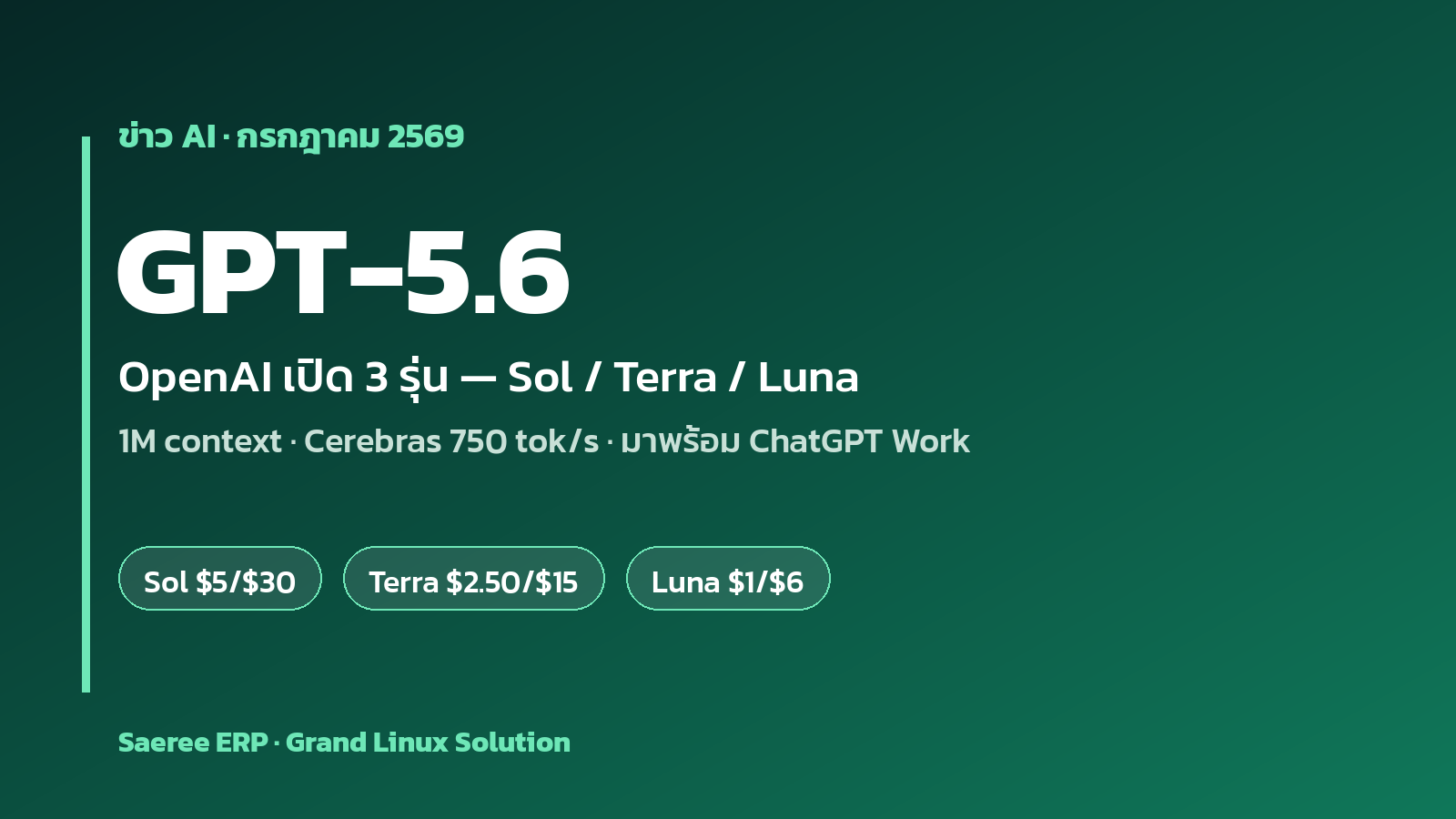
In one line: GPT-5.6 = OpenAI's three models (Sol flagship $5/$30, Terra balanced $2.50/$15, Luna cheapest $1/$6 per 1M tokens), all with a 1M-token context, 128k max output, Feb 2026 knowledge cutoff, served via Cerebras at up to 750 tokens/sec, and shipped with the ChatGPT Work agent.
In this article
Spec and pricing figures here come from OpenAI's announcement and AI-media reporting (sources at the end). We stick to disclosed facts and avoid unverified benchmark numbers.
1. What GPT-5.6 is + the three models
GPT-5.6 differs from earlier updates in that OpenAI split it into three clearly named models by use case, instead of one model with an effort dial — similar in spirit to the Claude class split (Opus/Sonnet/Haiku):
| Model | Position | Best for |
|---|---|---|
| Sol | Flagship (frontier) | Complex reasoning, coding, long-horizon agent work |
| Terra | Balanced, everyday | General enterprise work, good quality at mid price |
| Luna | Fastest/cheapest | High-volume work that must stay cost-controlled |
In short: Instead of guessing how powerful a setting is, GPT-5.6 lets you pick by name — Sol when you need the most, Terra for daily work, Luna when volume and cost matter most.
2. Specs and pricing
All three share the same core specs, differing in capability and price (USD per 1M tokens, standard API):
| Item | Sol | Terra | Luna |
|---|---|---|---|
| Input / 1M tokens | $5 | $2.50 | $1 |
| Output / 1M tokens | $30 | $15 | $6 |
| Context window | 1,000,000 tokens (all) | ||
| Max output | 128,000 tokens | ||
| Knowledge cutoff | February 2026 | ||
OpenAI's headline: Sol holds the same price as GPT-5.5 did at its April launch — a smarter flagship with no price increase — while Terra effectively gives GPT-5.5-class performance at about half the cost, pushing value down much like Claude did with Sonnet 5.
3. Cerebras — 750 tokens/sec
OpenAI partnered with Cerebras to serve Sol at up to ~750 tokens/sec, much faster than typical GPU serving. That speed matters for agents that reason over many steps and for real-time user-facing work.
Speed isn't always quality: speed helps UX and multi-loop agents, but choosing a model for important work still means checking output quality on your own real tasks — not tokens-per-second alone.
4. ChatGPT Work — the agent alongside it
Alongside GPT-5.6, OpenAI announced ChatGPT Work — an agent designed to carry out multi-hour projects rather than answer single prompts, the same direction the whole industry is moving: AI that "gets real work done" continuously, not just chats.
Zooming out, rivals are moving in parallel: Anthropic just brought Cowork to web and mobile so it can run in the cloud. We compared the concept in ChatGPT Work vs Claude Cowork — the competition now isn't only "whose model is smarter" but "whose agent runs long tasks more reliably."
5. Vs Claude Opus 5 / Sonnet 5
With GPT-5.6 and the Claude 5 family both out in the same window, here's a rough price-tier line-up (USD per 1M tokens, input/output) to see market positioning:
| Tier | OpenAI | Anthropic (Claude) |
|---|---|---|
| Flagship | Sol — $5/$30 | Opus (around $5/$25) |
| Mid-tier | Terra — $2.50/$15 | Sonnet 5 — launch $2/$10 |
| Budget | Luna — $1/$6 | Haiku (small class) |
| Context | 1M all | 1M (Opus 5/Sonnet 5) |
The picture: both camps arrive with similar structures — flagship/mid/budget tiers, 1M context, and a focus on long-running agents. The choice comes down to your real workload, existing ecosystem and data governance, more than benchmark numbers alone. See our deep comparison at ChatGPT vs Claude vs Gemini.
6. From a Thai ERP organization's view
For organizations running an ERP at the core, having many vendors and price tiers is good — it lowers and diversifies the cost of adopting AI. But the selection principle stays the same:
- Choose by task and ecosystem, not hype — if you already use Microsoft/Google or Claude, fit with your existing tools matters more than a benchmark score.
- Mind the data — whichever vendor, these models process on overseas clouds; sensitive data needs a clear policy on what can and can't be sent. See our guide on AI tooling and cost.
- The ERP remains the source of truth — every vendor's AI is an assistant; accounting/inventory/finance numbers must come from a system with controlled permissions and an audit trail.
Saeree ERP stays neutral on AI assistants — the system holds the real data and controls permissions, while which AI assistant it connects to depends on your organization's fit and data policy (see more on AI in accounting).
7. Conclusion
GPT-5.6 reflects the whole industry's direction — tiered models to pick by task (Sol/Terra/Luna), pushing value down, adding speed via Cerebras, and moving into the "long-running agent" era with ChatGPT Work. Lined up against Claude Opus 5/Sonnet 5, the structures are strikingly similar, so each organization's decision should hinge on real workload, existing ecosystem and data policy — not on any single vendor's numbers.
When every vendor has flagship, mid and budget tiers, the question isn't "who's strongest" but "which one fits our work and our data best."
- The Saeree ERP Team
References
- Simon Willison — The new GPT-5.6 family: Luna, Terra, Sol (accessed 25 Jul 2026)
- OpenAI — GPT-5.6 and ChatGPT Work announcement
- AI Pricing Guru — OpenAI Pricing (Sol/Terra/Luna pricing source)
Want to choose the right AI assistant for your work and systems?
Grand Linux Solution advises on ERP implementation and picking AI tools that fit your real processes, and supplies Claude team licenses with proper Thai tax invoicing.
Get advice / request a quoteTel 02-347-7730 | sale@grandlinux.com