- 25
- July
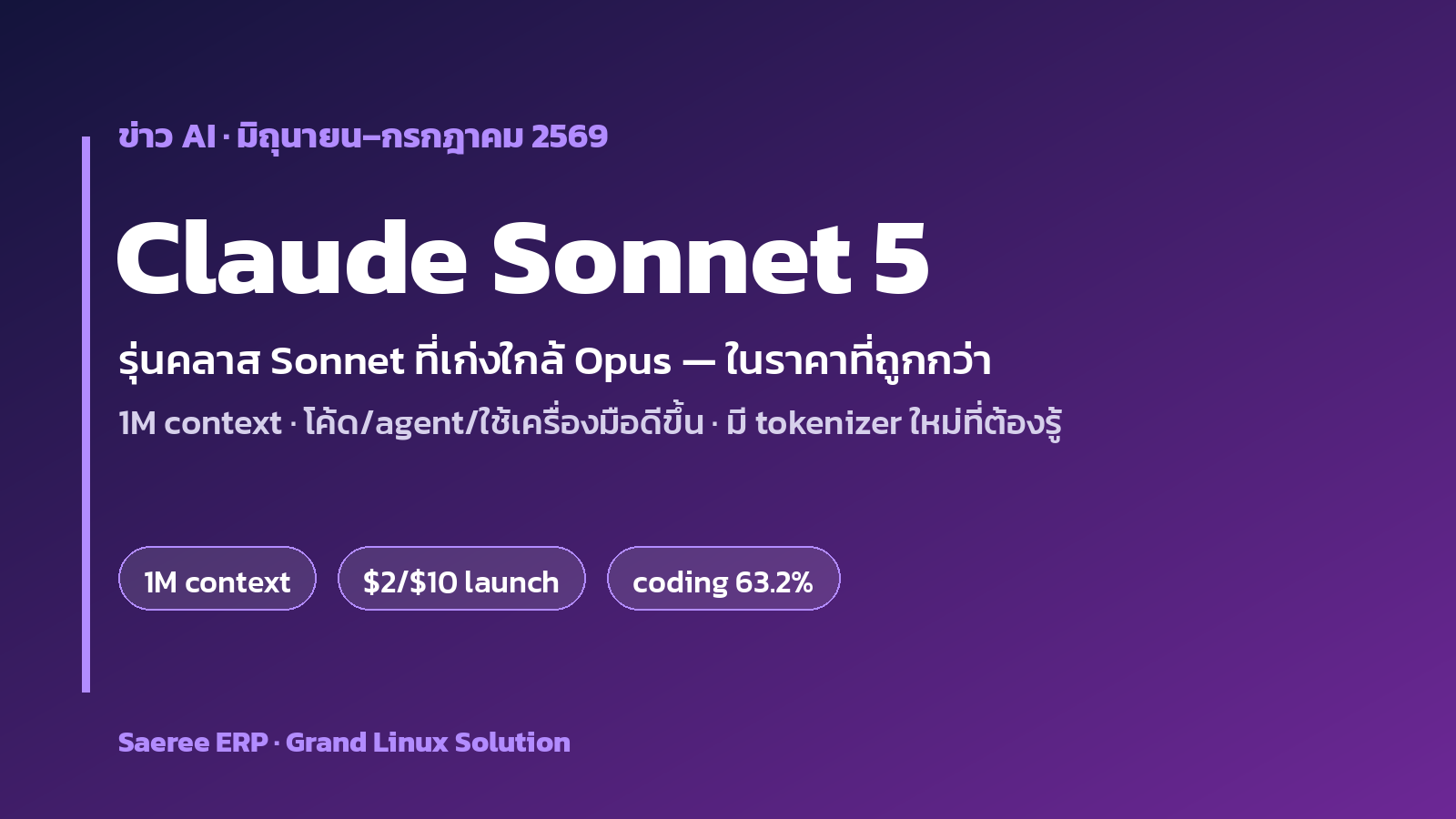
Claude Sonnet 5 is Anthropic's latest Sonnet-class AI model, released on 30 June 2026. Its selling point is bringing Opus-like capability — coding, tool use, browser work and professional tasks — into a cheaper model, with a 1 million-token context window. This article covers the specs, pricing, benchmarks and the one thing to watch — a new tokenizer that affects cost — following our review of Claude Opus 5, so you can see the whole Claude 5 family, flagship and mid-tier.
In one line: Claude Sonnet 5 is a much-improved mid-tier model — around 63.2% on agentic coding (between Sonnet 4.6 at 58.1% and Opus 4.8 at 69.2%), a 1M-token context, and launch pricing of $2/$10 per 1M tokens through 31 Aug 2026 before rising to $3/$15 — but a new tokenizer counts ~1.0–1.35x more tokens, so real costs after 1 Sep can be higher.
In this article
Spec and pricing figures here come from Anthropic's official announcement; benchmark numbers are test results reported by AI media (sources at the end) — we keep clear which come from the vendor and which from third-party testing.
1. What Claude Sonnet 5 is + core specs
The Claude family splits into three broad classes — Opus (flagship, most capable), Sonnet (balanced cost/capability) and Haiku (small, fast, cheap). Sonnet 5 is the mid-tier that Anthropic designed to bring Opus-like capability down into the Sonnet class, especially for common enterprise work like coding, tool-using agents and professional document tasks.
In short: Sonnet 5 = "near-Opus quality, but cheaper" — ideal for high-volume work that must stay cost-controlled yet high-quality, such as team coding, frequently-run agents, and summarizing/analyzing long documents.
Core specs of Sonnet 5
| Item | Detail |
|---|---|
| Release date | 30 June 2026 |
| Model ID (API) | claude-sonnet-5 |
| Context window | 1,000,000 tokens (1M) |
| Max output | 128k tokens (raisable to 300k via batch API beta) |
| Highlights | Coding, tool use, browser work and professional tasks approaching Opus level |
| Watch out | Uses a new tokenizer that counts tokens differently from Sonnet 4.6 (see §4) |
Using Claude at work? Get a quote in Thai Baht with a full tax invoice
A short form — you get a request number by email right away, and our sales team follows up using that number · one form for Team and Enterprise
2. Benchmarks — vs Sonnet 4.6 and Opus 4.8
Per test results reported by AI media, Sonnet 5 moves up clearly from Sonnet 4.6 and approaches Opus 4.8 in several areas:
| Test | Sonnet 4.6 | Sonnet 5 | Opus 4.8 |
|---|---|---|---|
| Agentic coding (SWE-bench style) | 58.1% | 63.2% | 69.2% |
| Knowledge work (GDPval-AA v2) | — | 1,618 | 1,615 |
Notably, on knowledge work, Sonnet 5 scores 1,618 on GDPval-AA v2 — edging out Opus 4.8 (1,615). That suggests for general document/analysis work, a mid-tier model like Sonnet 5 can be better value than paying for Opus, while Opus still leads on heavy coding.
Read benchmarks with care: a test score is just one indicator. Real enterprise work has its own context (codebase structure, Thai language, internal documents) — test with your own sample tasks before migrating a whole team to a new model.
3. Pricing — launch vs standard
Anthropic set introductory launch pricing, moving to standard pricing after 31 August 2026 (USD per 1M tokens, standard API):
| Period | Input / 1M tokens | Output / 1M tokens |
|---|---|---|
| Launch (through 31 Aug 2026) | $2 | $10 |
| Standard (from 1 Sep 2026) | $3 | $15 |
Compared with Opus (around $5/$25), Sonnet 5 is clearly cheaper, so it suits high-volume work — but the numbers above aren't the full real cost, because of the tokenizer. Read on.
4. The catch — a new tokenizer
Sonnet 5 moves to a new tokenizer that encodes the same text into ~1.0–1.35x more tokens than Sonnet 4.6. That means the "same text" can be counted as more tokens, so real per-task cost doesn't drop in direct proportion to the per-token price.
Cost impact: Anthropic set launch pricing to make migrating to Sonnet 5 roughly cost-neutral at first, but once standard pricing starts on 1 Sep 2026, the real cost of unchanged workloads could land around 20–35% higher — from the price increase plus more tokens counted. Teams managing an API budget should plan for this ahead of time.
For subscription users (Claude.ai / Team), the tokenizer affects usage limits more than direct billing, but teams calling via API or using Claude Code heavily should measure real cost on sample tasks before deciding.
5. When to pick Sonnet 5 vs Opus
With Sonnet 5, Opus 5 and Opus 4.8 all available, the question is "which task uses which." A rough guide:
| Task type | Recommended | Why |
|---|---|---|
| High-volume, cost-sensitive (summarize, draft, classify, frequent agents) | Sonnet 5 | High enough quality at a lower price than Opus |
| General knowledge / document analysis | Sonnet 5 | GDPval edges Opus 4.8 at a lower price |
| Hard coding / complex multi-hour agents | Opus 5 / 4.8 | Coding benchmarks still lead Sonnet clearly |
| Finance/legal where mistakes are costly | Opus (high effort) | Maximize capability, then have a human review |
In practice many teams go "mixed" — set Sonnet 5 as the default for general work and switch to Opus only for hard tasks. That's the most flexible way to balance quality and cost.
6. From a Thai ERP organization's view
For organizations running an ERP such as Saeree ERP as their core, having a "good value" model like Sonnet 5 is a positive — repetitive assistant work such as summarizing documents, drafting emails, classifying data, or answering questions from manuals can be done at lower cost, making broad, real-world AI adoption more feasible.
But the core principle is unchanged — the ERP is the source of truth, and the AI model, Sonnet or Opus, is an assistant. Numbers that must be accurate for accounting, inventory and finance still come from a system with controlled permissions and an audit trail. What to focus on:
- Choose the model by task, not by tier name — most internal work is fine on Sonnet 5; you don't need to pay top price every time.
- Measure real cost — especially via API, account for the new tokenizer. See our guidance on using AI in accounting for cost control.
- Humans still verify — AI output that will drive real decisions, especially in finance/legal, must always be reviewed.
Saeree ERP positions its AI Assistant along these lines (currently in development): AI working on the system's real data, not replacing the ERP's controls.
7. Conclusion
Claude Sonnet 5 is more a "value" update than a capability leap — it makes near-Opus quality accessible at Sonnet-class prices, ideal for high-volume enterprise work. The important caveats are the new tokenizer and the standard pricing that begins 1 Sep 2026, which could push real cost up 20–35%. The move is to test on your own real work, measure cost after the tokenizer effect, and adopt a "mixed-model" strategy that fits each task.
The "best value" model isn't always the most expensive one — it's the one that fits the task, at a cost you've actually measured and can accept.
- The Saeree ERP Team
References
- Anthropic — Introducing Claude Sonnet 5 (specs and pricing, accessed 25 Jul 2026)
- MarkTechPost — Claude Sonnet 5 vs Sonnet 4.6 vs Opus 4.8: benchmarks & pricing (benchmark source)
- Anthropic Documentation — model, tokenizer and context window details
Want to pick the right Claude plan for your work and budget?
Grand Linux Solution supplies Claude team licenses with proper Thai tax invoicing, and advises on choosing the model/plan that fits your organization's actual workload.
Get advice / request a quoteTel 02-347-7730 | sale@grandlinux.com