
- 01
- October
"New Fiscal Year Starts 1 October: A 30-Day Checklist for Thai Government Agencies on Carried-Over Budget and the New Plan" — the short answer is FY2026 money still sitting in Reserved, Committed or Pending Payment does not vanish on 1 October, but it does not all carry on by itself either. Committed and Pending Payment items carry on for certain. Reserved items split into two groups: those already in the procurement process carry on, while operating-budget reservations that were never acted on last year must be cancelled and raised again under FY2027. This article shows what happens to each status in the budget module after 1 October, gives a four-week checklist with evidence of completion for every item, and explains how a system that encumbers by status removes the roll-forward work.
In one line: In the first 30 days of the fiscal year do four things in order: reconcile last year's money with GFMIS, sort Reserved items by whether procurement has started and cancel the operating-budget ones that never got going, set up the new plan, then push inspected work through to Pending Payment, because every carried-over item needs either a contract or a procurement process already under way.
1. On 1 October, Two Years of Money Sit on the Same Desk
The Thai government fiscal year runs from 1 October to 30 September. This year the Budget Appropriation Act for fiscal year 2027 (B.E. 2570) was published in the Royal Gazette on 30 September 2026, with a total of 3.788 trillion baht, and took effect on 1 October 2026. The new plan can be used from day one, with no interim spending arrangement of the kind needed in years when the Act is late.
But fiscal year 2026 money does not end with the fiscal year. Items that were approved but not yet paid are still sitting in the system in three statuses: Reserved, Committed and Pending Payment. Budget officers therefore spend October looking at two pots at once. One is the FY2027 plan that has just opened. The other is FY2026 money that has to be decided item by item: carry on, or cancel.
The law sets the frame. Section 43 of the Budgetary Procedures Act B.E. 2561 (2018) allows funds to be drawn from the Treasury only within the fiscal year they belong to. The exception is where the agency incurred a binding obligation before the year ended and could not draw the money in time. In that case the drawing period extends by up to six months into the next fiscal year, and if it is still necessary after that, the agency must agree a further extension of up to six months with the Ministry of Finance. The key phrase is "incurred an obligation before year-end". Items with a contract carry on for certain. Items approved but not yet contracted need two further checks: has procurement started, and which fund source is paying.
| Status in the system | Meaning | Posted to accounting? | What happens after 1 October |
|---|---|---|---|
| Plan | The total budget in that plan | No | Any amount not reserved or obligated by 30 September cannot be used. Close the old plan, open the new one. |
| Reserved | Approved for spending, but no contract signed and nothing disbursed yet | No | The system keeps the funds encumbered and they can be used in the new year. Two groups: items already in the procurement process (tender published, vendor selection under way) carry on until a contract is signed; operating-budget reservations that were never acted on last year must be cancelled and raised again as an FY2027 operating-budget request. |
| Committed | Moved from Reserved once a contract or purchase order is signed, but no liability recorded yet | No | An obligation exists, so the funds can be carried over. The remaining work is to chase delivery and inspection within the extension window. |
| Pending Payment | Moved from Committed once goods or services pass inspection and the invoice is submitted (liability recorded) | Yes | A liability already on the books. Process the payment within the carried-over window. |
| Paid | Payment processed and deducted from the bank account | Yes | Done. Only reconciliation with the FY2026 financial statements remains. |
The definitions and the year-end handling in this table are the ones used in our budget system. Other agencies may use the same words for different stages, so before you start working through the list, agree with Finance and Procurement which word means which stage. How money moves through each stage is explained in Budget Management in ERP: Planning, Revision and Transfers.
Is your agency still running this on Excel and paper?
Saeree ERP is built around Thai public-sector rules — 3 fund sources · reserve/commit/accrue · fixed assets · procurement · memo-style approvals
2. The Accounting Line Is at "Liability Recorded", Not at "Contract Signed"
The place where Procurement and Finance most often see different numbers is the item that has a contract but has not yet been inspected. Procurement counts that money as spent, because a contract binds it. The ledger shows nothing at all, because a liability only arises when the work passes inspection and the invoice is submitted. That is why the system keeps these two stages apart as Committed and Pending Payment. Merge them into one column and Finance can no longer find its own figure.
A made-up example to make it concrete. One programme has a plan of 10 million baht. On 30 September the outstanding items look like this:
| Status | Amount (example) | Procurement sees | Finance sees | Carries over? |
|---|---|---|---|---|
| Reserved | 1,000,000 | Spent (approval exists) | No entry | Yes if procurement has started; an operating-budget reservation never acted on is cancelled and raised again under FY2027 |
| Committed | 3,000,000 | Spent (contract exists) | No entry; may be disclosed as a commitment in the notes | Yes, carry over |
| Pending Payment | 2,000,000 | Spent | Payable 2,000,000 | Yes, pay within the extension window |
| Paid | 3,500,000 | Spent | Expense 3,500,000 | Already done |
| Available | 500,000 | Remaining | No entry | Does not carry over |
The table shows why a Procurement report saying "9.5 million spent" and a Finance report saying "3.5 million expensed" are both correct and answer different questions. The first says how much is left to approve. The second says how much expense has actually been incurred. How to reconcile the two views is covered in Budget vs Accounting: Reconciling Two Different Bases.
Do not lump everything together as "reserved": many agencies say "approved but not yet paid = reserved money". That is too broad at year-end, because Committed items carry on for certain under Section 43, while Reserved items have to be checked one by one for whether procurement has started. If a report folds both stages into one column, executives cannot see which money has to be cancelled and raised again. More in Budget Runs Out Before Year-End: Why Excel Tracking Fails.
3. The 30-Day Checklist for the New Fiscal Year
October work has an order to it. Set up the new plan before clearing last year's money and the available balance is wrong from the very first purchase request. Clear last year's money but leave stale reservations uncancelled and that money stays locked all year with nobody using it. The checklist below is therefore arranged by week, and every item has an "evidence of completion" so a manager can verify it without taking anyone's word.
| Week | What to do | Evidence of completion |
|---|---|---|
| 1 1–7 Oct | Pull the FY2026 budget status report by fund source and by status: Reserved, Committed, Pending Payment · Match Committed and Pending Payment items against the fund-reservation documents filed in GFMIS before the end of September; find items in the system with no reservation, and reservations with no matching item · List every Reserved item with no contract, split it into two groups, procurement started and not started, and send it to the owner to confirm | One report set plus a two-system reconciliation where every line matches or carries an explanation |
| 2 8–15 Oct | Cancel operating-budget reservations that were never acted on in FY2026, approved by the officer with cancellation authority · Work that is still needed: raise a new FY2027 operating-budget request instead · Reserved items already in the procurement process stay in the system and run on to contract; do not cancel them and do not raise them again · Record the reason for every cancellation in the system | FY2026 Reserved balance contains only items in the procurement process, each with its tender number or the stage reached |
| 3 16–23 Oct | Set up the FY2027 budget plan in the system by budget code, fund source, programme, output, activity and expenditure category, with a 12-month disbursement plan · Review approval authorities and limits at each level, because staff rotations cluster at the start of the fiscal year | The first FY2027 purchase request draws from the new plan, does not go negative, and does not touch the old plan |
| 4 24–31 Oct | Chase Committed items that have been delivered but not inspected; get the inspection committee to accept and submit for payment so the amount moves to Pending Payment and is posted in the correct period · Build the carry-over calendar: the first deadline is six months into the new fiscal year, and any item that will miss it must start the extension process before that date · Produce the first executive report of the year: FY2026 money carried over in three statuses, and the FY2027 plan now open | A one-page executive report with a due date against every carried-over item |
The report used in week one and week four is the same report, budget status in six columns. The first time it is used to find problems, the second time to confirm they are fixed. If the agency has that report in real time, the four weeks shrink to decision work only, with no number-gathering. A sample screen is in Real-Time Budget Dashboard: Tracking Available Balance.
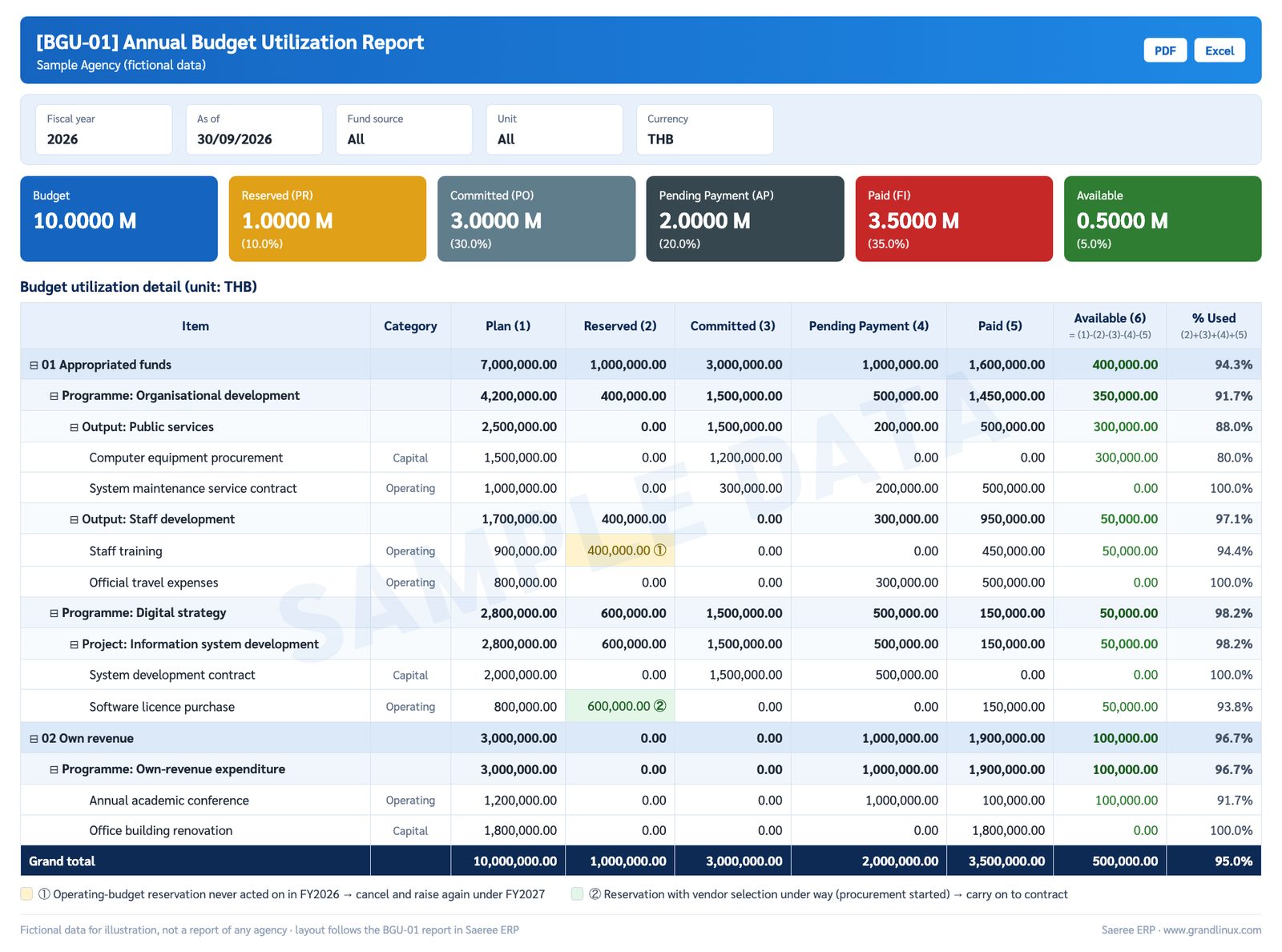
Sample BGU-01 budget utilization report as of 30 September 2026 — fictional data, the same figures as the example in section 2. Reserved row ① must be cancelled and raised again under FY2027; Reserved row ② is already in the procurement process and carries on.
What you have after 30 days: every baht of FY2026 money has a clear status and a due date, FY2027 money draws from a correct plan from the first request, and executives hold a one-page report that says which carried-over items are at risk of missing the March deadline. The extension request to the Ministry of Finance can then start early, not with two weeks to go.
4. GFMIS and the Internal System: Different Jobs, Same Numbers
New GFMIS Thai (Government Fiscal Management Information System) is the Comptroller General's Department system for drawing funds from the Treasury. Carry-over is requested through fund-reservation documents in that system. For FY2026 funds, the Comptroller General's Department announced on 26 August 2026 that where a binding obligation exists, agencies could reserve every item with no minimum amount, and had to complete the request by the last working day of September 2026. Items filed in time enter FY2027 with the right to be drawn.
GFMIS answers the question "what will the Treasury allow us to draw". It does not answer which document is sitting with whom inside the agency, whether inspection has happened, which contract is near its delivery date, or how much of the agency's own revenue is left. Those questions have to be answered by the agency's internal system. The two systems do not replace each other, but they must reconcile at every month-end.
| Year-end question | GFMIS can answer | The internal system must answer |
|---|---|---|
| How much is carried over | Yes, from fund-reservation documents | Yes, and it must equal Committed + Pending Payment for appropriated funds |
| Which items are approved but have no contract | No | Yes, from the Reserved status |
| Which contracts are delivered but not inspected | No | Yes, from Committed items with a delivery note |
| Liabilities on the books but not yet paid | Partly, only those already requested for payment | Yes, from the Pending Payment status |
| Available balance of own revenue and grant funds | No, it covers appropriated funds only | Yes, by every fund source |
The last row matters for agencies with several pots of money, such as public organisations and universities, because own revenue has no mandatory fiscal-year cut-off the way appropriated funds do. A Reserved item funded from own revenue may continue into the new year under the agency's own regulations. The differences between the three pots are explained in The Three Pots of Money in a Thai Government Agency.
5. How Saeree ERP Actually Does It: Encumbrance by Status, Not by Separate Paperwork
In Saeree ERP every financial document shows six columns on one screen: Plan, Reserved, Committed, Pending Payment, Paid and Available, broken down by every fund source the agency manages, whether appropriated funds, own revenue or grants. Each column moves with the real document. Approval puts the amount into Reserved, a signed contract moves it to Committed, inspection and invoice submission move it to Pending Payment and post the accounting entry, and payment moves it to Paid. No column is typed in by hand.
Items in Reserved, Committed or Pending Payment are encumbered automatically. When the system crosses into the new fiscal year those amounts are still there and can be drawn and disbursed straight away. There is no separate carry-over document to create in the internal system, no balances to roll forward manually, and no risk that a document awaiting inspection disappears at year-end close. Officers spend the first week of October checking items, not typing opening balances.
What the system does not do for people is decide which Reserved items will not proceed. It knows which documents have entered the procurement process, but it cannot know whether an operating-budget amount reserved last year and never used is still wanted. The user must cancel that item in the system and raise a new request against the new year's operating budget. Left uncancelled, the money stays encumbered and the available balance reads lower than it really is. That is why week two of the checklist is the week of cancellations, not the week of setting up the new plan.
The internal system does not replace GFMIS. Fund-reservation documents and Treasury drawings are still done in GFMIS as before. Saeree ERP is the source of the figures that go into those documents, and the place where the two are reconciled at month-end. The approval flow that runs as official memos with an audit trail on every document, and the rest of the public-sector setup, is described on Saeree ERP for Government Agencies, and the related terminology is in the ERP Budget Glossary.
Conclusion
Fiscal year 2027 opened on time with 3.788 trillion baht, but the hard work of October is FY2026 money still sitting in three statuses: Reserved, Committed and Pending Payment. Committed and Pending Payment items carry on for certain, and so do Reserved items already in the procurement process. Operating-budget reservations that were never acted on must be cancelled and raised again under FY2027. Committed and Pending Payment items each need a tracked due date. A system that encumbers by status removes the roll-forward work and leaves only the decisions that genuinely need a person. The four-week checklist above is the order that gets every one of those decisions made before the first purchase request of the new year.
"Closing a fiscal year is not one button pressed on 30 September. It is a decision on every single item: does this money carry on, or go back. A good system encumbers automatically; cancelling has to be a person's call."
- Sureeraya Limpaibul, Managing Director, Grand Linux Solution Co., Ltd.
References
- Thansettakij — Royal Gazette publishes the FY2027 Budget Act, 3.788 trillion baht, effective 1 October (30 Sep 2026, Thai)
- Bangkok Biz News — FY2027 Budget Act published in the Royal Gazette (Thai)
- Bureau of the Budget — Budgetary Procedures Act B.E. 2561 (Section 43, extension of the Treasury drawing period)
- Thansettakij — Ministry of Finance allows carry-over of all FY2026 obligated items with no minimum amount (Aug 2026, Thai)
- The Bangkok Insight — Comptroller General's Department issues FY2026 carry-over criteria (Thai)
- New GFMIS Thai (Comptroller General's Department) — Guidance on carry-over requests via fund-reservation documents (Circular 0414.3/Wor 530, Sep 2024, Thai)
Sources last checked 1 October 2026. The figures in section 2 and the sample report image in section 3 are made-up examples to illustrate the statuses, not data from any agency.
Start FY2027 Seeing Every Budget Status on One Screen
Saeree ERP is built for Thai public-sector rules: multiple fund sources, Reserved / Committed / Pending Payment statuses, automatic cross-year encumbrance and memo-style approvals, in production at government agencies today.
See Saeree ERP for Government AgenciesTel 02-347-7730 | sale@grandlinux.com