

- 19
- February
Government agencies, state enterprises, and public organizations all need to manage both "budget" and "accounting" simultaneously. However, since these two systems use different recognition bases, a common problem arises: figures from budget reports and accounting reports do not match. This article explains the causes of these differences and how to properly reconcile them.
In short
When the budget report and the accounting report disagree, it does not mean somebody recorded something wrong — both systems recognise the same transaction at different moments. The budget answers "how much money has left the organisation?" while accounting answers "how much obligation arose this period?" What an organisation needs is therefore not two identical numbers, but a reconciliation process that can explain every baht of the gap.
Cash Basis vs. Accrual Basis — What Is the Difference?
The heart of the problem is that the budget system and the accounting system use different recognition bases.
- Budgeting uses the cash basis — expenditure is recognised when cash is actually paid out, regardless of whether the goods or services have already been received.
- Accounting uses the accrual basis — transactions are recognised when they occur or when an obligation arises, regardless of whether payment has been made.
Thailand's Public Sector Accounting Standard No. 1, Presentation of Financial Statements (developed in line with IPSAS 1) defines the accrual basis explicitly as the basis of accounting under which transactions and events are recognised when they occur, not when cash or cash equivalents are received or paid. The items recognised under this basis are assets, liabilities, net assets/equity, revenue and expenses.
This difference is not merely theoretical — it reaches all the way down to daily operations:
| Dimension | Budget system (cash basis) | Accounting system (accrual basis) |
|---|---|---|
| When the number moves | When cash leaves the organisation | On goods receipt / when the obligation arises |
| Question it answers | How much has been disbursed, how much budget remains | What expenses and liabilities belong to this period |
| Time frame | Fiscal year (1 Oct – 30 Sep in Thailand) | Accounting period / reporting period |
| Source document | Disbursement request, payment voucher | Goods receipt note, AP invoice |
| Primary report users | Executives, parent agency, Bureau of the Budget | Auditors, State Audit Office, financial reporting team |
| Year-end obligation | File the carry-over request in time | Accrue every outstanding expense in full |
A concrete example: suppose an organisation orders goods worth THB 1,000,000, accepts delivery in September, but pays in October.
- Budget side (cash basis): the expenditure is recorded in October, the month cash was actually paid — which already falls in the next fiscal year.
- Accounting side (accrual basis): the expense is recorded in September, the month the goods were received and the liability arose.
The same transaction, the same set of documents, but landing in different months and different fiscal years. That THB 1,000,000 gap will appear in both reports — and both figures are correct.
Understand this before going further
Neither basis is "more correct" than the other — they are designed for different purposes. The cash basis enforces spending discipline against an approved appropriation, while the accrual basis reflects the organisation's true financial position. Forcing the two figures to match without recording reconciling items is therefore solving the wrong problem.
Is your agency still running this on Excel and paper?
Saeree ERP is built around Thai public-sector rules — 3 fund sources · reserve/commit/accrue · fixed assets · procurement · memo-style approvals
Thailand's Fiscal Year Widens the Gap
The Thai public sector fiscal year runs from 1 October to 30 September, which does not align with the calendar year. As a result, every year-end transition leaves a stack of documents "received this year, paid next year", and the volume peaks in August and September.
The governing rule is the Ministry of Finance Regulation on Withdrawal of Funds from the Treasury, Receipt, Payment, Custody of Funds and Remittance to the Treasury, B.E. 2562 (2019), which sets out the carry-over conditions as follows:
- Clause 105 — a state agency that has entered into an obligation before the end of the fiscal year, for an amount of THB 100,000 or more (or as prescribed by the Ministry of Finance), and cannot draw the funds to settle that obligation before the fiscal year ends, may request to carry the funds over for no more than six months into the following fiscal year. If disbursement is still required after that, the agency must reach an agreement with the Ministry of Finance to extend by no more than a further six months.
- Clause 106 — the carry-over request must be filed before the end of the fiscal year, following the procedure prescribed by the Ministry of Finance.
The mistake you cannot undo
The critical conditions are "obligation entered into before the end of the fiscal year" and "request filed before the end of the fiscal year". An agency that fails to close its commitments in time, or only discovers outstanding items after 30 September, cannot go back and file the request. The accounting team — which sees accrued liabilities coming from goods receipt documents — is therefore the budget team's most important early-warning system during the final quarter.
Five States of Budget Money — Where Most Confusion Starts
When someone says "there is still budget left", the right follow-up question is left in what sense? A single appropriation travels through several states before cash actually leaves the organisation, and each state affects the accounting side differently. This is the number one reason the two reports appear to contradict each other.
| State | Occurs when | Budget side | Accounting side |
|---|---|---|---|
| Reserved | Approved, no action taken yet | Amount set aside, not yet drawn | Nothing recorded yet |
| Committed | Purchase order issued / contract signed | Amount tied to a counterparty | No expense recognised yet (goods not received) |
| Accrued / payable | Goods received and invoice submitted | Not drawn down until cash is paid | Expense and liability recognised ← the gap appears here |
| Paid | Cash paid to the creditor | Drawn down in full | Liability cleared, cash/bank decreases |
| Available | — | Balance after deducting all states above | No direct accounting meaning |
Use the term that matches the state
Do not lump everything that is "approved but unpaid" together as reserved, because the three states have entirely different accounting consequences — reserved touches the books not at all, committed reflects only a contractual obligation, while accrued is the point at which accounting has already recognised the expense and the liability in full. Mixing these terms in a management meeting is the most common root cause of misreading the reports.
Problems That Arise When Using Different Bases
When the budget and accounting systems use different bases with no clear bridge between them, these symptoms follow:
- Expense figures do not match — budget expenditure for a given month differs from accounting expenses, making month-on-month performance comparison impossible.
- Reports contradict each other in the same meeting — the budget team reports remaining appropriation while the accounting team reports a large accrued liability already waiting. Both are right, but the executive walks away with two different conclusions.
- Poor spending decisions — seeing an "available" figure and approving a new project, when that amount is in fact committed to a contract whose goods have not yet been received.
- Fiscal year cutoff problems — year-end transactions paid early in the new year make annual closing complex and slow.
- Audit observations on the financial statements — incomplete accruals understate both expenses and liabilities for the period, which auditors detect without much difficulty.
- Everything piles up at closing — without monthly reconciliation, differences accumulate all year and get chased down at once, a classic cause of missing the financial close deadline.
How to Reconcile Budget and Accounting
Reconciliation rests on one principle: take cash-basis expenditure and adjust it with the differing items to arrive at accrual-basis expenses, using the formula:
Accrual-basis expenses = Cash-basis expenditure ± Adjusting items
The main adjusting items, with the documents that substantiate each figure:
- (+) Accrued expenses at period end — received but unpaid at the close of the period · substantiated by goods receipt notes and AP invoices with no payment voucher yet
- (−) Accrued expenses at period start — prior-period accruals settled in the current period · substantiated by the opening accounts payable register
- (+) Prepaid expenses at period start — paid in a prior period but recognised as expense in the current one · substantiated by the prepaid amortisation schedule
- (−) Prepaid expenses at period end — paid this period but not recognised as expense until the next · substantiated by service and insurance contracts spanning periods
- (−) Unsettled cash advances — the budget has been drawn in full but actual expenses are not yet known · substantiated by the advance receivable register
Sample reconciliation table (illustrative figures, shown to demonstrate the method):
| Item | Amount (THB) | Where the figure comes from |
|---|---|---|
| Cash-basis expenditure (budget) | 5,000,000 | Disbursement performance report |
| (+) Accrued expenses at period end | 800,000 | Goods receipts not yet paid |
| (−) Accrued expenses at period start | (500,000) | Opening AP register |
| (+) Prepaid expenses at period start | 200,000 | Prepaid amortisation schedule |
| (−) Prepaid expenses at period end | (300,000) | Contracts spanning periods |
| Accrual-basis expenses (accounting) | 5,200,000 | Statement of financial performance |
The goal of this table is not to make the two sides "equal", but to make that THB 200,000 difference explainable line by line and traceable back to source documents. Any line that cannot be explained is precisely the item to chase down before closing the period.

A Reconciliation Calendar — What to Do and When
Organisations that reconcile smoothly are not more talented than the rest; they simply do it more often. Chasing twelve months of differences at year-end is always the most expensive approach. The schedule below works in practice for government agencies and state enterprises.
| Frequency | What to do | What it catches |
|---|---|---|
| Weekly | Review goods receipts not yet turned into AP invoices | Expenses about to fall out of the period |
| Monthly | Prepare the cash-to-accrual reconciliation table | Unexplained differences, while documents are still findable |
| Monthly | Reconcile the remaining balance across all five states | Commitments that have been open abnormally long |
| Quarterly | Review unsettled cash advances | Budget already drawn with actual expenses still unknown |
| Jul–Sep | Close out commitments and prepare carry-over requests | Items that will miss disbursement — must be known before 30 Sep |
| Fiscal year end | Record all accruals in full and close every module period | Understated expenses and liabilities |
Four Reasons Reconciliation Never Quite Balances
On the ground, unexplained differences usually trace back to the same handful of causes.
- 1. Reconciling in Excel, outside the system — files get copied into many generations, formulas are edited without anyone noticing, and there is no way to trace a figure back to a specific document. This is the same failure pattern seen when Excel becomes the organisation's core system.
- 2. The chart of accounts is not linked to the budget structure — when account codes and budget codes are not designed to map to each other from the start, reconciliation becomes a manual code-translation exercise every month. See more on setting up a chart of accounts for easy closing.
- 3. Goods receipt documents enter the system later than reality — the goods have arrived at the warehouse but the receipt note is still in a folder, so accruals are incomplete. This junction is the core of recording accounting entries from goods receipt.
- 4. Cash advances left unsettled — the budget is drawn in full on the day the advance agreement is signed, but actual expenses are only known once the advance is settled. The longer it sits, the wider the gap grows.
How Saeree ERP Manages Budget and Accounting
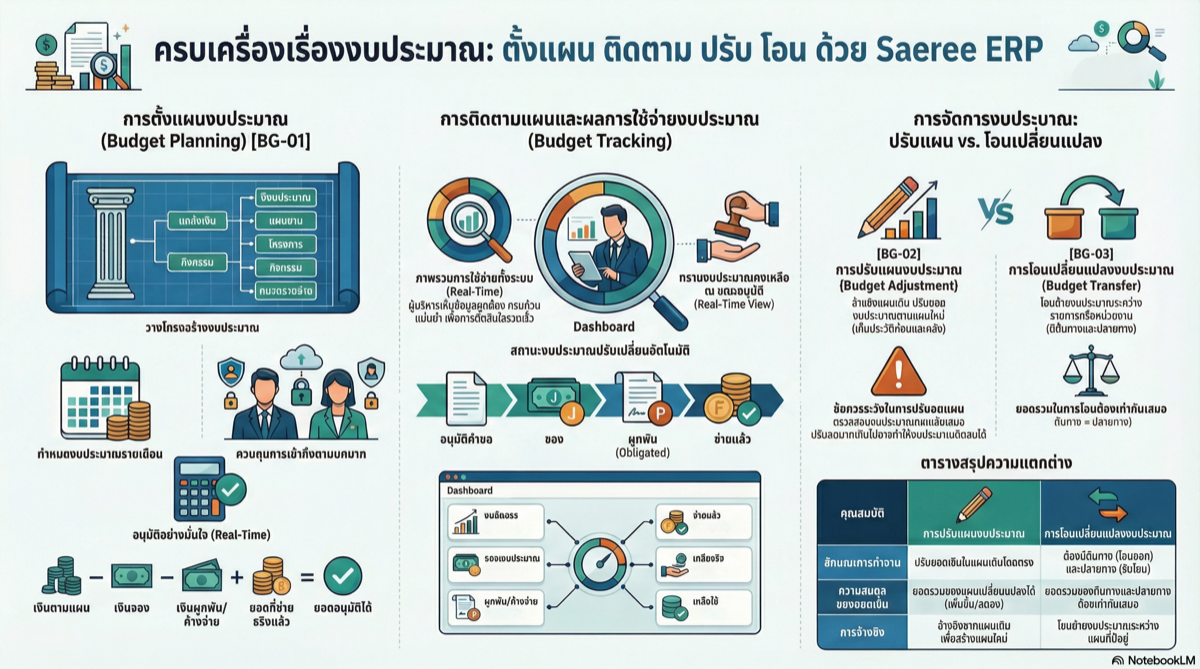
The idea behind the Budget module (BG) in Saeree ERP is to make budget and accounting run off the same set of documents, instead of two systems that have to be compared after the fact.
Commit the appropriation at the source, not at period close
BG-01 sets the annual budget plan broken down by programme, output, activity and expenditure category. The system checks the available appropriation automatically on every disbursement request and raises an alert when the budget is nearly exhausted or exceeded — preventing budget overruns at the point where they can still be corrected, rather than after the money is gone.
Multiple funding sources in one system
Public sector agencies typically run several funding sources at once — appropriated budget, own revenue and subsidies. The system supports planning and tracking separately by funding source, and on the accounting side it produces a trial balance by funding source and a statement of financial performance by funding source/budget. That makes it possible to reconcile one funding source at a time instead of seeing only a single combined total.
Transfers and reservations, with an audit trail
BG-02 handles budget transfers and revisions between programmes and activities, recording the history every time. BG-03 reserves appropriation in advance. Together they ensure that the "available" figure an executive sees is a figure that has already had reserved amounts deducted from it.
One document trail, both bases covered
The document flow is designed so that the recognition moments for both sides occur naturally in sequence — goods receipt at IM-01 feeds the AP invoice at AP-01, which posts accounting entries automatically and links to the budget system, and payment then follows at FI-03. The result is that the accrued expense appears in the books on the goods receipt date without the accounting team re-keying anything, while the budget is drawn down when cash actually leaves.
Cash advances you can actually track
LN-01 creates the advance agreement from the approval document and draws the budget in full. When the advance is settled at LN-02 and the supporting vouchers are received at FI-01, the system clears the advance receivable and posts the actual expenses, backed by an advance receivable register that can be reviewed each quarter.
What the system does — and what remains human work
The system makes both sets of figures originate from the same documents and remain traceable, supported by budget-versus-actual disbursement reports and a trial balance by funding source, which removes almost all of the re-keying and document-hunting. But deciding which accrual belongs in which period, and what explains the remaining difference, is still the accountant's professional judgement. A good tool is one that lets people decide on complete information — not one that decides for them.
Conclusion
A gap between the budget report and the accounting report is normal and correct, because the two systems recognise transactions on different bases for different purposes. What separates organisations that control their numbers from organisations that chase them is therefore not an attempt to make both sides equal, but the ability to explain every baht of the difference and trace every line back to a source document.
| Signs the process is healthy | Signs it needs urgent review |
|---|---|
| Reconciled every month, with a named owner | Reconciled once a year at closing |
| Reserved / committed / accrued reported separately | Reports show only "spent" and "remaining" |
| Every difference points back to a document number | There is an "other differences" line nobody can explain |
| Carry-over amounts are known by August | Missed disbursements are discovered after 30 September |
| Budget and accounting teams read the same data | Each team keeps its own Excel file |
"The goal of reconciliation is not to make two numbers equal. It is to make sure every baht of the difference has a name, a document, and someone who can explain it."
- Sureeraya Limpaibul, Managing Director, Grand Linux Solution Co., Ltd.
If your organisation is struggling with budget and accounting reports that do not agree, and you want a process that stays traceable end to end, contact our team for a consultation and a walkthrough of how the system works in practice.
References
- The Comptroller General's Department. "Thai Public Sector Accounting Standard No. 1: Presentation of Financial Statements" (developed in line with IPSAS 1). https://www.cgd.go.th
- Ministry of Finance Regulation on Withdrawal of Funds from the Treasury, Receipt, Payment, Custody of Funds and Remittance to the Treasury, B.E. 2562 (2019), Clauses 105–106 on carrying funds over to the following fiscal year. Government Gazette, Vol. 136, Special Part 120 Ngor, 13 May 2019.
- Ministry of Finance Regulation on Withdrawal of Funds from the Treasury (No. 2), B.E. 2563 (2020). Government Gazette, Vol. 137, Special Part 272 Ngor, 18 November 2020.
- Budgetary Procedures Act, B.E. 2561 (2018). Government Gazette, Vol. 135, Part 92 Kor, 11 November 2018. https://www.bb.go.th
- State Fiscal and Financial Discipline Act, B.E. 2561 (2018).