

- 26
- September
"How Far Can AI Go on Porter's Five Forces? Part 4 with Anthropic: Rating the Pressures in the AI-Model Market, Then Arguing Against Itself" — the short answer is it can rate all five pressures with evidence in ten minutes, but confident-looking ratings can flip: told to argue against itself from the same documents, Claude flipped one of the five from High to Medium, cut its confidence on two more, and caught its own double counting. This is part 4 after the BMC, SWOT/TOWS and CVP: a real test on the market Anthropic competes in, with 31 documents, results shown as a diagram and tables, and a method you can run on your own industry.
In one line: AI rated Porter's Five Forces for the frontier AI-model market: 3 High and 2 Medium in step 1. Told to argue against itself from the same 31 documents, it flipped substitutes from High to Medium, cut confidence on two forces, caught one case of double counting, and wrote a "what would change my mind" condition for every force.
Before you read: This is part 4, following the Business Model Canvas, SWOT and TOWS, and the Customer Value Proposition. The test ran on 26 September 2026 with Claude (the Claude Fable 5.1 model, through Claude Code), web search off, answering only from 31 attached documents. Every rating is the AI's interpretation of public documents, not Anthropic's view. Run-rate revenue and margin figures are press reports or third-party estimates, and we flag each one. Prices are in US dollars, not converted to baht. And as in the first three parts: our company sells and supplies Claude to Thai organisations, but this article uses public information only. The prompts were run in Thai; the versions shown here are translations.
The first three parts looked outward from inside the company. This one steps back to the whole industry with the oldest tool in the set, Porter's Five Forces, and adds one rule that makes it different from the three before it. After the AI rated all five pressures, we told it to play the "opposition" and argue against its own ratings from the same documents. One rating in five flipped, confidence dropped on two more, and the AI caught itself double counting.
1. What Porter's Five Forces is, and why the AI has to argue against itself
Porter's Five Forces is Michael Porter's framework (revised in Harvard Business Review, 2008) which says an industry's profitability is set by five pressures, not by how good any one company is. If most forces are high, even the market leader earns thin margins. If most are low, an ordinary company does fine. The analyst's job is to rate each force High, Medium or Low, with evidence.
| Force | Question it answers | What makes it high | Who it is in the AI-model market |
|---|---|---|---|
| Rivalry among existing competitors | How hard do current rivals fight? | Similar-sized rivals, high fixed costs, little differentiation, slow growth | OpenAI, Google and Anthropic |
| Threat of new entrants | How easily can outsiders come in? | Low capital needs, no regulatory barriers, open access to channels | Anyone with capital, chips and a sales channel |
| Bargaining power of suppliers | How much can input sellers set our prices? | Few suppliers, hard to switch, suppliers able to compete directly | Chip makers, cloud providers, energy, research talent |
| Bargaining power of buyers | How hard can customers squeeze us? | A few large customers, easy switching, comparable products | Enterprises, developers, and clouds as a sales channel |
| Threat of substitutes | Can customers solve the same problem another way? | Substitutes far cheaper and easy to adopt | Self-hosted open-weight models, models buyers build themselves, or no AI |
What makes Five Forces a better test of AI than the other frameworks is that its ratings always look confident. A reader sees "High" with five pieces of evidence and believes it, even though Porter himself wrote that ratings depend on how you scope the industry and which time horizon you take. Change those two and the ratings change while the facts do not. So our question was not just whether the AI can rate the forces, but whether, forced to argue against itself, it would admit where a rating stands on a viewpoint rather than on data.
The principle this time: two passes over the same documents. The first rates the forces. The second is told to argue that each rating should be the opposite, with no new facts allowed, and then to weigh both sides itself. Every force has to end with "what would change my mind", because a rating with no condition for changing is a rating nobody can check.
Using Claude at work? Get a quote in Thai Baht with a full tax invoice
Our procurement service starts at 5 seats · fewer than that? buy direct from Anthropic · Enterprise: talk to our team
2. Method: rate first, then argue against your own ratings
The 31 attached documents are the 25 from the previous part plus 6 that Five Forces needs and the earlier parts did not: NVIDIA's latest quarterly results (the chip-supplier side), SignalFire's report on AI talent movement, Epoch AI's estimates of frontier training costs, Andreessen Horowitz's survey of 100 enterprise CIOs, Porter's original HBR article, and a summary of our own conclusions from parts 1 to 3 as document 31, so the AI could check consistency with what it had concluded before.
You are a business strategy consultant. Build Porter's Five Forces for the
industry "frontier AI models for enterprises", the market Anthropic competes
in, from the attached documents below.

Rules
1. Answer in Thai, in plain working language, no preamble
2. Cover all 5 forces: rivalry among existing competitors · threat of new
   entrants · bargaining power of suppliers (chips, cloud, energy, talent) ·
   bargaining power of buyers (enterprises, developers, and hyperscalers as a
   channel) · threat of substitutes (self-hosted open-weight models, models
   buyers build themselves, or not using AI)
3. For each force give (a) a rating High / Medium / Low (b) 3-5 factors coded
   R1, N1, S1, B1, T1 ... every one citing [n] and tagged fact or
   interpretation (c) 1-2 "what would change the rating" (d) one sentence on
   the effect on Anthropic
4. Never guess numbers. Where the documents do not cover it, tag it
   (prior knowledge, may be outdated)
5. Close with (a) a summary table of the 5 forces: rating · confidence ·
   short reason (b) a table of "what people must decide or verify"
6. Do not search the web
The second prompt attached the full first-pass output with the same documents, then switched roles.
Continuing from the Porter's Five Forces below, act as the "opposition" and
argue against the rating of each force using the same documents.

Rules
1. Answer in Thai, in plain working language, no preamble
2. For each force give (a) the strongest argument that the rating should be
   the opposite (if it was High, argue Medium or Low; if Low, argue High),
   every point citing [n], adding no facts that are not in the attached
   documents (b) the weaknesses of that argument itself (c) the final rating
   after weighing both sides, with confidence, and whether it changed and why
   (d) "what would change my mind": the evidence that, if seen, would flip
   the rating
3. Check consistency with the previous parts [31]: where does the final
   rating support or contradict the SWOT/TOWS/CVP conclusions? Cite the codes
4. Close with (a) a summary table (b) a table of "what people must decide",
   things that depend on viewpoint or risk appetite, not on data
5. Do not search the web
Rule 2 (a), "add no new facts", matters most. If the opposition may go and find new evidence, it always wins. What we wanted to know is how far the same documents can support the opposite rating. We explain how to write rules like these in our guide to prompting Claude. Each pass took roughly 5 to 7 minutes and returned about 13,000 and 18,600 characters. The opposition pass is longer than the rating pass because it has to write the argument, the argument's weaknesses, and the verdict.
3. Step 1 results: 3 High, 2 Medium, and an explanation that fits too neatly
The AI began by scoping the industry itself: the market for selling frontier models to enterprises through APIs, clouds and tools, with three main players according to the documents, and with Chinese and open-weight models classed as substitutes as our prompt asked. It then rated all five forces with 25 factors, each with a reference number and a fact-or-interpretation tag.
| Force | Rating | Confidence | Short reason the AI gave | Effect on Anthropic (the AI's words) |
|---|---|---|---|---|
| Rivalry | High | High | Enterprise LLM API share changes hands fast (Anthropic 24% to 40%, OpenAI 50% to 27%) [17] · OpenAI cut a price by ~80% (Jul 2026) [18] · everyone has pre-committed capacity to fill [7][8] | Must make the coding lead measurable, because every point that cannot be measured becomes a price fight |
| New entrants | Medium | Medium | = Low at the true frontier (training cost heading past $1B) [28] + High near the frontier (six Chinese models in three months) [18] | The real moat is capital, compute and channels, not model quality alone |
| Suppliers | High | High | Compute takes $0.56–0.71 of every $1 of revenue (estimate) [11] · NVIDIA gross margin 74.9% [26] · clouds are shareholder, rival and channel at once [7][8][20] | The ~44% margin ceiling is set from outside the company |
| Buyers | Medium | Medium | 37% of enterprises use 5+ models [29], but coding is "price-insensitive" [22], evidence from before the price shock · channels sit with rivals | A premium is possible only where the difference is measurably proven |
| Substitutes | High | Medium | "Cents vs dollars" [18], but the usage evidence is startups, not large enterprises, and the cheap prices are not stable | The bottom of the price line collides with "cents"; the top is protected only where the quality gap is measurable |
The AI's overall conclusion was "3 of 5 forces high, consistent with a gross margin of about 44%". It reads very neatly, and that is the problem. Three things to notice before step 2.
- The AI split forces into layers without being asked. New entrants became "true frontier = Low" plus "near frontier = High", averaged to Medium. Buyers became large enterprises, developers, and clouds as a channel, each rated differently. That is what a good consultant does, and it is what makes the overall ratings persuasive.
- The AI dated the evidence against the threat. The evidence that buyers are "price-insensitive" and that Anthropic holds 54% of coding was collected in November 2025; the rival's 80% price cut came in July 2026. The AI noted on its own that the evidence is older than the threat and put it first in its 12-row table of "what to verify".
- But the AI double counted without noticing. The six Chinese models were used to push new entrants from Low to Medium (factor N2) and at the same time as the main evidence for substitutes (factor T1), even though the scope it had set itself said Chinese models were substitutes. We did not point this out, because we wanted to see whether the opposition pass would catch it.
The trap in step 1: a result that explains everything neatly ("3 of 5 forces high, hence thin margins") is the result to distrust most, because Five Forces is flexible enough to explain any margin once you already know the number. Stop here and you get a document that reads well and cannot be checked.
4. Step 2 results: the opposition flips 1 force, cuts confidence on 2, and catches the double count
This table is the whole process on one page. The second column is the strongest argument the AI could find in the same documents. The third is the weakness of that argument, which the AI pointed out itself. The fourth is the verdict, and the last column is the most valuable thing in this part. Click the image to open it full size.
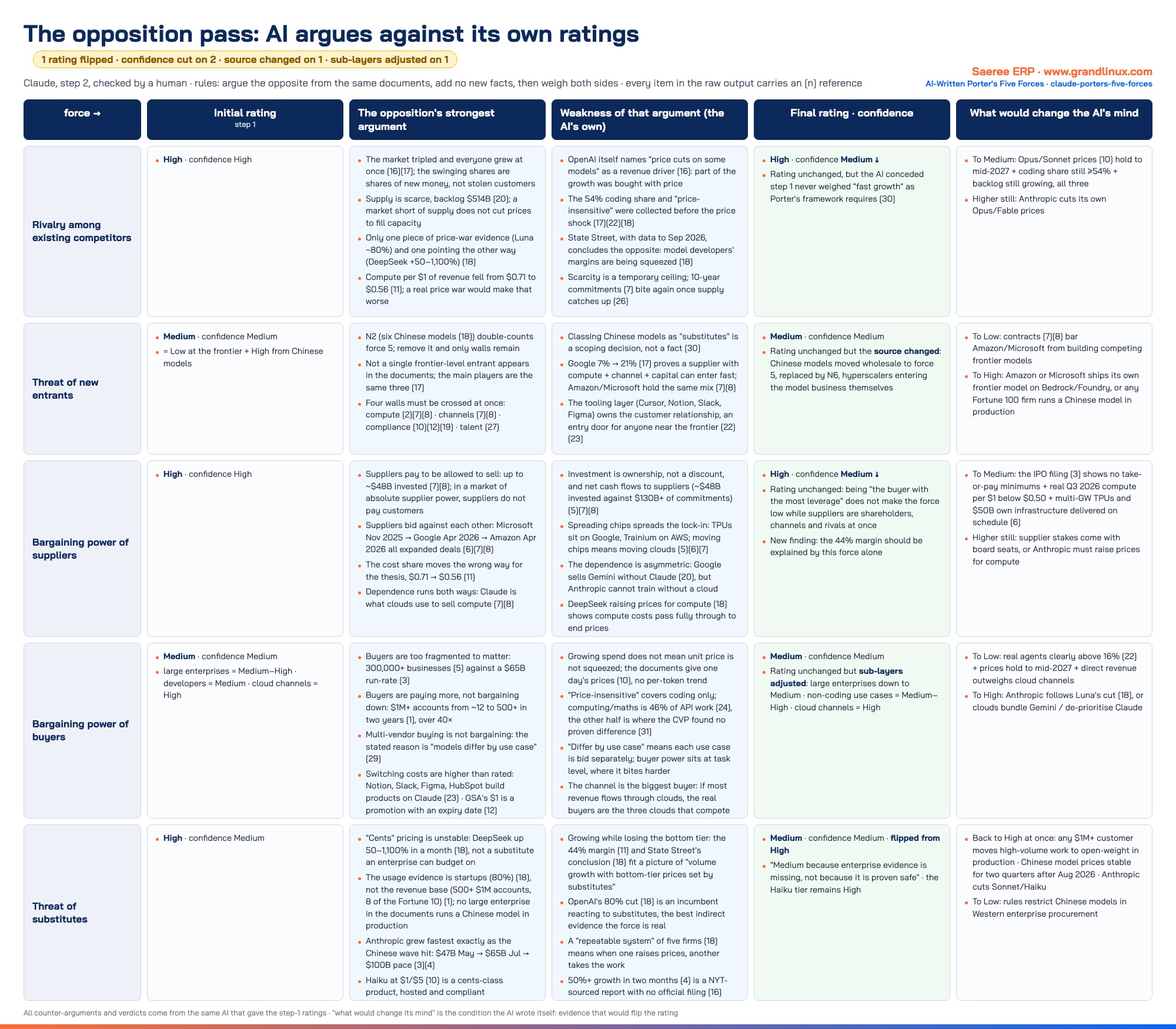
The opposition pass for all five forces on one page. The arguments and verdicts come from the same AI that gave the step-1 ratings. We shortened them to fit the image but did not change the substance.
What happened, force by force
- Substitutes flipped from High to Medium. The opposition showed the original rating stood on two legs the documents themselves undercut: "cents" pricing is not stable (DeepSeek raised prices 50–1,100% in a single month), and the 80% usage figure is startups, not the revenue base of more than 500 accounts above $1M. What matters is the sentence the AI attached to its own verdict: "Medium because enterprise evidence is missing, not because it is proven safe", and its note that the moment any large customer moves work to open-weight in production, the rating goes straight back to High.
- New entrants kept its rating but changed its source. The opposition caught that N2 double counts force 5. The AI conceded, moved the Chinese models wholesale to force 5, and replaced them with a new factor N6: the dangerous entrants are the clouds that are already suppliers, with Google, whose share went from 7% to 21%, as the example that has already happened. Still Medium, but the source of the threat is clearer and closer.
- Rivalry stayed High, but confidence fell from High to Medium. The opposition won one point that matters: a market that tripled and a shortage of supply are factors Porter names as reducing rivalry, and step 1 never weighed them. The AI ruled that they limit the price war for now without removing the structure, so it kept the rating but admitted the price evidence is one for and one against.
- Suppliers stayed High, confidence fell, and a new finding appeared. The opposition had two facts step 1 had overlooked: suppliers bid against each other and pay to invest for the right to sell, and the compute share of cost is falling. The AI replied that investment is ownership, not a discount, and that net cash still flows to suppliers. The new finding: the 44% margin should be explained by this force alone, not by "3 of 5 forces high" as the original overview said.
- Buyers stayed Medium, but the sub-layers moved. The opposition was right that spend growing more than 40-fold, and Notion, Slack and Figma building products on Claude, do not support "High" for large enterprises. The AI lowered large enterprises to Medium but raised non-coding use cases to Medium–High, because "models differ by use case" means each task is bid separately.
Here is the final result in Porter's standard layout. The coloured pill is the rating after the opposition pass, the small line under it is the initial rating and confidence, and the text under the dashed line in each box is the "changes if" condition the AI wrote itself.
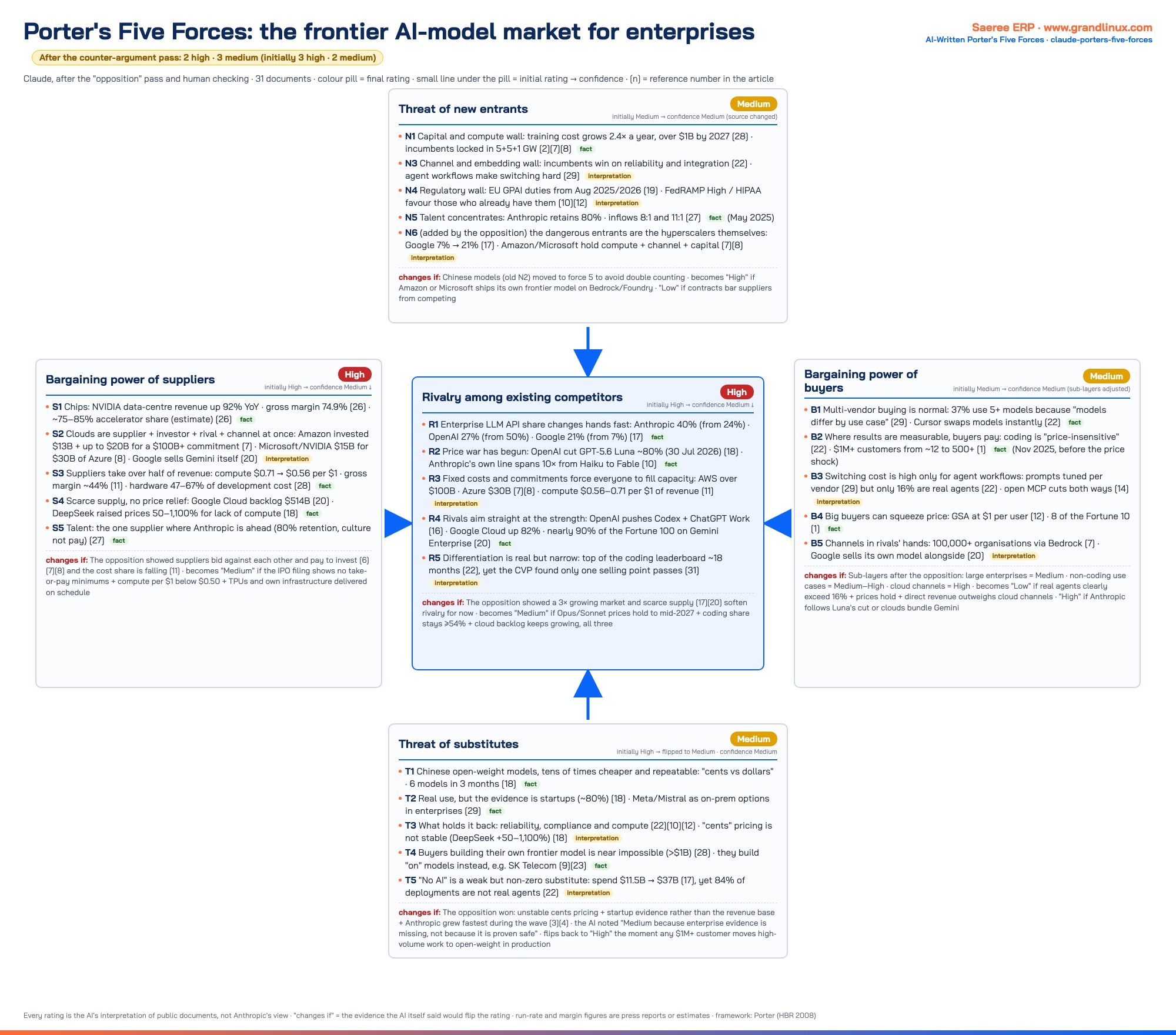
The final Five Forces: 2 High and 3 Medium, from 3 High and 2 Medium. Factor N6 in the top box is the one the opposition added.
Rule 3 asked the AI to check whether the final ratings support or contradict the conclusions of parts 2 and 3. It contradicted two points and supported the rest, which is what we wanted to see: if it had supported everything, it would simply have been repeating the earlier work.
| Force | Supports earlier conclusions | Contradicts or corrects them |
|---|---|---|
| Rivalry | Threat T4, weakness W1, strategy WT1 (tiered pricing) and the CVP finding that only coding has a proven difference | WT1 has more time than the earlier part said, as long as supply stays short across the market |
| New entrants | Threat T2 and weakness W4 (cloud dependence) get stronger; supports WO1 (use IPO money to lock in compute and raise the wall) | Removes the double count of threat T1 between forces 2 and 5 |
| Suppliers | All of W1, W4, T2, T3 and WO1 | The 44% margin should be explained by this force alone; the original "3 of 5 forces high" overview was wrong |
| Buyers | ST1 (lock in workflows), threat T6 (channels), and the CVP finding that office workers still show no proven difference | Enterprises pay a premium more readily than the earlier part feared; WT1's assumption gets stronger |
| Substitutes | WT1 is still right because the bottom tier of the price line stays High; supports the CVP finding that the top is protected by coding quality | Threat T1 moves from "a threat that has arrived" to "a latent threat with no enterprise evidence yet"; WT1 is less urgent and WO1 gains weight instead |
The W/T/WT/WO/ST codes refer to part 2, SWOT and TOWS · the CVP findings are from part 3
The most valuable thing here is not the ratings but the "what would change my mind" column. Every force has a checkable condition. Rivalry drops to Medium if Opus and Sonnet prices hold to mid-2027, and the coding share stays at or above 54%, and cloud backlogs keep growing, all three. Suppliers drop to Medium if the IPO filing shows no take-or-pay minimums and compute per $1 of revenue falls below $0.50. That is a list of indicators a person should revisit every quarter, and it is what most hand-made Five Forces never include.
5. What people must decide: 9 questions more data cannot answer
The last table of the opposition pass differs from step 1's "what to verify" table. The first lists things you can go and find. This one lists things that still need a human choice even with complete data, because they depend on viewpoint or risk appetite. The AI found nine.
| # | Question | Force | Seen one way | Seen the other way |
|---|---|---|---|---|
| 1 | Are Chinese models sold through APIs "new entrants" or "substitutes"? | 2, 5 | Substitutes: force 2 Low, the answer is WT1 tiered pricing | Entrants: force 2 High, the answer is WO1 raising the wall. Same total, different strategy |
| 2 | Time horizon: 12 months or 3–5 years | 1, 3 | 12 months: scarcity holds the price war down, force 1 can be Medium | 3–5 years: supply catches up, committed capacity bites again, force 1 High |
| 3 | Weight by revenue, or by the worst case | 5 | By revenue: substitutes Medium | Looking at the Haiku tier: High |
| 4 | Are supplier equity stakes shared interest, or control? | 3 | Shared: force 3 can fall | Control: stays High. Reading intent is a viewpoint; data helps only partly |
| 5 | Is "demand above capacity" a shield or a burden? | 1, 3, 4 | Shield: forces 1 and 4 fall | Burden: force 3 rises. Same fact |
| 6 | How much risk to accept on "no enterprise evidence yet is not the same as safe" | 5 | Wait for data: WT1 not urgent, keep bottom-tier margin for now | Do not wait: prepare WT1 now, at the cost of giving up bottom-tier margin early |
| 7 | Unit of analysis for buyer power: the enterprise, or the use case | 4 | Enterprise: Low–Medium | Use case: Medium–High |
| 8 | How much weight to give run-rate figures whose counting method is unconfirmed | 1, 4, 5 | Trust them: the opposition's case gets stronger on all three forces | Distrust until the IPO filing: original ratings stand |
| 9 | Are MCP and open standards an attacking weapon or a leak? | 4 | Attack: keep them open, lower the cost of switching in | Defend: lock in through your own tooling. A choice of posture, not a data question |
Questions 1 and 2 are the two errors Porter himself named as the root of bad analysis (scoping the industry too broadly or too narrowly, and looking at a snapshot instead of a trend). The AI reached both by arguing with itself, not by reading the framework · MCP = Model Context Protocol, an open standard for connecting models to data and tools
6. What we learned: the opposition pass is what makes AI output checkable
Across four parts the AI has gone five steps: organise the data, separate fact from opinion, pair them into options, form hypotheses about customers, and now rate and then refute its own ratings from the same documents. This last step differs from the others because it adds no information. It adds knowledge of how far the information supports the conclusion.
- Where the AI did better than expected: it caught its own double counting, separated fact from scoping decision (whether Chinese models are entrants or substitutes "is not a fact"), flipped a rating when it lost the argument, and attached a sentence to that flipped verdict that stops the reader relaxing too much.
- What must be human: answering the nine questions in section 5, which are about viewpoint and risk appetite; supplying the internal data public documents lack (share of revenue through channels, commitment terms, unit-price trends); and owning the ratings that go into an investment decision.
- What to watch for: step 1 always reads more smoothly than step 2, because step 2 is full of conditions. Put both in front of executives and they will pick step 1. Choose step 2, and present it with the "what would change my mind" column as the centrepiece.
7. Using it in your own company: your supplier and buyer forces are already in your systems
A Five Forces for a large company in the news depends on analyst reports. But two of the five forces for your own company, the bargaining power of suppliers and of buyers, have evidence sitting in your ERP (Enterprise Resource Planning) system already, and it is better evidence than the news because the numbers are yours.
- Scope narrowly and write it down first. Questions 1 and 2 in the section 5 table are where most analyses fail from the start. State what the industry is, who you sell to, in which territory, and whether you are looking 12 months or 3–5 years out, and put that in the first line of the prompt. If you do not, the AI will scope it for you, and you will argue with the ratings without realising you are arguing about scope.
- Pull the supplier and buyer forces from the system. Export purchasing history by supplier for the last 2–3 years. You will see at once how many suppliers your spend concentrates on, how many times the unit price of key inputs has risen, and whether you have a backup source. On the buyer side, export sales and receivables by customer to see what share of revenue the top five customers hold and which ones negotiate discounts or stretch credit. Date every file. On reading procurement data, see procurement in an ERP.
- Public documents for the other three forces. For rivalry, entrants and substitutes, use industry news, trade-association reports and rivals' published prices, and turn them into a numbered, dated attachment as we did. Where there is no document, let the AI tag it "prior knowledge". How to attach files and give the team one shared document set is in using Claude to read Excel, CSV and PDF files and Claude Projects.
- Always run both passes, and never skip the opposition. Use the step-1 prompt and follow immediately with step 2. Keep the "no new facts" rule. If the opposition can flip a rating with the same documents, that rating should not be used until more data is in.
- Turn the "what would change my mind" column into quarterly indicators. For example: share of purchases from the largest supplier, share of revenue from the top five customers, number of times you had to cut price to match a rival. Read them from the system every quarter, and re-rate only when a number crosses the line the AI wrote. That turns Five Forces from a one-off document into a risk-management tool. Read more in enterprise risk management and, on executives deciding from real data, ERP succeeds or fails with top management.
From our own work: Saeree ERP customers can export purchasing history by supplier, sales and receivables by customer, and purchase-price reports for key materials to Excel or PDF, and attach them to Claude for the supplier and buyer forces following the steps above. For organisations that want Claude to query those numbers from the ERP directly every quarter, we connect it over MCP with role-based permissions and a log of every query. The ERP remains the source of truth. Claude is the rater and the opposition. People are the judges. See the engagement formats at Claude Solutions and the concept in what MCP is.
The whole series: part 1 Business Model Canvas · part 2 SWOT and TOWS Matrix · part 3 Customer Value Proposition · part 4, this article. All four use the same document set, grown step by step from 21 to 31 items.
Conclusion
- The AI rated all five of Porter's forces with 25 factors, each carrying a reference number and a fact-or-interpretation tag, in under 10 minutes. Step 1 gave 3 High and 2 Medium.
- Told to argue against itself from the same documents, it flipped substitutes from High to Medium, cut its confidence on rivalry and suppliers, and caught itself counting the Chinese models in two forces.
- The conclusion that changed: the 44% margin is not explained by "3 of 5 forces high" but by one force alone, suppliers who are shareholder, rival and channel at the same time.
- The most valuable outputs are the "what would change my mind" condition for every force, and the table of nine questions that still need a human decision even with complete data.
- For your own company, the supplier and buyer forces are already in the ERP. Export them with dates, run both passes, and turn the change conditions into quarterly indicators.
The first set of Five Forces ratings the AI gave read fluent and confident. The second pass, where it argued against itself, showed which ratings stood on facts and which stood on how the industry was scoped. What is worth keeping is not the ratings but the conditions that say when they will change.
- What we learned from the part-4 test, 26 September 2026
References
- [1] Anthropic: Anthropic raises $30B Series G at $380B post-money valuation (12 Feb 2026)
- [2] Anthropic: Anthropic raises $65B Series H at $965B valuation (28 May 2026)
- [3] TechCrunch (citing Bloomberg): Anthropic's annualized revenue surges to $65B (17 Aug 2026)
- [4] Axios (citing The New York Times): Anthropic tops $100 billion revenue pace, report says (18 Sep 2026)
- [5] Anthropic: Expanding our use of Google Cloud TPUs and services (23 Oct 2025)
- [6] Anthropic: Anthropic expands Google and Broadcom compute deal (6 Apr 2026)
- [7] Amazon: Amazon announces $5B Anthropic investment, up to $20B more (20 Apr 2026)
- [8] Microsoft: Microsoft, NVIDIA and Anthropic announce strategic partnerships (18 Nov 2025)
- [9] Anthropic: Seoul becomes third Anthropic office in Asia-Pacific (and Sydney fourth office, 10 Mar 2026) (23 Oct 2025)
- [10] Claude: Pricing page (checked 26 Sep 2026)
- [11] Yahoo Finance: Anthropic's gross margin is the most important number in tech (10 Jun 2026)
- [12] GSA: GSA strikes another OneGov deal with Anthropic (extended to 31 Oct 2026 per Nextgov, Sep 2026) (12 Aug 2025)
- [13] Anthropic: The Long-Term Benefit Trust (Sep 2023)
- [14] Anthropic: Claude Cowork and product pages at claude.com (checked 26 Sep 2026)
- [15] Sacra: Anthropic revenue, valuation & funding (third-party estimate) (2026)
- [16] Yahoo Finance / Quartz (citing Bloomberg): OpenAI annualized revenue tops $40 billion ahead of IPO (14 Aug 2026)
- [17] Menlo Ventures: 2025 — The State of Generative AI in the Enterprise (9 Dec 2025)
- [18] State Street Investment Management: Beyond DeepSeek — China's 2026 model wave and the repricing of the AI stack (21 Sep 2026)
- [19] EU Artificial Intelligence Act: Implementation timeline (updated 31 Aug 2026)
- [20] PYMNTS: Google Cloud rides enterprise AI demand to 82% growth (Alphabet Q2 2026 results) (22 Jul 2026)
- [21] Our part 1: How far can AI go on a Business Model Canvas? — the verified BMC (26 Sep 2026)
- [22] Menlo Ventures (same report as [17]), the section on why enterprises choose a vendor and price sensitivity (9 Dec 2025)
- [23] Claude: Customer stories (checked 26 Sep 2026)
- [24] Anthropic Economic Index: Economic primitives (15 Jan 2026) and Cadences (26 Jun 2026)
- [25] Our part 2: How far can AI go on SWOT and a TOWS Matrix? (26 Sep 2026)
- [26] NVIDIA: Financial results for first quarter fiscal 2027 (quarter ended 26 Apr 2026) (20 May 2026)
- [27] SignalFire: State of Tech Talent Report 2025 (20 May 2025)
- [28] Epoch AI: How much does it cost to train frontier AI models? (3 Jun 2024)
- [29] Andreessen Horowitz: How 100 Enterprise CIOs Are Building and Buying Gen AI in 2025 (10 Jun 2025)
- [30] Porter, M. E. (2008): The Five Competitive Forces That Shape Strategy, Harvard Business Review (Jan 2008)
- [31] Our part 3: How far can AI go on a Customer Value Proposition? — the parts 1–3 summary attached as document 31 (26 Sep 2026)
Want a Five Forces for your industry built from real supplier and customer data in your systems?
We supply Claude Team and Enterprise seats with a Thai-baht quotation and tax invoice, from 5 seats, and connect Claude to procurement, receivables and sales data in your ERP over MCP with role-based permissions.
Get advice / request a quoteTel 02-347-7730 | sale@grandlinux.com