- 26
- September
"How Far Can AI Go on SWOT and a TOWS Matrix? Continuing the Anthropic Test, from Business Model Canvas to Strategic Options" — the short answer is further than we expected: with the data attached, Claude built a SWOT that separates "fact" from "interpretation" on its own and paired it into a 12-strategy TOWS that states which assumption sinks each one, but choosing the path is still human work, because the seven central issues depend on the risk an executive will accept, not on data. This is part 2 after the Business Model Canvas: a real test on Anthropic with 21 documents, the results shown as images and tables, and a method you can run on your own company.
In one line: AI produced a 28-item SWOT (self-tagged: 12 facts, 16 interpretations) and a 12-strategy TOWS with a "must hold" assumption and a confidence level for each (1 high, 9 medium, 2 low) from 21 documents. What a human must decide: seven issues that depend on acceptable risk, not on data.
Before you read: This is part 2, following using AI to write a Business Model Canvas. The test ran on 26 September 2026 with Claude (the Claude Fable 5.1 model, through Claude Code), web search off, answering only from 21 attached documents. SWOT and TOWS contain opinion by nature. We kept the "fact" and "interpretation" tags exactly as the AI labelled them. Every strategy is the AI's interpretation of public information, not Anthropic's plan. Revenue and margin figures are press reports or third-party estimates. Prices are in US dollars, not converted to baht. And as in part 1: our company sells and supplies Claude to Thai organisations, but this article uses public information only. The prompts were run in Thai; the versions shown here are translations.
Part 1 showed that AI sorts facts into a nine-block frame well, as long as you attach the data. The open question was whether it could go past "sorting" into "judging what is good or bad" and "proposing what to do". SWOT answers the first, TOWS the second. So we continued with the same company, the same documents plus six new ones, and present the results as both images and tables.
1. What SWOT is, and how TOWS differs
SWOT splits a business into four boxes. Strengths and Weaknesses are internal, things the company controls. Opportunities and Threats are external, things it cannot control. It has been in use since the 1960s. Its well-known weakness is that it ends in a list and says nothing about what to do next.
Heinz Weihrich's TOWS Matrix (1982) fixes that by pairing the four boxes into four groups of strategies. Every strategy must point to the SWOT items it came from. If it cannot, it was made up.
| Group | Pairs | Question it answers | Type of strategy |
|---|---|---|---|
| SO | Strengths + Opportunities | How do we use what we have to seize the opportunity? | Offensive, expansion |
| ST | Strengths + Threats | How do we use what we have to counter the threat? | Defence through strengths |
| WO | Weaknesses + Opportunities | How do we use outside opportunities to fix our weaknesses? | Improvement, change |
| WT | Weaknesses + Threats | How do we limit the damage when a weakness meets a threat? | Defensive, risk reduction |
This pair is a good AI test because roughly half of SWOT is sorting facts and the other half is judgement, while TOWS is judgement all the way. If the AI does well, we learn it can reason. If it does well but does not know its own limits, we get strategies that look good and cannot be trusted.
The rule for this part: make the AI tag every item as fact or interpretation, and make every strategy state "what must hold first". Without those two, an AI-written SWOT and TOWS look more credible than they are.
Using Claude at work? Get a quote in Thai Baht with a full tax invoice
Our procurement service starts at 5 seats · fewer than that? buy direct from Anthropic · Enterprise: talk to our team
2. The method: two chained steps, SWOT first, then TOWS from its output
We did it the way a consultant does: finish the SWOT, check it, then feed it into a second prompt that pairs it into a TOWS. The attachment had 21 documents. The first 15 were the set from part 1 (Anthropic announcements, news, pricing pages). We added 5 that a SWOT needs but a BMC does not: competitor numbers (OpenAI, Google Cloud), the Menlo Ventures enterprise market-share survey, State Street's report on Chinese open-weight models, and the EU AI Act timeline. Item 21 was the verified BMC from part 1.
You are a business strategy consultant. Build a SWOT Analysis of Anthropic
(the developer of Claude) from the attached documents below.

Rules
1. Plain working language, no preamble.
2. Write 5–7 items per side (Strengths, Weaknesses, Opportunities, Threats),
   most important first, coded S1, S2, W1, O1, T1 ... each at most two lines.
3. For every item state (a) the reference number [n] of the document used and
   (b) a tag: "fact" or "interpretation". If interpretation, say briefly what
   it is interpreted from.
4. Strengths and Weaknesses must be internal to the company. Opportunities and
   Threats must be external. Do not mix them.
5. If the documents do not cover something and you must use prior knowledge,
   mark it (prior knowledge, may be out of date). Do not guess numbers.
6. End with a table titled "What a human must decide or verify", listing which
   SWOT items depend more on viewpoint than on data, and what data is missing.
7. No web search.
The second prompt attached the full SWOT plus the same documents and asked for four groups of three strategies. The three rules that mattered most: every strategy must name the SWOT codes it pairs (for example S3+O2) and nothing outside the SWOT may be proposed; every strategy must state "what must hold first", the assumption that sinks it if wrong, with a confidence level of high, medium or low; and the answer must end with a table "if you could pick only three" and a table "what a human must decide" that says which choices depend on the risk an executive will accept rather than on data. How to write rules like these is covered in our guide to writing prompts for Claude.
The two steps took about 15 minutes in total, each returning roughly 8,000 to 10,000 characters in Thai.
3. The SWOT: 28 items, and the AI tagged 12 as fact and 16 as interpretation on its own
Here is the SWOT after we checked it against the documents. Every figure points to a source [n] at the end of the article. Green tags are facts, yellow tags are interpretations, as the AI labelled them. Click the image for full size.
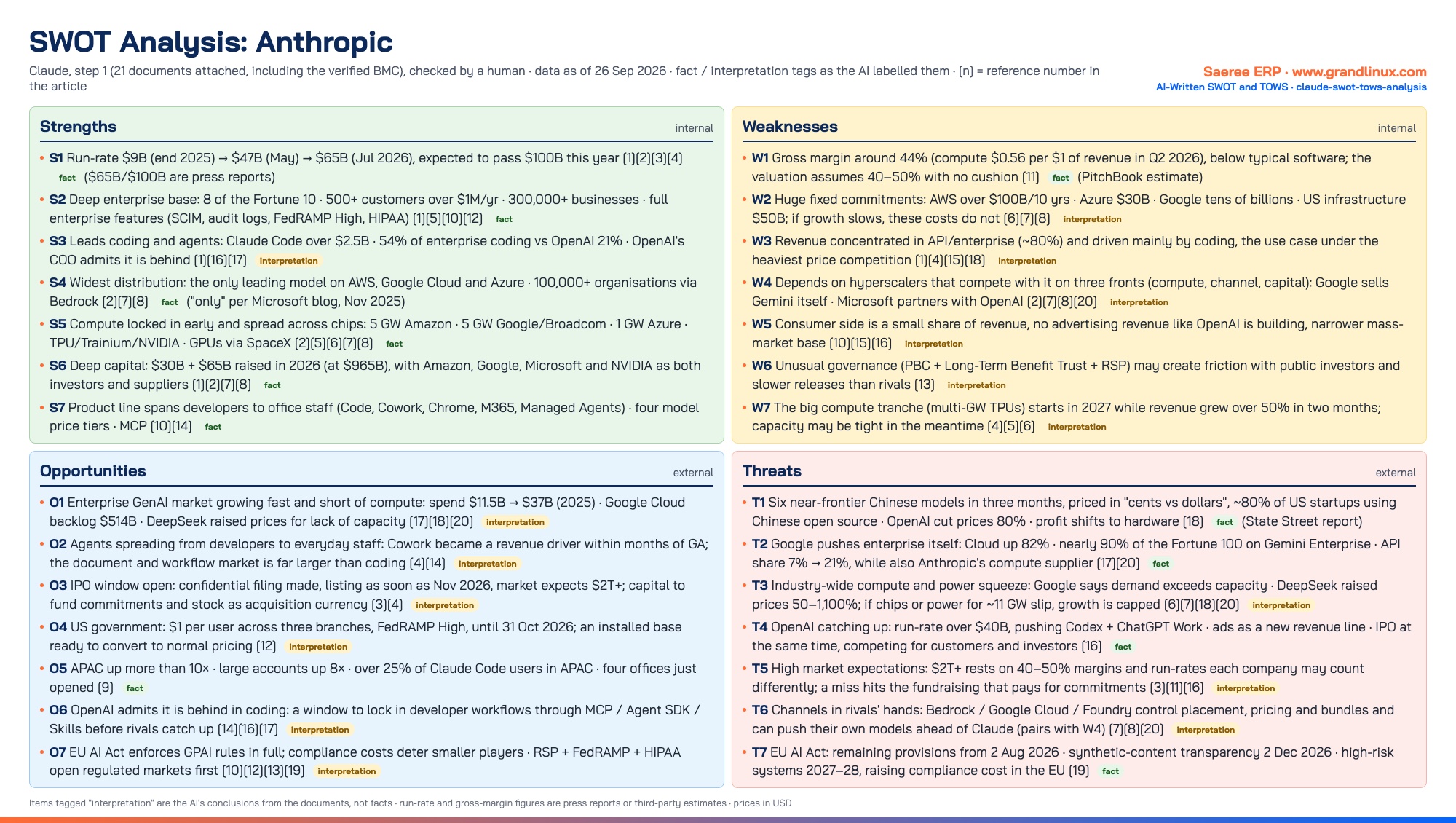
Anthropic's SWOT from step 1, checked against the sources. The "fact" and "interpretation" tags are the AI's; we did not change them.
Three things worth noticing in the image.
- The tags cluster the way the work does. Six of seven strengths are facts, because numbers back them. Six of seven weaknesses and opportunities are interpretations, because they must be inferred from structure. The AI did not dress the tags up. It reflects that the second half of any SWOT is always opinion.
- The same data can be a strength and a weakness. The roughly 11 gigawatts of compute contracts sit in S5 as an advantage rivals cannot buy overnight, and in W2 as a fixed burden that does not fall with revenue. The AI did not pick a side. It wrote in the closing table: "the difference is whether you believe growth continues for another few years; no data proves the future." The EU AI Act likewise appears in both O7 and T7.
- The AI flagged the age of its own data. The 54% coding market share that makes S3 look strong is marked as coming from a November 2025 survey, before OpenAI pushed Codex and cut prices, so it is tagged "interpretation", not fact, and the closing table asks for 2026 figures.
The "what a human must decide or verify" table at the end of the SWOT has nine rows. We picked the five a reader is most likely to meet in their own company.
| SWOT item | Why it depends on viewpoint more than data (the AI's words) | Data still missing |
|---|---|---|
| S1, T5 | "Real growth" or "a different run-rate definition"? The $65B and $100B figures both come from the press | Recognised revenue under accounting standards, retention, the run-rate definition the company uses |
| W1 | 44% is an estimate; this number decides whether Anthropic is a software business or an infrastructure business | Actual financials in the S-1, whether cost includes model training, margin split API vs subscription |
| S5 and W2 | ~11 GW of commitments is a strength if you believe in demand, a weakness if you do not; same data | Contract terms, rights to scale down, unit price vs market, how much is already used |
| W4, T2, T6 | Hyperscalers as "partners" or "competitors" can be argued both ways | Placement terms on each cloud, revenue share through each cloud |
| S3, O6 | The 54% share is a November 2025 survey, before rivals cut prices | 2026 coding market share, continued Claude Code use after rival price cuts |
GW = gigawatt, data-centre power capacity · run-rate = latest month's revenue × 12 · S-1 = the registration document filed before a US listing · the full nine-row table is in the raw output we kept on file
4. The TOWS: 12 strategies with the assumption behind each, and the three the AI picked
Step two was the part we doubted most. The result: all 12 strategies, each pointing back to SWOT codes, each with "what must hold first" and a confidence level. The stars in the image are the three the AI chose when forced to pick only three.
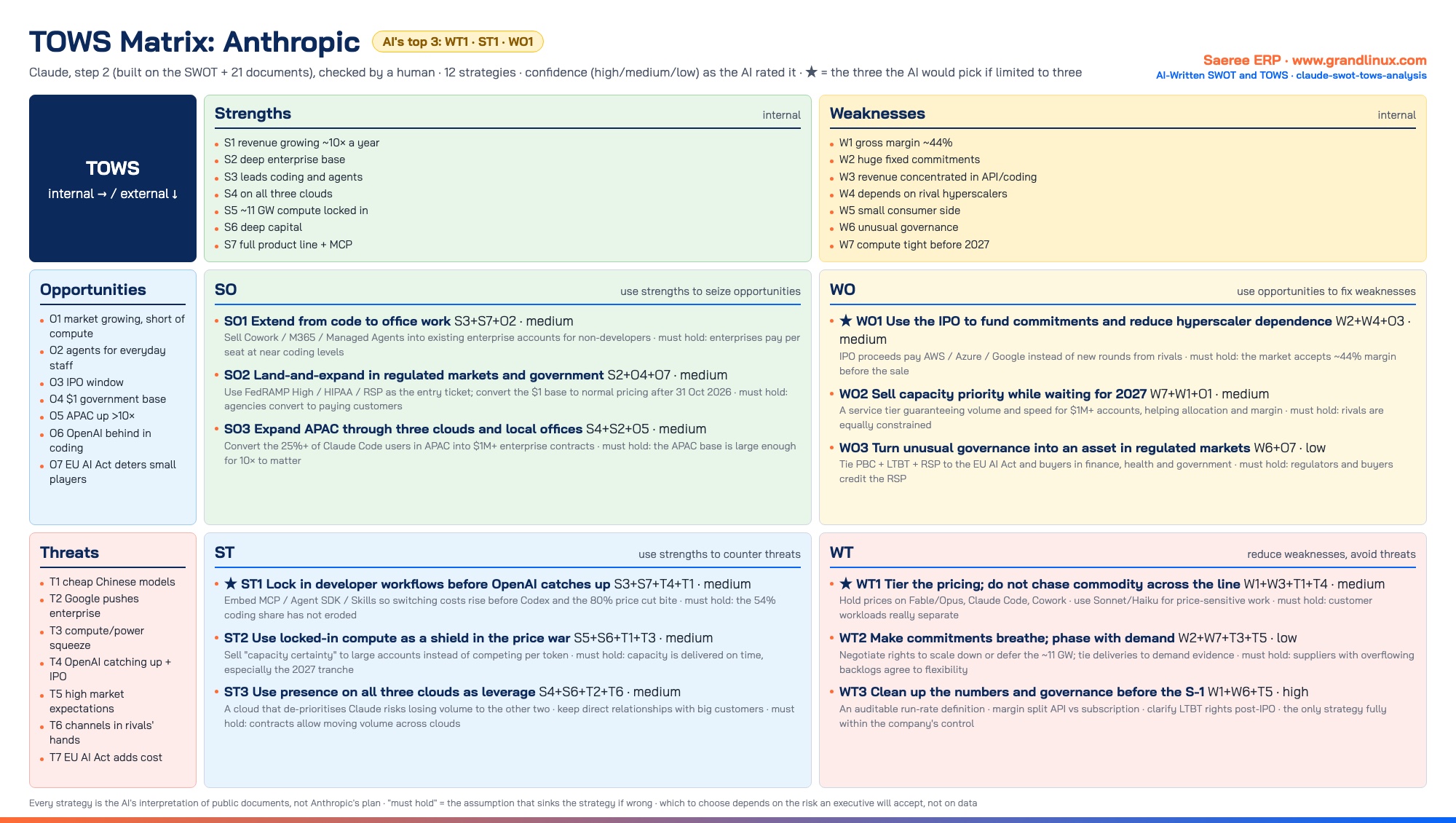
Anthropic's TOWS Matrix from step 2. Top row: strengths and weaknesses. Left column: opportunities and threats. Centre cells: the paired strategies. Click the image for full size.
| Group | Strategy | Paired from | Confidence | What must hold first (the AI's words) |
|---|---|---|---|---|
| SO | SO1 Extend from code to office work | S3+S7+O2 | medium | Enterprises pay per seat for office agents at near coding levels |
| SO2 Land-and-expand in regulated markets and government | S2+O4+O7 | medium | Agencies convert from the $1 deal into paying customers | |
| SO3 Expand APAC through three clouds and local offices | S4+S2+O5 | medium | The APAC revenue base is large enough for the 10× multiple to matter | |
| ST | ★ ST1 Lock in developer workflows before OpenAI catches up | S3+S7+T4+T1 | medium | The 54% coding share has not eroded after rival price cuts, and open standards cut both ways: customers can leave as easily as they arrived |
| ST2 Use locked-in compute as a shield in the price war | S5+S6+T1+T3 | medium | Capacity is delivered on schedule; if Anthropic itself is constrained, the advantage exists only on paper | |
| ST3 Use presence on all three clouds as leverage | S4+S6+T2+T6 | medium | Contracts really allow moving volume between clouds | |
| WO | ★ WO1 Use the IPO to fund commitments and reduce hyperscaler dependence | W2+W4+O3 | medium | The IPO window stays open to late 2026 and the market accepts a ~44% margin without repricing |
| WO2 Sell capacity priority while waiting for 2027 | W7+W1+O1 | medium | Rivals are equally constrained; if one has spare capacity, customers move instead of paying more | |
| WO3 Turn unusual governance into an asset in regulated markets | W6+O7 | low | Regulators and buyers credit the RSP itself, not just the certifications | |
| WT | ★ WT1 Tier the pricing; do not chase commodity across the line | W1+W3+T1+T4 | medium | Customer workloads really separate into work that needs top-tier models and work that does not |
| WT2 Make commitments breathe; phase with demand | W2+W7+T3+T5 | low | Counterparties that are both supplier and shareholder agree to flexibility they do not need to give | |
| WT3 Clean up the numbers and governance before the S-1 | W1+W6+T5 | high | The real numbers support the story when disclosed; if not, transparency accelerates repricing rather than preventing it |
RSP = Responsible Scaling Policy, Anthropic's safety framework · LTBT = Long-Term Benefit Trust · all confidence levels are the AI's
The reasoning behind the AI's top three reads like a finance person's logic. It chose WT1 first because "the 44% margin is the number that decides both the IPO valuation and the ability to pay the commitments; below 40%, the other strategies have no money to run on." It chose ST1 second because the window in which the rival admits it is behind "has an expiry date". It chose WO1 third as the unlock that gives the other two weight in negotiation. And it explained why it did not pick the more exciting SO1: "the press already says Cowork is a revenue driver, so it is something happening rather than something to decide anew."
Two things the AI did beyond the instructions, and the two we liked most
First, it pointed out that WT3 "is the only one of the 12 entirely in the company's hands, dependent on no rival, counterparty or market", and gave it the only high confidence. Separating what you control from what you do not is what good consultants do.
Second, in the "what a human must decide" table there is a consumer-and-advertising question (W5 with T4) for which the AI deliberately wrote no strategy, noting "left out because the data is insufficient to build one". Leaving a gap instead of filling it is exactly the behaviour we want from AI in analytical work.
The last table the AI produced was "what a human must decide": seven issues, each with the choice a high-risk-tolerance executive would make, the choice a low-risk-tolerance one would make, and why data cannot settle it. We picked four.
| Issue | If you accept high risk | If you accept low risk | Why data cannot answer it (the AI's words) |
|---|---|---|---|
| Size of the compute bet (S5 vs W2) | Sign more, take delivery early, sell capacity as a weapon | Phase with demand, negotiate rights to scale down | The difference is how many more years you believe 10× growth continues; no data proves the future |
| Answering the price war (T1) | Hold premium prices, give up share in commodity work | Cut prices to keep share, accept margin below 40% | You must choose to lose "share" or "margin"; both are measurable, but data does not say which hurts more long term |
| IPO timing (O3 vs T5) | Go late 2026, lock in capital before the rival | Wait for clearer margin and audited numbers | A trade between the risk of not raising in time for commitments and the risk of the stock falling after listing |
| Allocating tight capacity (W7) | Big accounts first, sell priority | Spread across developers and the ecosystem, accept less short-term revenue | Revenue today versus lock-in tomorrow, with no churn data to decide |
A caution: the criterion the AI used to rank its top three is money, margin and fundraising, which suits a company heading for a listing. Your executives may use other criteria, such as risk to existing customers or the people you have. The AI's TOWS is an organised list of options, not the answer. Never present it to management without the "what a human must decide" table attached.
5. What we learned: AI can reason, but it does not know how bold you are
Across the two parts, AI got through three stages: sort facts into a frame, separate fact from opinion, and pair them into options with conditions. The fourth stage is choosing. It will choose if forced, but with a criterion it guesses is suitable, not yours, and without the internal information that really decides, such as contract terms, true unit costs or the relationship with a key account.
- Where AI did better than expected: tagging fact and interpretation without bias, showing the same data can be a strength and a weakness, separating what is controllable from what is not, and leaving gaps where the data ran out.
- What stays human: setting the risk you will accept, adding the internal data that is not in public documents, testing whether each strategy's "must hold" assumption is true, and owning the choice.
- What to watch for: a fluent TOWS makes people want to believe it. Read the "what must hold first" column before the strategy names, every time.
6. Running it on your own company: strengths and weaknesses come from numbers in your systems, not from feelings
Most SWOTs fail on the internal half. Strengths and weaknesses get written from how people feel in the meeting room rather than from numbers, even though those numbers already sit in the organisation's ERP (Enterprise Resource Planning) system. It is the external half, opportunities and threats, that genuinely has to be gathered from outside.
- Pull the internal numbers first. Margin by product or project, unit cost over the last eight quarters, overdue receivables, slow-moving stock, budget actual versus plan, headcount versus workload. Export them from the accounting, budget, procurement, inventory and HR modules to Excel or PDF and date every file. That is your attachment for the strengths and weaknesses side.
- Collect the external set separately. Competitor news, new regulation, input prices, customer behaviour, at least five items with dates, the way we added five for Anthropic. In the public sector, next year's regulations and budget are the most important documents in this set.
- Run step 1 and check before step 2. Do not build the TOWS yet. Show executives the SWOT and its verification table first, fix the tags, add the internal data the AI does not have, then feed the corrected version into step 2. How to attach files and their limits is in using Claude to read Excel, CSV and PDF files; sharing one document set across the team is done through Claude Projects.
- Run the executive meeting on the "what a human must decide" table, not on the list of strategies. That table forces the conversation about acceptable risk first, which strategy meetings usually skip. On the executive's role in deciding on real data, see ERP succeeds or fails at the top, and on the risk side, enterprise risk management.
- Tie each chosen strategy to a number you will watch every quarter. Every strategy has a "must hold" assumption. Turn it into a metric in your system, such as a minimum margin per product. If it breaks, the strategy comes back for review.
Next in the series: the AI's top three strategies all rest on the assumption that "customers pay for quality". In part 3 we test that assumption with a Customer Value Proposition, in How far can AI go on a Customer Value Proposition (CVP)?
From our own work: Saeree ERP customers can export margin, cost, receivables, stock, budget and headcount reports to Excel or PDF and attach them to Claude for the internal half of a SWOT, following the steps above. For organisations that want Claude to query the ERP numbers directly every quarter without exporting files, we connect it over MCP (Model Context Protocol) with role-based permissions and a log of every query. The ERP remains the source of truth. Claude is the assistant that frames and pairs. See the engagement formats at Claude Solutions and the concept in what MCP is.
Conclusion
- AI built a 28-item SWOT from 21 documents and tagged 12 items as fact and 16 as interpretation on its own; the tags cluster the way the work does, not to look good.
- AI paired them into a 12-strategy TOWS, every strategy pointing to SWOT codes, each with a "must hold" assumption and a confidence level: one high, nine medium, two low.
- Forced to pick three, the AI chose by margin and fundraising and explained why it skipped the more exciting option.
- The AI separated what is controllable from what is not and left out a strategy where data was insufficient; that is what makes the result credible.
- What stays human: set the acceptable risk, add internal data, test each strategy's assumption, and own the choice.
- For your own company, strengths and weaknesses must come from the numbers in your systems, and the "what a human must decide" table is the best executive agenda an AI can produce.
AI can pair strengths with opportunities in ten minutes, but it does not know how much risk you will take. The most valuable table it produced is not the list of strategies. It is the list of questions you have to answer yourself.
- What we learned from the part-2 test, 26 September 2026
References
- [1] Anthropic: Anthropic raises $30B Series G at $380B post-money valuation (12 Feb 2026)
- [2] Anthropic: Anthropic raises $65B Series H at $965B valuation (28 May 2026)
- [3] TechCrunch (citing Bloomberg): Anthropic's annualized revenue surges to $65B (17 Aug 2026)
- [4] Axios (citing The New York Times): Anthropic tops $100 billion revenue pace, report says (18 Sep 2026)
- [5] Anthropic: Expanding our use of Google Cloud TPUs and services (23 Oct 2025)
- [6] Anthropic: Anthropic expands Google and Broadcom compute deal (6 Apr 2026)
- [7] Amazon: Amazon announces $5B Anthropic investment, up to $20B more (20 Apr 2026)
- [8] Microsoft: Microsoft, NVIDIA and Anthropic announce strategic partnerships (18 Nov 2025)
- [9] Anthropic: Seoul becomes third Anthropic office in Asia-Pacific (and Sydney fourth office, 10 Mar 2026) (23 Oct 2025)
- [10] Claude: Pricing page (checked 26 Sep 2026)
- [11] Yahoo Finance: Anthropic's gross margin is the most important number in tech (10 Jun 2026)
- [12] GSA: GSA strikes another OneGov deal with Anthropic (extended to 31 Oct 2026 per Nextgov, Sep 2026) (12 Aug 2025)
- [13] Anthropic: The Long-Term Benefit Trust (Sep 2023)
- [14] Anthropic: Claude Cowork and product pages at claude.com (checked 26 Sep 2026)
- [15] Sacra: Anthropic revenue, valuation & funding (third-party estimate) (2026)
- [16] Yahoo Finance / Quartz (citing Bloomberg): OpenAI annualized revenue tops $40 billion ahead of IPO (14 Aug 2026)
- [17] Menlo Ventures: 2025 — The State of Generative AI in the Enterprise (9 Dec 2025)
- [18] State Street Investment Management: Beyond DeepSeek — China's 2026 model wave and the repricing of the AI stack (21 Sep 2026)
- [19] EU Artificial Intelligence Act: Implementation timeline (updated 31 Aug 2026)
- [20] PYMNTS: Google Cloud rides enterprise AI demand to 82% growth (Alphabet Q2 2026 results) (22 Jul 2026)
- [21] Our part 1: How far can AI go on a Business Model Canvas? (26 Sep 2026) — the verified BMC, attached as document 21
- Weihrich, H. (1982): The TOWS Matrix — A Tool for Situational Analysis, Long Range Planning 15(2)
Want a SWOT and TOWS for your company built from the real numbers in your systems?
We supply Claude Team and Enterprise seats with a Thai-baht quotation and tax invoice, from 5 seats, and connect Claude to your ERP data over MCP with role-based permissions.
Get advice / request a quoteTel 02-347-7730 | sale@grandlinux.com