- 26
- September
"How Far Can AI Go on a Business Model Canvas? A Real Test on Anthropic, the Company Behind Claude" — the short answer is far enough to draft all nine blocks with reference numbers in minutes, but every figure is still a human's job to verify, and the result is only usable when you attach the data to Claude rather than letting it recall. This article runs a real two-pass test on Anthropic, once with no data and once with 15 documents attached, compares the results figure by figure, and turns it into a method you can run on your own company.
In one line: AI can write a full nine-block Business Model Canvas in minutes. With no data attached, the headline numbers were about a year old (off by 5 to 9 times). With 15 documents attached, every line was traceable to a source, but 15 items still needed a human check.
Before you read: The test was run on 26 September 2026 with Claude (the Claude Fable 5.1 model, through Claude Code), with web search switched off in both passes. The Anthropic figures used for checking come from the company's own announcements and from news outlets, listed at the end of this article. Anthropic is a private company and has not published financial statements, so every revenue and margin figure here is a press report. Prices are in US dollars as published by Anthropic and are not converted to baht. In full disclosure: our company sells and supplies Claude to Thai organisations, but this article uses public information only. No inside information was used.
This article is not a theory lesson. It answers one question executives ask more and more often: "If I let AI write my Business Model Canvas, how far can I trust it?" The most direct way to answer is to run a real test on a company with plenty of public data that changes fast. So we picked Anthropic, the company behind Claude, had Claude analyse its own parent company, and then checked the result figure by figure.
1. What a Business Model Canvas is, and why it suits AI
A Business Model Canvas (BMC) is a single page that explains how a business makes money, in nine blocks. It was created by Alexander Osterwalder and Yves Pigneur in the 2010 book Business Model Generation. Its strength is that it forces you to write short, see the whole picture on one page, and keep all nine blocks consistent. If the revenue block says you sell to enterprises but the channels block only lists a consumer app, something is wrong.
| Block | Question it answers | Data you need before writing |
|---|---|---|
| Customer Segments | Who do we sell to? | List of customer groups, revenue share per group |
| Value Propositions | Why do they buy? | Problems solved, outcomes customers get |
| Channels | How do we reach them? | Sales channels, delivery channels |
| Customer Relationships | How do we look after them? | Self-service, sales team, user community |
| Revenue Streams | Where does money come in? | Prices, pricing model, share of each stream |
| Key Resources | What must we have? | People, capital, technology, intellectual property |
| Key Activities | What must we do? | The work that stops the business if it stops |
| Key Partnerships | Who do we depend on? | Suppliers, partners, investors |
| Cost Structure | Where does money go out? | Largest costs, fixed or variable |
The BMC suits AI because it is a "sort the facts into a frame" task, which AI does very well. That is also its weakness. If the input is incomplete or old, AI will sort old facts into the frame neatly and beautifully, and you will not know until you check.
The rule for this whole article: AI builds the frame, people own the numbers. Every figure in the frame must point back to a document a person chose.
Using Claude at work? Get a quote in Thai Baht with a full tax invoice
Our procurement service starts at 5 seats · fewer than that? buy direct from Anthropic · Enterprise: talk to our team
2. The method: one prompt, two passes, the only difference is "data attached or not"
We used the same prompt in both passes. The first pass attached nothing and let the AI answer from what it already knew. The second pass attached 15 documents we collected ourselves: 8 Anthropic announcements plus 7 news reports and pricing pages, each with a date. Web search was off in both passes, so that any difference in the result comes from the attached data, not from the model's ability.
You are a business strategy consultant. Analyse Anthropic (the developer of Claude)
with a Business Model Canvas, all nine blocks.

Rules
1. Answer in plain working language, no preamble.
2. Write 3–6 short bullets per block.
3. For every number (revenue, valuation, customer counts, prices) state
   "as of when" and "from where". If unsure, say you are unsure. Do not guess.
4. End with a table titled "What a human must verify", listing which blocks
   may be out of date or incomplete.
5. Answer from your own knowledge only, no web search, and say when your
   knowledge ends.
These five rules are the heart of the test. Rule 3 forces a date and a source on every number. Rule 4 makes the AI write its own "what to verify" list, which is the rule that saves the human checker the most time. The second pass changed only rule 3 to "use the attached documents as the primary source, put a reference number [n] on every figure, and if you must fall back on prior knowledge, mark it as possibly out of date". Everything else stayed identical. We ran the prompt in Thai; the version above is the English translation. How to write instructions like this is covered in our guide to writing prompts for Claude.
Each pass took about 5 to 7 minutes, because this is the top-tier model and it thinks for a long time. Each answer came back at roughly 7,000 to 8,000 characters in Thai, with the verification table at the end.
3. Pass 1, no data attached: all nine blocks right, but the numbers almost a year behind
The first line the AI wrote, before any analysis, was a statement of its own limits: "My knowledge runs to about mid-2026, but the part I am really confident about ends in late 2025. Today is 26 September 2026, so there is a gap of at least three months. And I am an Anthropic model myself, so my view may be biased." That sentence is the most valuable one in the whole answer, because it tells you how to read everything that follows.
All nine blocks came back, and the structure was correct. Main customers are enterprises and developers calling the API (Application Programming Interface). The value proposition is coding and agent capability plus a safety brand. There are three compute partners. The largest cost is compute. All of that is still true today. But when you go through the numbers, every one stops at the end of 2025.
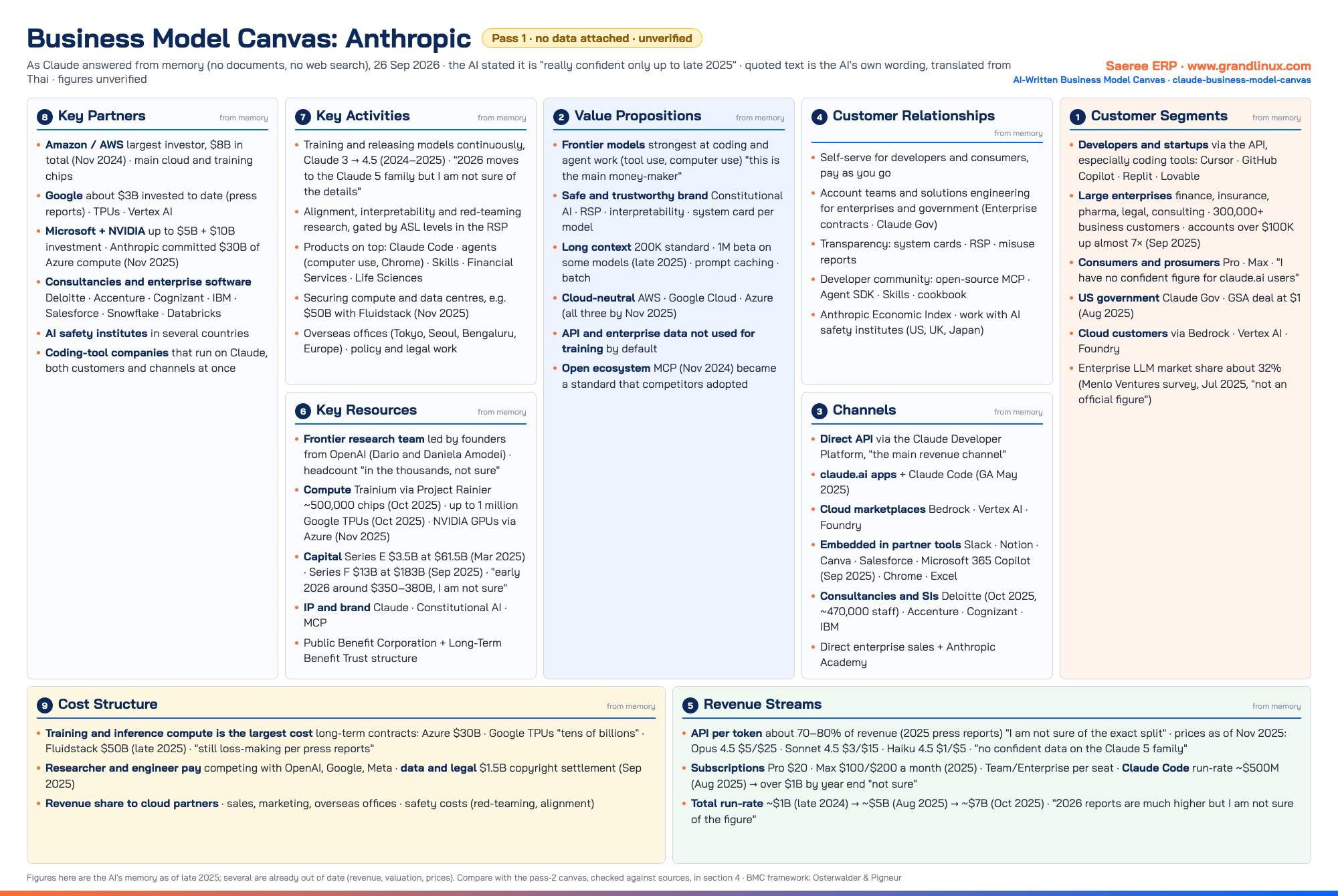
The pass-1 BMC as the AI answered from memory, unverified. We laid it out in the nine blocks keeping the AI's figures and its "not sure" notes as written (translated from Thai). Click the image to open it at full size. The table that follows compares the figures in this image with the latest data.
| Item | AI, pass 1 (from memory) | Latest data as of 26 Sep 2026 | Gap |
|---|---|---|---|
| Run-rate revenue (latest month × 12) | About $7B (Oct 2025), adding "2026 reports are much higher but I am not sure of the figure" | $65B at end of July 2026 [3], expected to pass $100B within 2026 [4] | About 9× |
| Valuation | $183B (Series F, Sep 2025) and "early 2026 around $350–380B, not sure" | $965B after the Series H round, May 2026 [2] | About 5× |
| Claude Code | Run-rate about $500M (Aug 2025), over $1B by year end, "not sure" | Over $2.5B (Feb 2026) [1] | 2.5× the later figure |
| API prices | 4.5-generation prices (Opus 4.5 $5/$25, Sonnet 4.5 $3/$15) and "no data on the Claude 5 family" | Fable 5.1 $10/$50 · Opus 5.5 $4/$20 · Sonnet 5 $2/$10 per million tokens [10] | Whole generation changed |
| Business customers | 300,000+ (Sep–Oct 2025) | Still the latest figure Anthropic has published [5], plus 100,000+ organisations on Amazon Bedrock [7] | Matches |
| Compute | Up to 1 million TPUs, Project Rainier ~500,000 chips (Oct 2025) | Correct, but missed the new deals: 5 GW with Amazon and 5 GW with Google/Broadcom (Apr–May 2026) [2][6][7] | New deals missing |
| IPO | Not mentioned at all | Confidential filing made, listing expected late 2026 [3][4] | Whole topic missing |
GW = gigawatt, the power capacity of a data centre · TPU = Tensor Processing Unit, Google's AI chip · IPO = Initial Public Offering · numbers in [n] point to the references at the end
To its credit, the AI did not make things up. Every number carried a date, and the ones it was unsure of were marked unsure. The "what to verify" table at the end had 10 rows and pointed correctly at every figure that really was out of date. But a reader who skips the first line gets a BMC that looks complete while its headline numbers are off by 5 to 9 times.
Worth remembering: a number the AI "remembers" from old news looks more trustworthy than a guess, because it comes with a date and a source. That is the real risk when analysing a fast-moving company. The date is a warning to go and find the new figure, not a stamp of approval.
4. Pass 2, 15 documents attached: a BMC where every line can be traced
The second pass changed the whole result. Every line with a number carried an [n] pointing back to an attached document. Where the AI gave its own opinion, it wrote "(interpretation)" next to it, without being told to. And it did three things we did not expect.
- It flagged that the $65B and $100B run-rate figures were "media citing sources, not official announcements", and recommended waiting for the S-1 (the registration document a company files before listing on a US exchange) before treating them as confirmed.
- It warned that every compute figure is an "up to" figure from an agreement, not installed capacity in use.
- It separated the "about 80% of revenue from API" share as a third-party estimate, not an Anthropic figure.
The "what a human must verify" table grew from 10 rows to 15. That sounds worse but is actually better, because each row is more specific. "The figures may be old" became "check the revenue-share terms with the cloud providers" or "separate the investment announced as 'up to' from what has actually been paid in". Those are the questions analysts ask.
Below is Anthropic's BMC from pass 2, after we checked it against the sources. We removed the items the AI had marked as "prior knowledge" and kept only what could be confirmed against a document. The image shows the canvas in the standard nine-block layout; the table that follows has the same content with reference numbers.
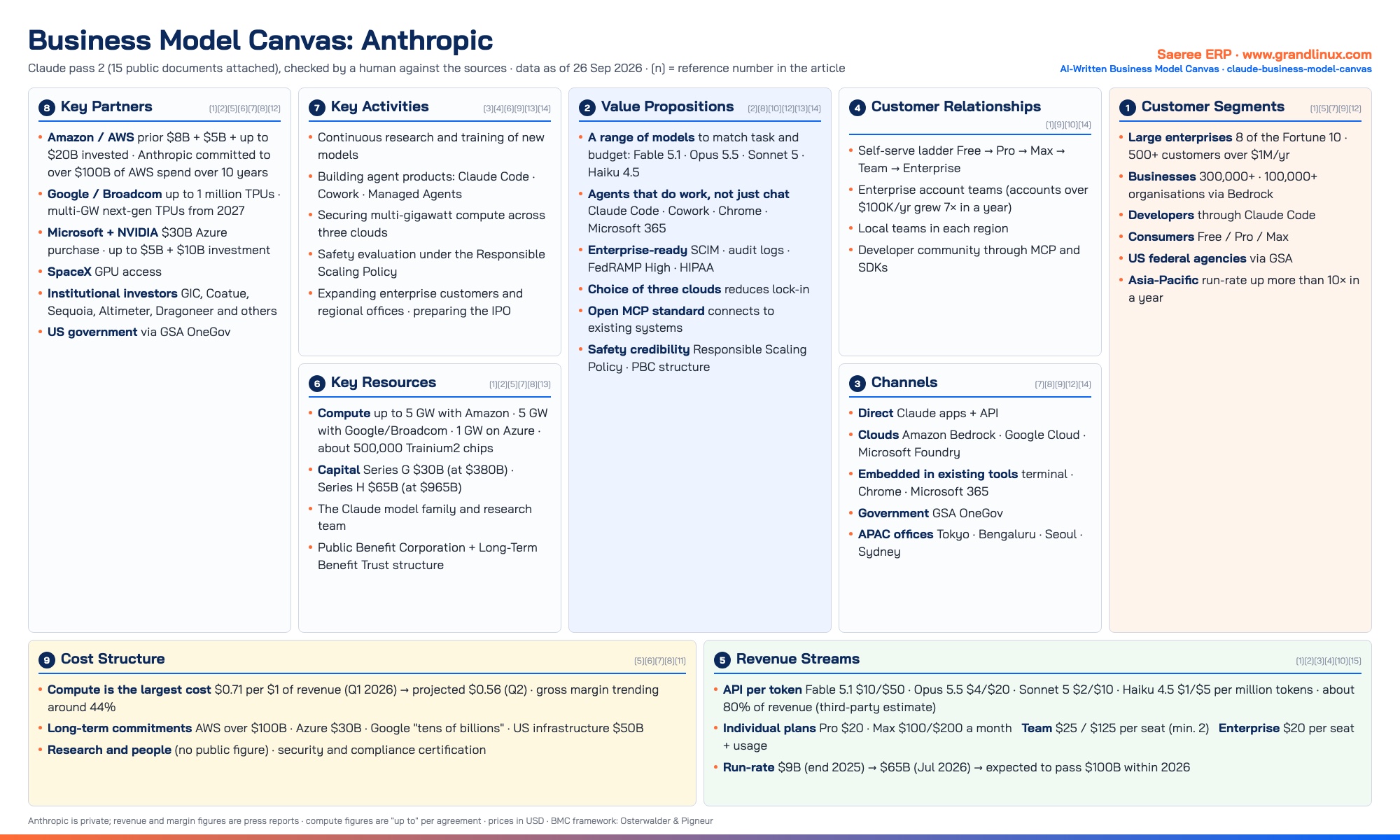
Anthropic's Business Model Canvas from pass 2, checked against the sources. Click the image to open it at full size (2000 px). The [n] numbers in each block are the references at the end of this article.
| Block | Anthropic's Business Model Canvas (as of 26 Sep 2026) | Sources |
|---|---|---|
| Customer Segments | Large enterprises (8 of the Fortune 10 are customers · 500+ customers spending over $1M a year) · 300,000+ businesses · developers through Claude Code · consumers on Free/Pro/Max · US federal agencies through the GSA (General Services Administration) · Asia-Pacific, where run-rate grew more than 10× in a year | [1][5][7][9][12] |
| Value Propositions | A range of models to match task and budget (Fable 5.1, Opus 5.5, Sonnet 5, Haiku 4.5) · agents that do work, not just chat (Claude Code, Cowork, Chrome, Microsoft 365) · enterprise-ready (SCIM, audit logs, FedRAMP High, HIPAA) · choice of three clouds, reducing lock-in · the open MCP (Model Context Protocol) standard · safety credibility through the Responsible Scaling Policy and the Public Benefit Corporation structure | [2][8][10][12][13][14] |
| Channels | Direct through the apps and the API · Amazon Bedrock, Google Cloud, Microsoft Foundry · embedded in tools people already use (terminal, Chrome, Microsoft 365) · government through GSA OneGov · four Asia-Pacific offices (Tokyo, Bengaluru, Seoul, Sydney) | [7][8][9][12][14] |
| Customer Relationships | Self-serve ladder Free → Pro → Max → Team → Enterprise · enterprise account teams (accounts spending over $100K a year grew 7× in a year) · local teams in each region · developer community through MCP and SDKs | [1][9][10][14] |
| Revenue Streams | API billed per token (Fable 5.1 $10/$50 · Opus 5.5 $4/$20 · Sonnet 5 $2/$10 · Haiku 4.5 $1/$5 per million tokens), estimated by a third party at about 80% of revenue · individual plans Pro $20 and Max $100/$200 a month · Team $25 (Standard) and $125 (Premium) per seat per month, minimum 2 seats · Enterprise $20 per seat per month plus usage at API rates · run-rate $9B at end of 2025 → $65B in July 2026, expected to pass $100B in 2026 | [1][2][3][4][10][15] |
| Key Resources | Compute: up to 5 GW with Amazon · 5 GW with Google/Broadcom · 1 GW on Azure · up to 1 million TPUs · about 500,000 Trainium2 chips · Capital: Series G $30B (at $380B) and Series H $65B (at $965B) · the Claude model family and research team · the Public Benefit Corporation plus Long-Term Benefit Trust structure | [1][2][5][7][8][13] |
| Key Activities | Continuous research and training of new models · building agent products · securing multi-gigawatt compute across three clouds · safety evaluation under the Responsible Scaling Policy · expanding enterprise customers and regional offices · preparing for the IPO | [3][4][6][9][13][14] |
| Key Partnerships | Amazon (prior $8B + $5B + up to $20B invested · Anthropic committed to spend over $100B on AWS over 10 years) · Google/Broadcom (TPUs) · Microsoft + NVIDIA ($30B Azure purchase · up to $5B + $10B investment) · SpaceX (GPU access) · institutional investors GIC, Coatue, Sequoia, Altimeter and others · GSA | [1][2][5][6][7][8][12] |
| Cost Structure | Compute is the largest cost: $0.71 spent per $1 of revenue in Q1 2026, projected $0.56 in Q2 · gross margin trending around 44% · long-term commitments: AWS over $100B · Azure $30B · Google "tens of billions" · US infrastructure $50B · research and people (no public figure) · security and compliance certification | [5][6][7][8][11] |
SCIM = System for Cross-domain Identity Management (automated user provisioning) · FedRAMP = the US federal cloud security authorisation programme · HIPAA = the US health data privacy law · run-rate = the latest month's revenue multiplied by 12, not actual full-year revenue
Read as strategy, the table shows one picture. Anthropic sells to enterprises through every channel enterprises already buy from, the three big clouds, the tools already in use, and the government channel, and then commits that revenue to multi-year compute contracts in advance. The revenue block and the cost block grow together. That is why the analysis in [11] calls gross margin "the most important number" for the company, and it is the number the official S-1 will finally reveal once it is public.
What this test cost: collecting the 15 sources took about an hour, running the two passes about 15 minutes, and checking the output about another hour. Done entirely by hand, work at this level takes days. The time saved is in the "sort into the frame" step. The "find sources" and "check" steps still take as long as they always did, and they are still human work.
5. Four things AI still cannot do for you, even with all the data attached
| Task | AI can do | A person must do |
|---|---|---|
| Sort facts into the nine blocks | Well, fast, complete | Check nothing important to your business is missing |
| Cite sources and separate fact from interpretation | Yes, when the rules say so clearly | Check the attached documents are right in the first place. AI cannot tell a document is wrong |
| Decide what matters most in each block | Partly, but tends to include everything it finds | Cut to the three points an executive really needs |
| Interpret the strategy, the "why" | Can propose, and labels it as interpretation | Decide, and own the consequences |
| Context specific to you, such as how to buy in Thailand | Not in the documents, so it does not know | Add it yourself |
The last row matters most for Thai readers. Nothing in Anthropic's nine blocks tells a Thai organisation how to buy Claude with a tax invoice, handle VAT under form Por.Por.36, or run the procurement paperwork, because that is a channel question in each country, not part of the parent company's business model. If you need that, we cover it in buying direct from Anthropic versus through a supplier in Thailand and in our Team and Enterprise plan FAQ.
About the data you attach: this test used public information only, so it could run in any account. If you build a BMC for your own company from real internal reports, use a Team, Enterprise or API plan, where Anthropic's commercial terms state your data is not used to train models, and set the data retention period to your organisation's policy. Do not attach internal reports to an employee's personal account.
6. Running it on your own company: five steps, and where ERP comes in
- Collect real data before you open the chat. At least five of the nine blocks already live in your systems. Customer segments and channels are in revenue reports by customer or department. Revenue streams are in the general ledger. Cost structure is in cost-centre reports. Key partners are the largest suppliers in your procurement system. Key resources are your headcount and budget. Export them to Excel or PDF and date every file.
- Use the prompt from section 2. Change the company name and attach your files in place of our 15 documents. How to attach files and the limits of each file type are covered in using Claude to read Excel, CSV and PDF files.
- Give the whole team the same document set through Claude Projects, so that sales, finance and management get a BMC from one data set instead of each attaching their own.
- Executives read the "what to verify" table before the BMC. That table is the homework list the AI prepared. An executive who signs off on the BMC without reading it is accepting numbers nobody has checked. We wrote about the executive's role with system data in ERP succeeds or fails at the top.
- Repeat every quarter. Keep the old version to compare. A block that changes is a signal the business is moving.
Next in the series: we take this BMC forward into a SWOT and a TOWS Matrix with the same method, in How far can AI go on SWOT and a TOWS Matrix?
From our own work: Saeree ERP customers can export reports from the accounting, budget, procurement and inventory modules to Excel or PDF and attach them to Claude following the steps above. For organisations that want Claude to query ERP data directly without exporting files, we connect it over MCP with role-based permissions and a log of every query. The ERP (Enterprise Resource Planning) system remains the source of truth. Claude is the assistant that reads and organises. See the engagement formats at Claude Solutions and the concept in what MCP is.
Conclusion
- AI can write a full nine-block Business Model Canvas in minutes, and the structure was right even in the pass with no data attached.
- Without attached data, the headline numbers stopped at late 2025 and were off by 5 to 9 times, but the AI stated its knowledge limits and its uncertainties clearly.
- With 15 documents attached, every figure pointed back to a source, facts were separated from interpretation, and the AI produced its own list of 15 items for a person to verify.
- The rules that made the difference: require a date and a source on every number, forbid guessing, and make the AI write the verification table.
- What remains human work: finding the right sources, cutting to what matters, making the strategic call, and adding local context such as how to buy in Thailand.
- For your own company, five of the nine blocks already sit in your ERP. Start by exporting dated reports, then use the same prompt.
AI can fill the canvas in ten minutes. The numbers in it belong to whoever attached the data. If nobody did, they belong to the past.
- What we learned from the 26 September 2026 test
References
- [1] Anthropic: Anthropic raises $30B Series G at $380B post-money valuation (12 Feb 2026)
- [2] Anthropic: Anthropic raises $65B Series H at $965B valuation (28 May 2026)
- [3] TechCrunch (citing Bloomberg): Anthropic's annualized revenue surges to $65B (17 Aug 2026)
- [4] Axios (citing The New York Times): Anthropic tops $100 billion revenue pace, report says (18 Sep 2026)
- [5] Anthropic: Expanding our use of Google Cloud TPUs and services (23 Oct 2025)
- [6] Anthropic: Anthropic expands Google and Broadcom compute deal (6 Apr 2026)
- [7] Amazon: Amazon announces $5B Anthropic investment, up to $20B more (20 Apr 2026)
- [8] Microsoft: Microsoft, NVIDIA and Anthropic announce strategic partnerships (18 Nov 2025)
- [9] Anthropic: Seoul becomes third Anthropic office in Asia-Pacific (and Sydney fourth office, 10 Mar 2026) (23 Oct 2025)
- [10] Claude: Pricing page (checked 26 Sep 2026)
- [11] Yahoo Finance: Anthropic's gross margin is the most important number in tech (10 Jun 2026)
- [12] GSA: GSA strikes another OneGov deal with Anthropic (extended to 31 Oct 2026 per Nextgov, Sep 2026) (12 Aug 2025)
- [13] Anthropic: The Long-Term Benefit Trust (Sep 2023)
- [14] Anthropic: Claude Cowork and product pages at claude.com (checked 26 Sep 2026)
- [15] Sacra: Anthropic revenue, valuation & funding (third-party estimate) (2026)
- Strategyzer: The Business Model Canvas (Osterwalder & Pigneur)
Want to run this on your own company with real data?
We supply Claude Team and Enterprise seats with a Thai-baht quotation and tax invoice, from 5 seats, and connect Claude to your ERP data over MCP with role-based permissions.
Get advice / request a quoteTel 02-347-7730 | sale@grandlinux.com