- 26
- September
"How Far Can AI Go on a Customer Value Proposition (CVP)? Part 3 with Anthropic, from Value Proposition Canvas to the Selling Point Customers Pay For" — the short answer is as far as "a testable hypothesis about the customer", but not as far as "knowing the customer". Forced to tag its sources, Claude admitted that only 12 of 36 customer-side items came from real customers and the rest from the vendor's view, and when tested with the HBR customer value proposition framework, only one selling point passed "different, measurable, evidenced" in full. This is part 3 after the Business Model Canvas and SWOT/TOWS: a real test on Anthropic with 25 documents, results as images and tables, and a method you can run on your own company.
In one line: AI built a Value Proposition Canvas for Anthropic's three customer segments and self-tagged the 36 customer-side items as 12 from real customers, 22 from the vendor's view and 2 from prior knowledge. Tested with the HBR CVP framework, only one selling point passed in full: code quality. The AI also produced 39 questions to ask real customers.
Before you read: This is part 3, following the Business Model Canvas and SWOT and TOWS. The test ran on 26 September 2026 with Claude (the Claude Fable 5.1 model, through Claude Code), web search off, answering only from 25 attached documents. Customer-value work contains opinion by nature; we kept the source tag on every item exactly as the AI stated it. Outcome figures for Anthropic's customers come from the vendor's own customer-story page with no stated method. Prices are in US dollars, not converted to baht. And as in the first two parts: our company sells and supplies Claude to Thai organisations, but this article uses public information only. The prompts were run in Thai; the versions shown here are translations.
Last time the AI picked three strategies for Anthropic, and all three rested on one assumption: "customers pay for quality". This part tests that assumption from the customer's side, with the tool consultants use to answer "why do customers actually buy?", the Customer Value Proposition (CVP). It is also the part where the AI meets its biggest limitation: it has never talked to a customer.
1. What a Customer Value Proposition is, and why it is the hardest exam for AI
We chained two tools. The first is the Value Proposition Canvas (VPC) by Osterwalder and colleagues (2014), a zoom into the "value propositions" block of the Business Model Canvas from part 1. It has two sides. The customer side is the jobs customers are trying to get done, the pains along the way, and the gains they want. The offer side is products, pain relievers and gain creators. When the two sides match, that is "fit"; a pain with nothing to relieve it is a gap.
The second is the Customer Value Proposition framework by Anderson, Narus and van Rossum in Harvard Business Review (2006), which says there are three kinds of value proposition and only one of them works.
| Type | Answers | Weakness | What you need to write it |
|---|---|---|---|
| All benefits | What can we offer the customer? | Long, and no different from rivals | Knowledge of your own product |
| Favorable points of difference | Where are we different from the next-best alternative? | Different, but the customer may not care | Knowledge of your product and the rivals' |
| Resonating focus | Which one or two differences matter most to the customer, and can be proven? | The hardest to write | Knowledge of your product, the rivals', and a real understanding of the customer, with evidence the customer can check |
The last line of that table is why this part is the hard exam. Parts 1 and 2 could be done from public documents because they are about the company. The customer side of a VPC has to come from customers, and public documents contain almost none of that. What they contain is the customer-story page the vendor chose to publish. So our question was not only "can the AI do it?" but "does the AI know it is looking at the customer through the vendor's eyes?"
The rule for this part: force the AI to tag the source of every customer-side item as real customer, vendor's or analyst's view, or prior knowledge, and to attach the questions that must be asked of real customers. Without those two, an AI-written VPC reads as if it all came from customers, when it did not.
Using Claude at work? Get a quote in Thai Baht with a full tax invoice
Our procurement service starts at 5 seats · fewer than that? buy direct from Anthropic · Enterprise: talk to our team
2. The method: build the Value Proposition Canvas first, then examine it with the HBR framework
Two steps, as before. Step one built a VPC for the three customer segments from the part-1 BMC: A, large enterprises in regulated industries; B, software engineering teams; C, everyday office staff. Step two examined that VPC with the HBR framework against the next-best alternative each segment would consider. The 25 attached documents were the 21 from part 2 plus four this job needs: the section of the Menlo Ventures report on why enterprises choose a vendor, Anthropic's customer-story page, the Anthropic Economic Index reports on what people actually do with Claude, and a summary of the part-2 SWOT/TOWS.
You are a business strategy consultant. Build Anthropic's (the developer of Claude)
Customer Value Proposition with a Value Proposition Canvas from the attached
documents, for three customer segments:
A. Large enterprises in regulated industries (finance, health, government)
B. Software engineering teams and developers
C. Everyday office staff in organisations (documents, analysis, workflows)

Rules
1. Plain working language, no preamble.
2. Two sides per segment. Customer side: jobs to be done · pains · gains.
   Offer side: products and services · pain relievers · gain creators.
   3–4 items each, coded A-J1, A-P1, A-G1, A-PR1, A-GC1 ...
3. Every offer-side item must cite [n]. Every customer-side item must state its
   source as one of: (a) evidence from a real customer in document [n],
   (b) inferred from what the vendor or press say [n], (c) prior knowledge,
   may be out of date.
4. State the "fit" per segment: which pains or gains have nothing addressing
   them (gaps), and which offers match no pain or gain at all.
5. Do not guess numbers.
6. End with a table "What must be confirmed with real customers", listing which
   customer-side items come from the vendor's view and what question to ask.
7. No web search.
The second prompt attached the full VPC plus the same documents and asked for three layers per segment: points of parity (what rivals also have), points of difference (with evidence) and resonating focus (the one or two items the customer would weigh most), every item cited and tagged fact or interpretation. Three rules were added. Every resonating focus must state the evidence present, the evidence missing and "what must hold first". It must connect back to the part-2 TOWS and say whether the "pay for quality" assumption behind WT1 and ST1 is supported or challenged. And it must write one value proposition statement per segment in the form "For [customer] who [job or problem], Claude is the [category] that [key difference] because [evidence]", marking which parts of the sentence are interpretation. How to write rules like these is in our guide to writing prompts for Claude.
The two steps took about 15 minutes in total and returned roughly 14,000 and 17,000 characters in Thai, the longest of the three parts, because half of it is tables of questions for customers.
3. Step 1 result: of 36 customer-side items, the AI admitted only 12 came from real customers
Here is the VPC in the standard Strategyzer layout, one canvas per segment. The square on the left is the offer side, the circle on the right is the customer side, and the arrow in the middle asks whether the two sides match. The green "real customer", yellow "vendor's view" and red "prior knowledge" tags were applied by the AI itself under rule 3, and the yellow badge on each image counts them for that segment. Click any image for full size.
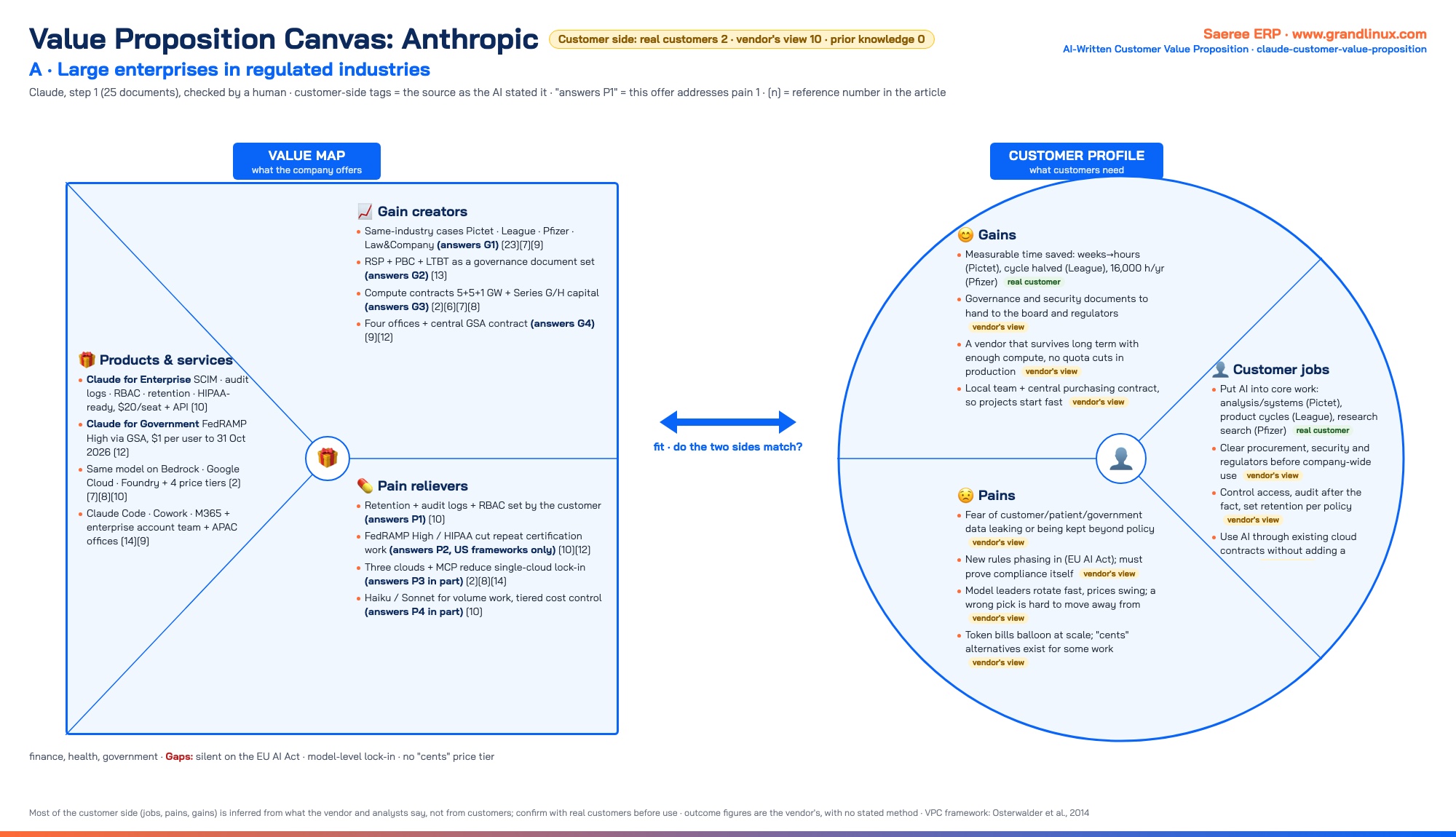
Segment A, large enterprises in regulated industries: only 2 of 12 customer-side items come from real customers, the fewest of the three.
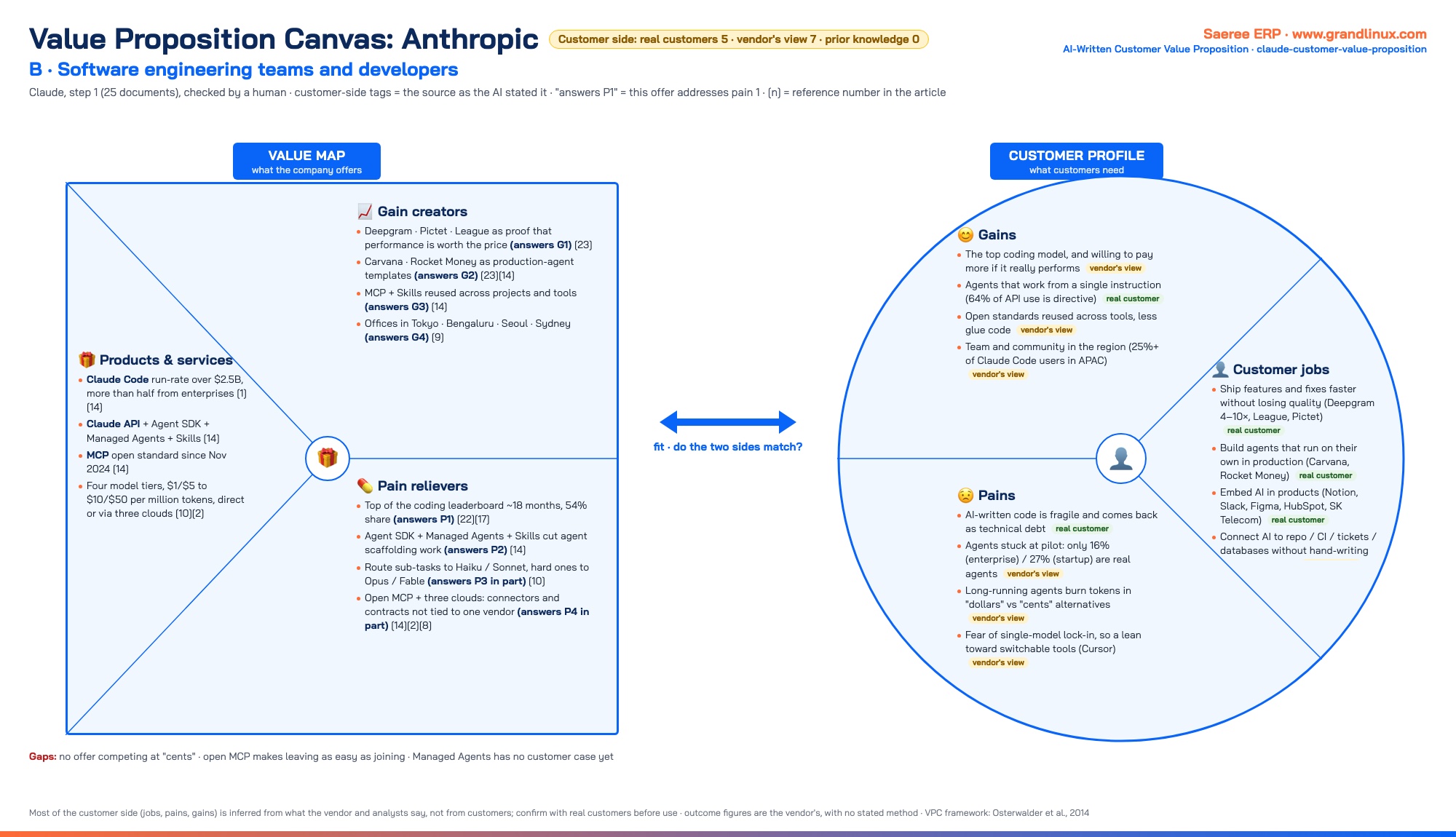
Segment B, software engineering teams: the most real-customer evidence, 5 of 12 items.
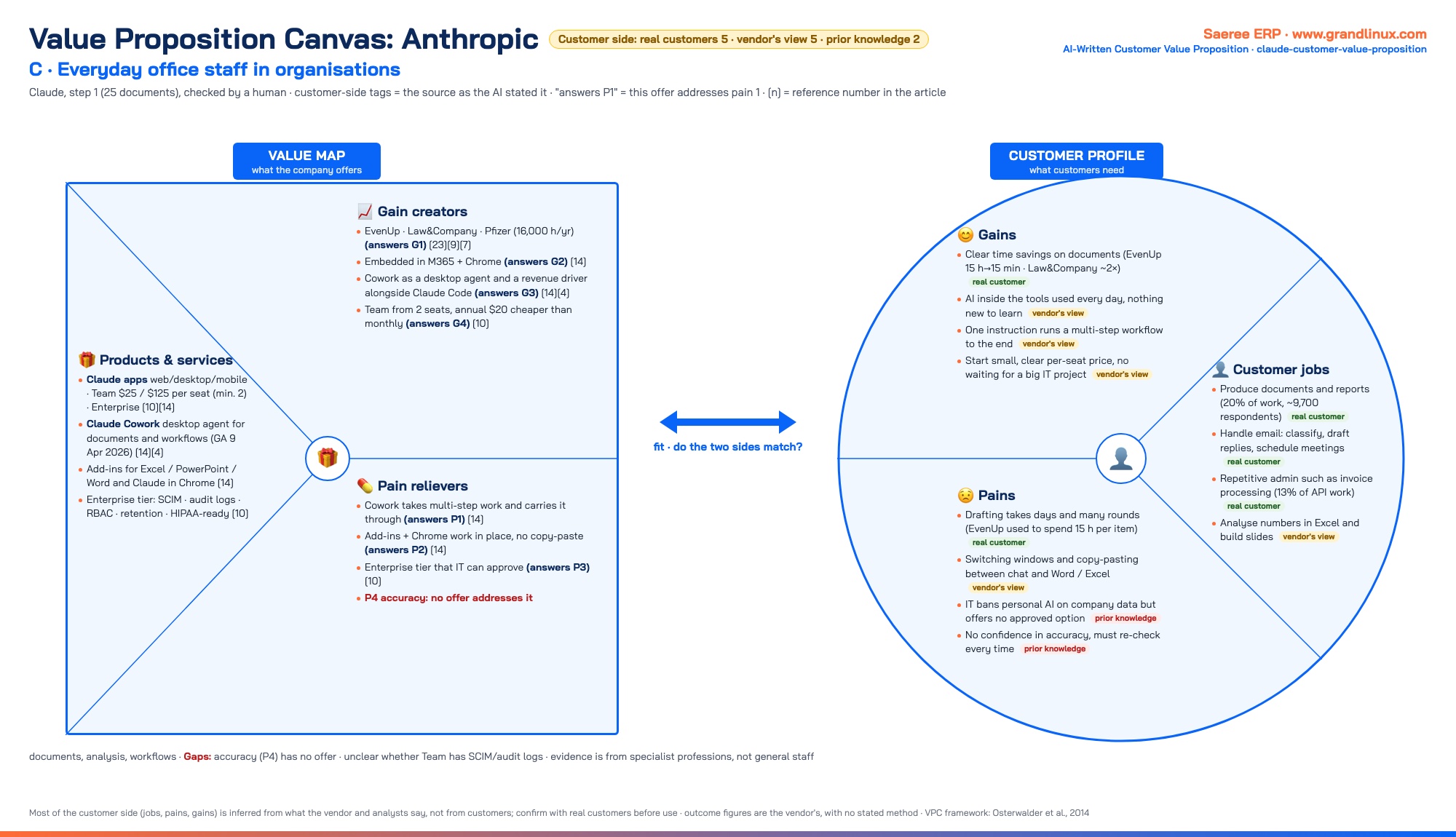
Segment C, everyday office staff: the accuracy pain (P4) has no offer addressing it, and the AI left that slot visibly empty.
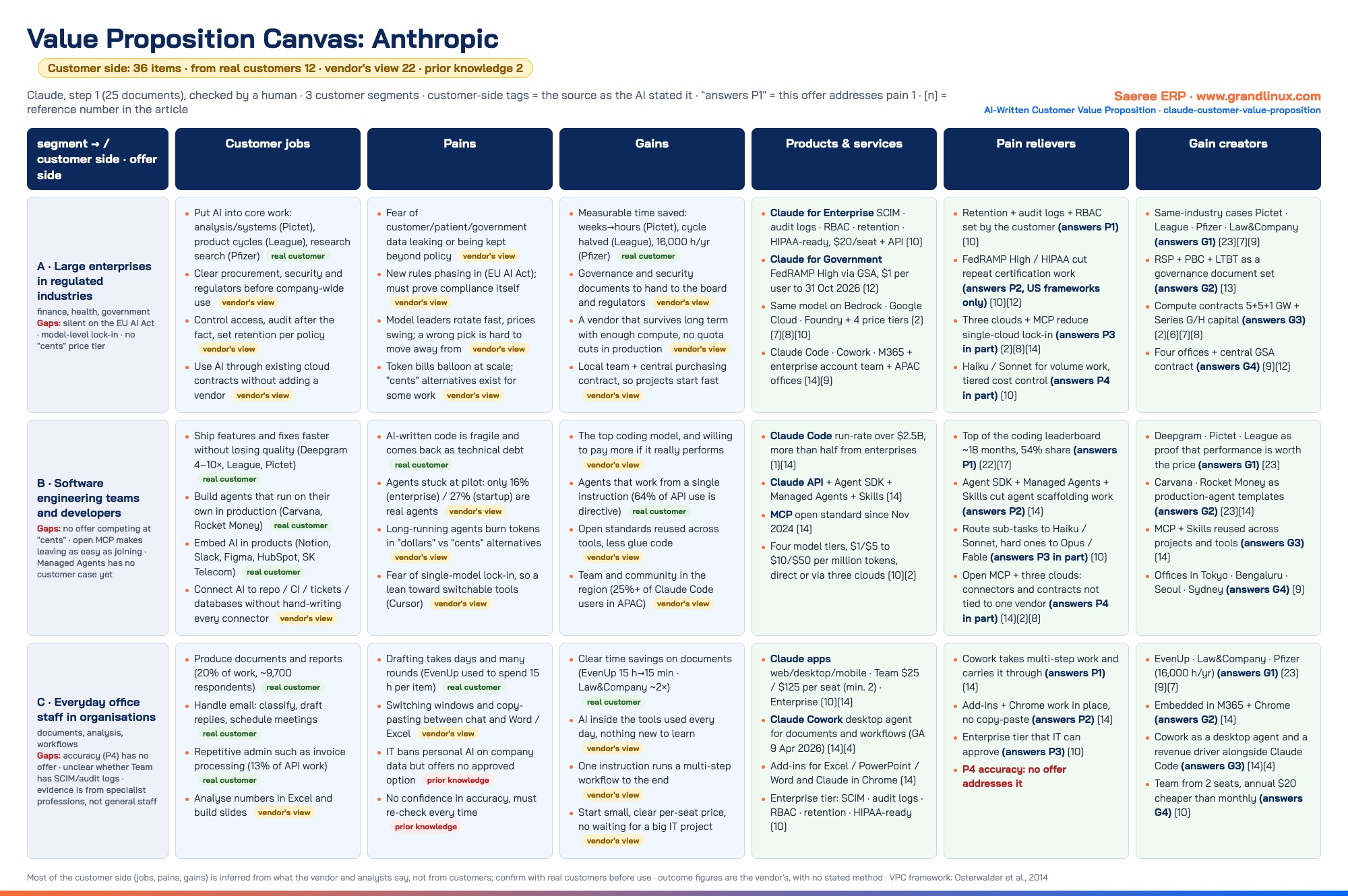
The table version comparing all three segments on one page. Red text in the row headers is the gaps the AI found. The customer-side tags are the AI's; we did not change them.
Three things worth noticing.
- Two thirds of the customer side is the vendor's view. Of 36 customer-side items, the AI tagged 12 as coming from real customers, 22 as inferred from what the vendor, partners or analysts say, and 2 as prior knowledge. Notably segment A, the one with the largest contracts, has the least real-customer evidence, 2 of 12, because the customer stories the vendor publishes talk about outcomes, not about the pain of procurement.
- The AI found the gaps the vendor does not talk about. For segment A the offers in the documents cover only US frameworks (FedRAMP, HIPAA) and are silent on the EU AI Act even though it is already in force. For segment B there is no offer competing at the "cents" price level. For segment C the pain "no confidence in accuracy, must re-check" has no offer addressing it at all, and the time-saved evidence comes from specialist professions such as law and pharma, not general office staff.
- The AI also pointed out what customers may not want. Being on all three clouds, a major strength in part 2, may not matter at all to a dev team buying Claude Code by the seat, the AI said. The $1 deal applies only to US federal agencies. And the Public Benefit Corporation governance the vendor is proud of has no evidence in the documents of being used as a purchasing criterion.
| Segment | Gaps the AI found (pains with no reliever) | Offers that may not fit this segment | Example question the AI wrote for customers |
|---|---|---|---|
| A regulated enterprises | Silent on the EU AI Act · three clouds fix cloud lock-in but not model lock-in · no "cents" price tier · the vendor's compute burden may be read as future price risk | The $1 deal is US federal only · LTBT/RSP governance is entirely the vendor's view | "Have documents like the RSP or the LTBT structure ever been requested in a real procurement, or only glanced at?" |
| B engineering teams | No offer competing at "cents" · open MCP makes leaving as easy as joining · Managed Agents is an announcement with no customer case | Three clouds: teams buying Claude Code by the seat may not care · unclear what Team Premium adds over Standard | "If another model catches up almost entirely but is much cheaper, would you move? How big a gap is worth paying for?" |
| C office staff | Accuracy of output has no offer · unclear whether the Team plan has SCIM/audit logs for IT approval · evidence from specialist professions | API pricing and Claude Code: office staff neither buy nor use them | "The last time the AI was wrong, what did it affect, and how long did re-checking take per item?" |
The full "what must be confirmed with real customers" table has 24 questions and is in the raw output we kept on file · SCIM = automated user provisioning standard · LTBT = Long-Term Benefit Trust · RSP = Responsible Scaling Policy
The trap to watch most in this work: without forced source tags, an AI-written VPC reads like it came from 30 customer interviews when it came from the vendor's brochure and the news. The 22 "vendor's view" tags are a list of interviews not yet done, not facts.
4. Step 2 result: only one selling point passes "different, measurable, evidenced" in full
Step two was the exam. The AI worked through all three segments with the HBR framework and concluded on its own that only one Anthropic value proposition meets all three resonating-focus tests, different from the next-best alternative, measurable and evidenced: code quality for segment B. And even that one has a problem with the age of its evidence.
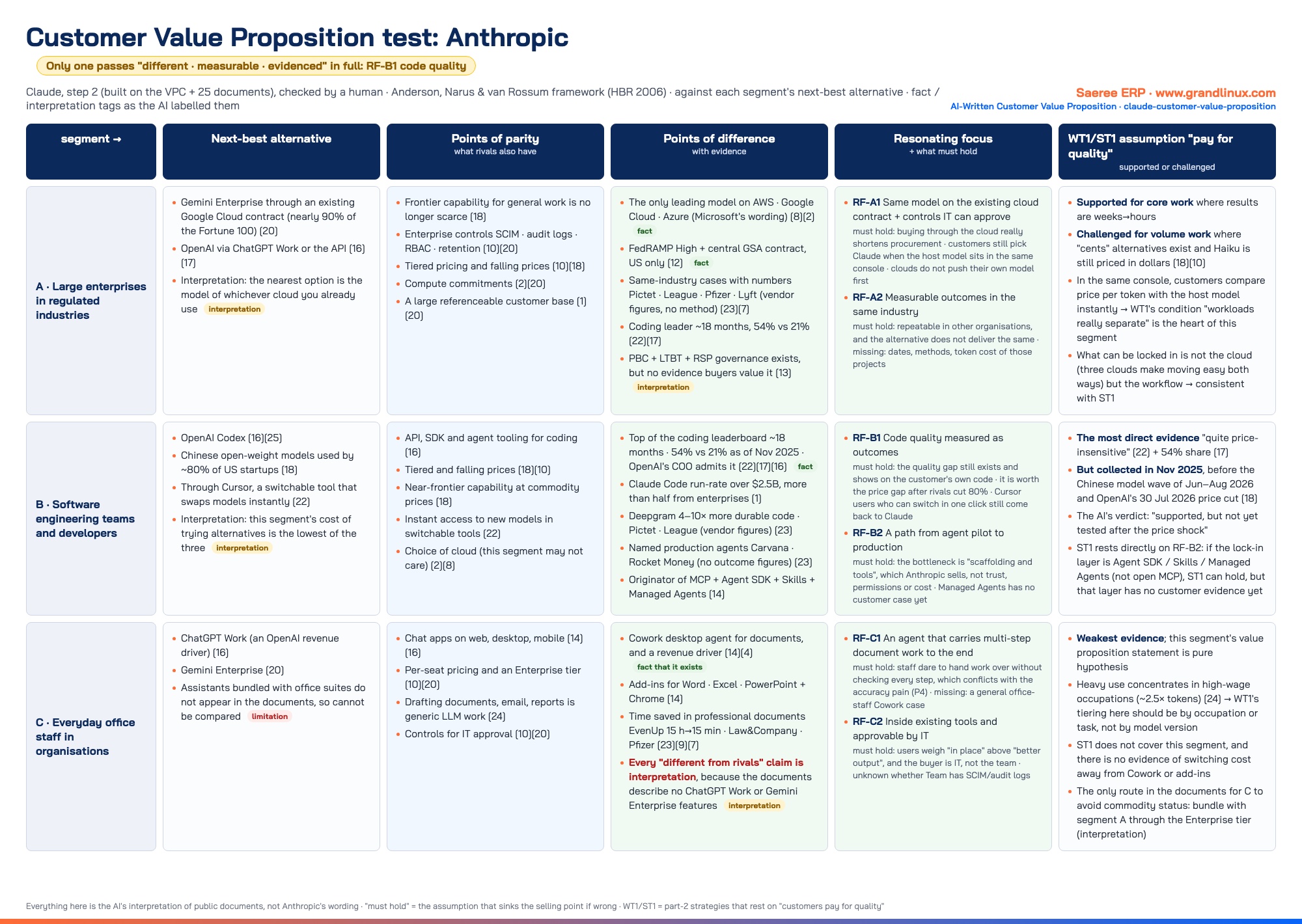
The CVP test from step 2, checked against the sources. The right-hand column is the AI's verdict on the part-2 assumption that "customers pay for quality". Click the image for full size.
| Segment | Next-best alternative the AI compared | Resonating focus | Evidence still missing (the AI's words) | Verdict on "pay for quality" |
|---|---|---|---|---|
| A | Gemini Enterprise through the existing Google Cloud contract · OpenAI | Same model on the existing cloud contract plus controls IT can approve · measurable outcomes in the same industry | No customer says "we chose it because it is on the cloud we use" · outcome figures have no dates, methods or token costs | Supported only for core work with weeks-to-hours results; challenged for volume work with "cents" alternatives. WT1's condition "workloads really separate" is the heart of it |
| B | OpenAI Codex · Chinese open-weight models, via Cursor which swaps models instantly | Code quality measured as outcomes · a path from agent pilot to production | Share and price sensitivity after July 2026 · total cost per piece of work including rework · Managed Agents has no customer case yet | The most direct evidence, but collected in November 2025 before the price shock: "supported, but not yet tested after the price shock" |
| C | ChatGPT Work · Gemini Enterprise (assistants bundled with office suites are not in the documents, so cannot be compared) | An agent that carries multi-step document work to the end · inside existing tools and approvable by IT | A general office-staff Cowork case · time saved by Cowork directly · rival features | Weakest evidence; the statement is pure hypothesis. Heavy use concentrates in high-wage occupations, so tiering should be by task, not by model version |
The value proposition statement the AI wrote for segment B, the one that passed, reads: "For engineering teams that must ship code faster without losing quality and take agents from pilot to production, Claude is the model and agent-tooling platform for coding that delivers measurably higher code quality than the next-best alternative, because it has sat at the top of the coding leaderboard for almost 18 months, holds 54% of enterprise coding versus 21%, and customers such as Deepgram get code that is 4 to 10 times more durable." Then the AI added at once that "measurably" rests on vendor figures and "higher than the next-best alternative" rests on November 2025 data.
Two things the AI did beyond the instructions, and the two that make the result credible
First, for segment C it refused to say how Claude differs from ChatGPT Work or Gemini Enterprise, on the grounds that "the documents contain no rival features", even though the rules asked for points of difference. So it wrote that every difference in this segment is interpretation and that the segment-C statement "is pure hypothesis".
Second, it noticed that the evidence behind the main selling point, a November 2025 survey, was collected before the Chinese model wave of June to August 2026 and before rivals cut prices in July, and concluded that "the supporting evidence is older than the threat". Comparing the date of the evidence with the date of the threat is what good analysts do and most people forget.
The "what a human must decide" table in this step has seven issues. We picked the four that part 2 did not already cover.
| Decision | Options | Evidence pointing the way (the AI's words) | Depends on acceptable risk |
|---|---|---|---|
| Which segment first | B, then A, C last; or A first because contracts are larger | B has the strongest evidence · A is where the 500+ accounts over $1M come from · C is weakest | How much concentration in coding you accept; if the price war bites B first, leading with B is a double bet |
| Channel for segment A | Push through Bedrock, Google Cloud, Foundry, or sell direct | Over 100,000 organisations use Bedrock · the channel for enterprise Claude Code revenue is not stated | Whether you let the cloud owner compare Claude with its own model in the same console |
| EU AI Act documentation | Do it before the 2 December 2026 milestone, or wait | A gap the AI found · the documents give no European revenue share | Whether you accept losing European deals in segment A while waiting |
| How open the agent layer is | Open like MCP, or keep Agent SDK / Skills / Managed Agents as the lock-in point | Part-2 ST1 "cuts both ways" · the documents say only MCP is open | Trading ecosystem growth against customers' switching cost |
And the most valuable output of this step is not the statements but the list of questions to ask real customers. Step 1 produced 24, step 2 added 15 that do not overlap, 39 in total. The three sharpest: "In the same console, what do you compare Claude with the cloud's own model on: price, quality or contract terms?", "After rivals cut prices by 80%, did the team re-test, and what work did you move?", and "If ChatGPT Work or Gemini cost the same or less, what would make you choose Claude?"
5. What we learned: AI forms hypotheses about customers very well, but it is not the customer
Across the three parts, the AI got through four stages: sort facts, separate fact from opinion, pair them into options, and now form hypotheses about customers with a way to test them. What it cannot do, and knows it cannot do, is confirm those hypotheses, because the answers sit with customers, not in any document.
- Where AI did better than expected: tagging every item as customer or vendor sourced, finding the gaps the vendor does not mention, refusing to compare with rivals it had no data on, and comparing the date of the evidence with the date of the threat.
- What stays human: taking the 39 questions to at least five real customers, adding internal data such as lost-deal reasons and churn, deciding which segment to lead with, and owning the statement that goes into real selling.
- What to watch for: the prettiest VPC is the one the vendor writes for itself. Count the "vendor's view" tags before reading the content, every time.
6. Running it on your own company: the customer side comes from real data and from asking, not from your own brochure
Most companies write a VPC by having sales and product people guess the customer's pains in a meeting room. The result is the same kind of VPC the AI wrote for Anthropic in step 1: two thirds vendor's view. The fix has two parts: the data that already records customer behaviour in your systems, and asking.
- Pull the signals from your systems first. Customer pain always leaves traces in the ERP (Enterprise Resource Planning) system: receivables that are habitually late, returns or credit requests, deliveries past their date, complaints. What customers want shows in what they buy again and in accounts that raise their orders. Export to Excel or PDF and date every file. That is your first set of "real customer" evidence.
- Have the AI draft the questions, then ask five customers. Run the step-1 prompt with the data from step 1 plus your own product documents. The output will carry many "vendor's view" tags. That is your interview list for customers who bought, customers who stopped, and customers who chose a rival, at least one or two of each.
- Build the VPC a second time from the interview notes. Attach the notes and the tags will flip from "vendor's view" to "real customer" one by one. Any item that will not flip is not yet ready to be used in selling. How to attach files and share one document set across the team is covered in using Claude to read Excel, CSV and PDF files and Claude Projects.
- In step 2, tell the AI who the customer's real next-best alternative is. Not the rival you would like to be compared with, but what customers said in step 2 they compare you with. Often the next-best alternative is "keep doing it the old way" or "do nothing".
- Tie the resonating focus to a number you will watch every quarter. If the selling point is "we deliver on time like nobody else", the number is on-time delivery in your system. If it is "we save the customer time", collect the figure from two or three real customers rather than estimating. On the executive's role in deciding on real data, see ERP succeeds or fails at the top.
From our own work: Saeree ERP customers can export invoice and receivables reports by customer, deliveries and returns from the inventory module, and purchasing history by supplier, to Excel or PDF, and attach them to Claude for the customer side of a VPC following the steps above. For organisations that want Claude to query those numbers from the ERP directly every quarter, we connect it over MCP (Model Context Protocol) with role-based permissions and a log of every query. The ERP remains the source of truth. Claude is the assistant that forms hypotheses and drafts questions. The final answers sit with your customers. See the engagement formats at Claude Solutions and the concept in what MCP is.
Conclusion
- AI built a six-block Value Proposition Canvas for three customer segments and self-tagged the 36 customer-side items: 12 from real customers, the rest from the vendor's view or prior knowledge.
- AI found the gaps the vendor does not mention on its own: silence on the EU AI Act, no "cents" price tier, and no offer addressing accuracy of output.
- Tested with the HBR framework, only one selling point passed "different, measurable, evidenced" in full, code quality, and its evidence is older than the price threat.
- The part-2 assumption "customers pay for quality" is supported for developers, challenged for volume work, and unevidenced for office staff.
- The most valuable thing the AI produced is 39 questions for real customers, not the value proposition statements.
- For your own company, the customer side of a VPC must come from traces in your systems and from interviews; let AI form the hypotheses and draft the questions, not answer for the customer.
AI can write a fluent value proposition in ten minutes, but the most fluent sentences usually come from the vendor's brochure, not from the customer's mouth. What AI can really give you is the list of questions. The answers still have to come from your customers.
- What we learned from the part-3 test, 26 September 2026
References
- [1] Anthropic: Anthropic raises $30B Series G at $380B post-money valuation (12 Feb 2026)
- [2] Anthropic: Anthropic raises $65B Series H at $965B valuation (28 May 2026)
- [3] TechCrunch (citing Bloomberg): Anthropic's annualized revenue surges to $65B (17 Aug 2026)
- [4] Axios (citing The New York Times): Anthropic tops $100 billion revenue pace, report says (18 Sep 2026)
- [5] Anthropic: Expanding our use of Google Cloud TPUs and services (23 Oct 2025)
- [6] Anthropic: Anthropic expands Google and Broadcom compute deal (6 Apr 2026)
- [7] Amazon: Amazon announces $5B Anthropic investment, up to $20B more (20 Apr 2026)
- [8] Microsoft: Microsoft, NVIDIA and Anthropic announce strategic partnerships (18 Nov 2025)
- [9] Anthropic: Seoul becomes third Anthropic office in Asia-Pacific (and Sydney fourth office, 10 Mar 2026) (23 Oct 2025)
- [10] Claude: Pricing page (checked 26 Sep 2026)
- [11] Yahoo Finance: Anthropic's gross margin is the most important number in tech (10 Jun 2026)
- [12] GSA: GSA strikes another OneGov deal with Anthropic (extended to 31 Oct 2026 per Nextgov, Sep 2026) (12 Aug 2025)
- [13] Anthropic: The Long-Term Benefit Trust (Sep 2023)
- [14] Anthropic: Claude Cowork and product pages at claude.com (checked 26 Sep 2026)
- [15] Sacra: Anthropic revenue, valuation & funding (third-party estimate) (2026)
- [16] Yahoo Finance / Quartz (citing Bloomberg): OpenAI annualized revenue tops $40 billion ahead of IPO (14 Aug 2026)
- [17] Menlo Ventures: 2025 — The State of Generative AI in the Enterprise (9 Dec 2025)
- [18] State Street Investment Management: Beyond DeepSeek — China's 2026 model wave and the repricing of the AI stack (21 Sep 2026)
- [19] EU Artificial Intelligence Act: Implementation timeline (updated 31 Aug 2026)
- [20] PYMNTS: Google Cloud rides enterprise AI demand to 82% growth (Alphabet Q2 2026 results) (22 Jul 2026)
- [21] Our part 1: How far can AI go on a Business Model Canvas? — the verified BMC (26 Sep 2026)
- [22] Menlo Ventures (same report as [17]), the section on why enterprises choose a vendor and price sensitivity (9 Dec 2025)
- [23] Claude: Customer stories (Spellbook, EvenUp, Deepgram, Pictet, League, Carvana and others, checked 26 Sep 2026)
- [24] Anthropic Economic Index: Economic primitives (15 Jan 2026) and Cadences (26 Jun 2026)
- [25] Our part 2: How far can AI go on SWOT and a TOWS Matrix? — the WT1/ST1 assumptions (26 Sep 2026)
- Strategyzer: The Value Proposition Canvas (Osterwalder, Pigneur, Bernarda, Smith, 2014)
- Anderson, Narus & van Rossum (2006): Customer Value Propositions in Business Markets, Harvard Business Review
Want a value proposition for your company built from real customer traces in your systems?
We supply Claude Team and Enterprise seats with a Thai-baht quotation and tax invoice, from 5 seats, and connect Claude to receivables, delivery and procurement data in your ERP over MCP with role-based permissions.
Get advice / request a quoteTel 02-347-7730 | sale@grandlinux.com