- 19
- August
"Claude vs OpenAI as of August 2026" — the short answer is neither wins outright any more, but each owns a clear lane. Claude leads where work means understanding a large codebase or a long document without losing the thread; OpenAI leads on low-tier cost, breadth of everyday tasks, and sheer familiarity across a workforce. This piece compares the current line-ups, API pricing, independent benchmarks and agent platforms, and closes with a table matching workload types to vendors.
In one line: As of August 2026, Claude Opus 5 leads the software-engineering benchmarks while GPT-5.6 wins on high-volume cost and ecosystem reach — which is why most enterprises now run both, split by workload.
Where each vendor stands right now
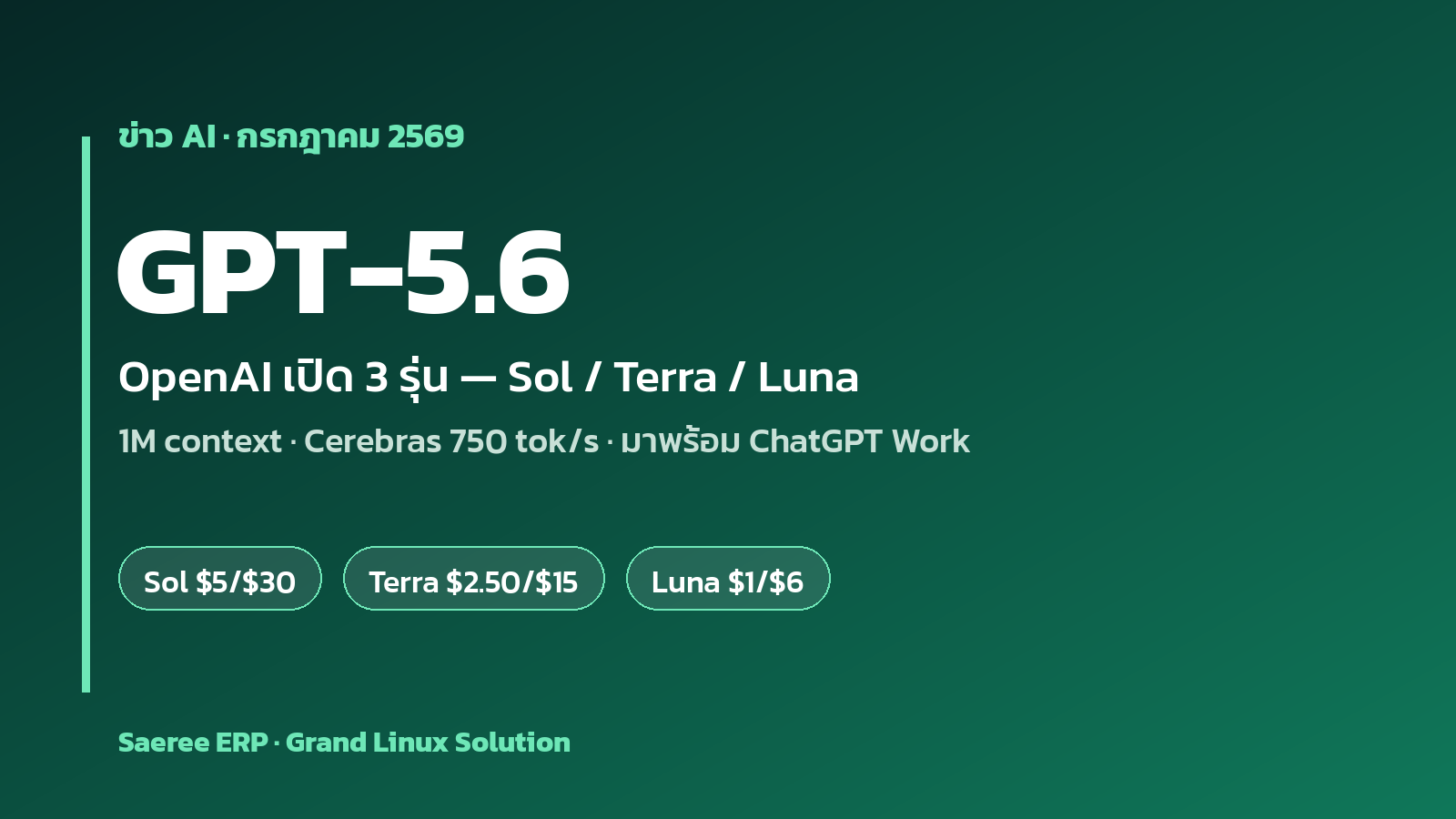
July replaced both vendors' flagships within the same fortnight (full timeline in our July 2026 AI roundup), so this is a comparison of two fresh line-ups rather than new-versus-old.
| Tier | Anthropic (Claude) | OpenAI |
|---|---|---|
| Top end | Claude Fable 5 — most capable, highest priced | GPT-5.6 Sol — OpenAI's flagship |
| Workhorse | Claude Opus 5 (24 July 2026) — 1M context, up to 128K output, five-level effort setting | GPT-5.6 Terra — the balanced everyday tier |
| High-volume / cheap | Claude Sonnet 5 and Haiku | GPT-5.6 Luna |
One thing to hold in mind before reading the price table: this is not only a fight at the top. In production, most organisations spend the bulk of their tokens on the mid and cheap tiers — which is exactly why the 30 July price cuts matter more than a flagship benchmark.
Using Claude at work? Get a quote in Thai Baht with a full tax invoice
Our procurement service starts at 5 seats · fewer than that? buy direct from Anthropic · Enterprise: talk to our team
API pricing, per million tokens
| Model | Input | Output |
|---|---|---|
| Claude Opus 5 | $5 | $25 |
| GPT-5.6 Sol | $5 | $30 |
| GPT-5.6 Terra | $2 | $12 |
| GPT-5.6 Luna | $0.20 | $1.20 |
How to read this: input parity at $5 but a real gap on output ($25 vs $30) — and agentic work is the most output-heavy category there is, because the model writes plans, calls tools and summarises repeatedly. Read-heavy, answer-light work such as contract review lands mostly on the input side instead. Estimate from your own input/output ratio, not from a single headline number.
Benchmarks — who leads where
The figures below are from independent leaderboards as of August 2026, not vendor-published numbers — a distinction worth keeping when reading launch coverage.
| Measure | Result | Leader |
|---|---|---|
| SWE-bench Verified (vals.ai) | Claude Opus 5 at 97.0%, against 88.6% for Opus 4.8 | Claude |
| SWE-bench Pro (harder set) | Claude Opus 5 at 67.7%, ahead of GPT-5.6 Sol at 64.6% | Claude |
| Coding Agent Index (Artificial Analysis) | GPT-5.6 Sol tops the index at 80 | OpenAI |
| Frontier-Bench | Claude Opus 5 at 43.3%, beating both Fable 5 and GPT-5.6 Sol | Claude |
| Intelligence Index (Artificial Analysis) | Claude Opus 5 first among 177 tested models at 63.0% | Claude |
| Maximum context | Both publish 1 million tokens | Tie |
Do not decide on benchmarks alone: notice that Claude leads the suites that measure fixing bugs in real repositories, while OpenAI leads an index that measures acting as an agent. Those are different things. If your actual work is producing many short scripts, neither result may match what your team experiences.
Who is better at what, by workload
Strip out the scores and look at the shape of the work, and the picture sharpens considerably.
| Workload | Usual edge | Why |
|---|---|---|
| Understanding large codebases, multi-file refactors | Claude | The enterprise pitch is consistent recall across the full context window, and it shows on this work |
| Long-document work — contract review, tender analysis | Claude | Same reason; tasks that fail by forgetting a clause mid-document are where the gap is visible |
| High-volume boilerplate code | OpenAI | Faster, and covers a wider range of frameworks without extra setup |
| Very large batch jobs where unit cost dominates | OpenAI | The Luna tier at $0.20 / $1.20 after the 80% cut is hard to beat per item |
| General knowledge and standardised-exam style tasks | Close | Both perform well enough that the difference rarely matters in business use |
| Non-technical staff across a whole organisation | OpenAI | A far broader installed base means lower training cost in practice |
Agent platforms — the sharpest divergence
At the model layer the gap narrows every month. At the "how does this get into real operations" layer, the two vendors have chosen genuinely different philosophies.
- Anthropic ships components you assemble. The Agent SDK is the loop; MCP connects tools and data; Agent Skills package procedural knowledge; Managed Agents provides hosted infrastructure — sandboxed code execution, checkpointing, credential management, scoped permissions and end-to-end tracing; Routines run agents on a schedule or on events such as GitHub webhooks; and Cowork works against local files and desktop applications. Cowork has been available on every paid plan since April 2026 with enterprise controls including role-based access, group spend limits, usage analytics, expanded OpenTelemetry support and per-connector controls.
- OpenAI ships a more finished product. ChatGPT Work is designed so a user states a goal in plain language and the platform works across applications and files until there is a deliverable — a document, deck, spreadsheet or published dashboard.
This distinction matters at selection time, because it is less about capability than about whether your team wants to assemble or wants to adopt. Organisations with engineering capacity and strict permission requirements tend to prefer the first; organisations that want business units productive immediately tend to prefer the second. We go deeper on this in Is Claude Agent self-sufficient, or do you still need n8n?
The enterprise market picture
AI market-share figures deserve caution because every source counts a different denominator. Still, the direction several reports agree on is this: Claude's consumer footprint is clearly the smaller of the two, while in head-to-head enterprise deals Anthropic is reported to win roughly 70%, and to hold around 54% of the enterprise coding market.
The other clear 2026 pattern is that many professional users no longer bet on one vendor at all — they run a multi-platform stack split by task type. That matches what we see with customers, and it is the same conclusion we reached when comparing purely on development work in Claude vs ChatGPT for development teams.
Context that does not appear on any leaderboard
For organisations operating in Thailand, three factors influence the decision more than a few benchmark points.
- Data leaving your perimeter — and the country. Both vendors are cloud services processing outside Thailand. If the inputs contain personal or classified data, filtering and redaction must happen before the call, regardless of which vendor you pick.
- Procurement paperwork. Many Thai organisations need a quotation from a Thai legal entity, a proper tax invoice, and terms that fit public procurement rules. None of this correlates with model quality.
- Existing team skill. The vendor your team already knows usually outperforms the higher-scoring one nobody has used — at least for the first six months.
So which should you choose?
| Situation | Sensible choice |
|---|---|
| Software team working in a large legacy codebase | Claude as the primary — long-context consistency is the difference you feel daily |
| Contracts, tenders, regulations — long and unforgiving | Claude as the primary, with mandatory human review on anything binding |
| High-volume work where unit cost beats depth | OpenAI, Luna or Terra tier |
| Non-technical departments who must self-serve | OpenAI — user familiarity is a real, measurable saving |
| Mid-size and larger organisations with both kinds of work | Run both, split by workload, and review cost-per-job quarterly |
| No central data or permission model yet | Do not choose yet — fix the data layer first, or no vendor will deliver value |
The view from an ERP team
The question we hear most is not "which vendor is smarter" but "will it be able to answer questions about our budget?" — and that depends on your systems, not on the vendor. If budget, reserved, committed and outstanding figures live in several spreadsheet versions, the highest-scoring model on earth still cannot answer reliably.
For Saeree ERP the prerequisite layer already exists — budget, procurement, inventory and accounting in one database, role-based access, and an auditable approval trail. On that base, we build MCP servers connecting Claude to your organisation's systems. We also sell and help organisations source Claude team and enterprise licensing, with quotations issued by a Thai legal entity so the paperwork fits local procurement. See Claude Code in the Team plan for how the seat tiers work.
Conclusion
As of August 2026 the honest answer to "who is better" is it depends on the shape of your work. Claude has the edge when the job means reading something long and not forgetting any of it, or when a codebase is large enough that understanding must precede changing. OpenAI has the edge when the job is to do a great deal cheaply, or to get an entire organisation productive within a week.
What changed since last year is that the capability gap has narrowed enough that it should no longer be the deciding factor. The real deciders have moved to cost-per-job, the readiness of your own data, and your ability to control who can instruct what. None of those can be outsourced to a vendor.
The question "which AI vendor is better" gets harder to answer every month — because the answer has moved off the model and onto how ready your own data is.
- The Saeree ERP team
References
- OpenAI — Advancing the price-performance frontier with GPT-5.6
- Anthropic Newsroom
- BenchLM — Claude Opus 5 benchmarks, pricing & speed (August 2026)
- Codersera — Claude Opus 5 benchmarks explained
- Finout — GPT-5.6 pricing 2026: Sol, Terra and Luna tiers explained
- Help Net Security — Claude Managed Agents
- InfoWorld — OpenAI launches ChatGPT Work
Need Claude licensing for your organisation, with paperwork that fits Thai procurement?
Saeree ERP, by Grand Linux Solution Co., Ltd., sells and helps organisations source Claude team and enterprise licensing — with quotations issued by a Thai legal entity.
See details / request a quoteTel 02-347-7730 | sale@grandlinux.com