- 24
- March
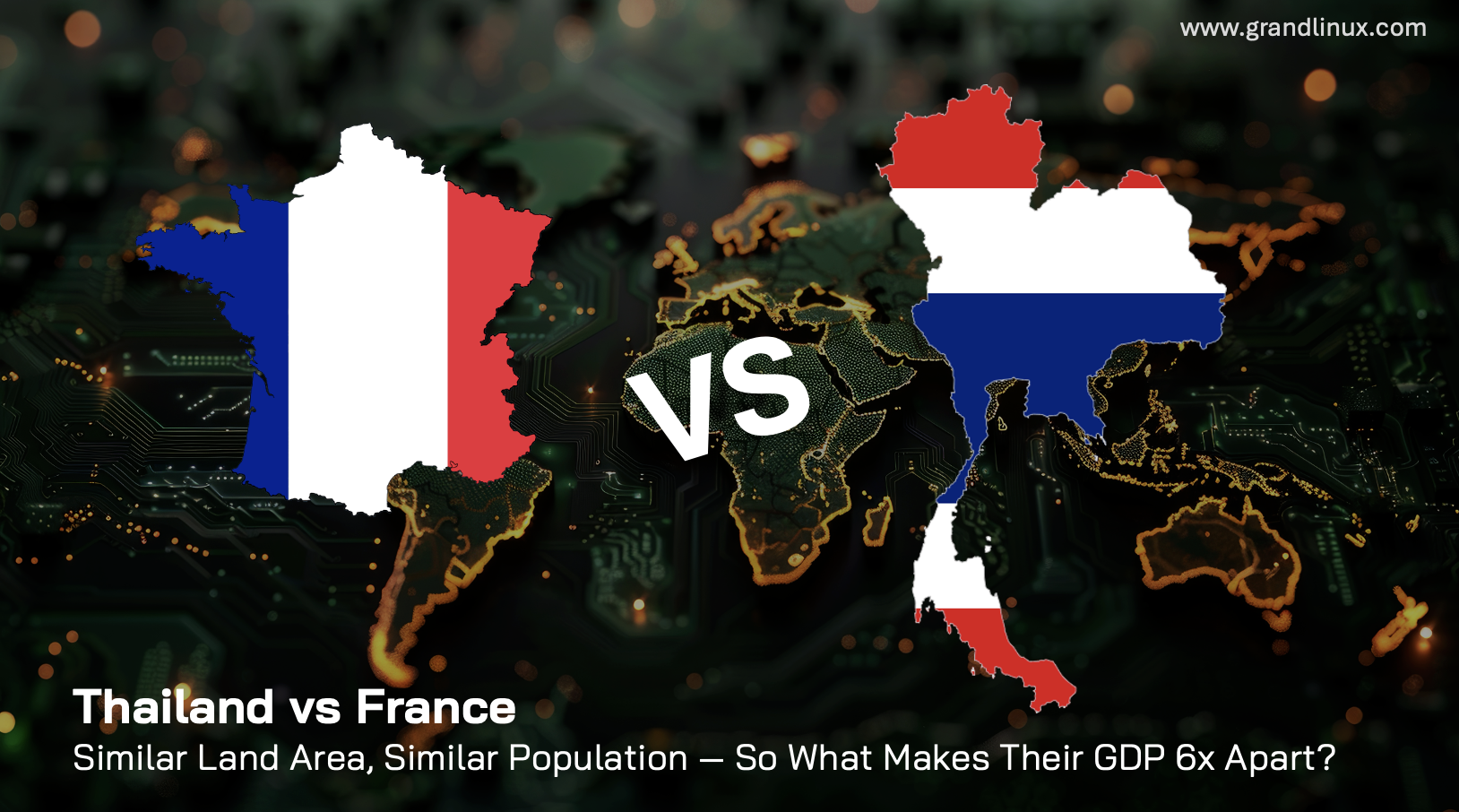
Thailand and France — if you look at a map, their land areas differ by only 7% (Thailand 513,120 km² vs France 551,695 km²) and their populations are similar (Thailand ~72 million vs France ~68 million). Yet France's GDP is $3.1 trillion while Thailand's stands at $520 billion — a 6x gap. The question is: why? And looking at it positively — how much room does Thailand still have to grow?
Key Takeaways
- Land area differs by 7% but GDP differs by 6x — the differentiator is "value-added," not "size"
- France spends $70 billion/year on R&D, Thailand $6 billion — a 12x gap
- Patents: France 7,700/year vs Thailand 860 — a 9x gap
- Thailand isn't inferior: GII rank 36 (better than many wealthier nations), strong fundamentals, no food insecurity, continuous economic growth
- 7 strategies Thailand can pursue: from government procurement, R&D tax credits, startup funds, to AgriTech and Thai ERP
Starting Point: Comparing Equal Fundamentals
| Indicator | Thailand | France | Difference |
|---|---|---|---|
| Land Area | 513,120 km² | 551,695 km² | ~7% |
| Population | ~72 million | ~68 million | Thailand has more |
| Coastline | 3,219 km | 3,427 km | ~6% |
| Arable Land | ~33% | ~34% | Equal |
| Median Age | 40.1 years | 42.0 years | Similar |
| GDP (Nominal) | $520 billion | $3.1 trillion | 6x |
| GDP per Capita | $7,300 | $46,000 | 6.3x |
What do these numbers tell us? Land area, population, and resources are remarkably similar, yet "economic output" differs by several multiples — meaning the differentiating factor isn't "natural resources" or "number of people," but rather "value-added" created through technology, innovation, and systems.
The Real Gap — R&D, Patents, and Innovation
| Indicator | Thailand | France | Difference |
|---|---|---|---|
| R&D Spending (% of GDP) | 1.14% | 2.2% | 2x |
| R&D Spending (Value) | ~$6 billion | ~$70 billion | 12x |
| Researchers per Million | ~1,400 | ~4,900 | 3.5x |
| PCT Patents/Year | ~860 | ~7,700 | 9x |
| Global Innovation Index | Rank 36 | Rank 12 | — |
| Tech Unicorns | ~1 company | ~28 companies | 28x |
| Population with Tertiary Education | ~19% | ~41% | 2.2x |
Data from WIPO, UNESCO, and OECD makes it clear — the biggest gap is in R&D investment. If France invests $70 billion per year while Thailand invests only $6 billion, a 12x difference — it's no surprise that the outcomes (patents, unicorns, value-added) also differ by multiples.
How Did France Get There?
What made France a technology powerhouse isn't "intelligence" or "culture" — it's systems that the government deliberately built over the past 60 years:
1. Defense Industry Creates Civilian Technology
France is the world's 3rd largest arms exporter. With an annual defense budget of $50-55 billion, it has built world-class technology companies:
- Airbus — the world's #1-2 commercial aircraft manufacturer (headquartered in Toulouse)
- Thales — defense electronics and world-class cybersecurity
- Safran — aircraft engines (JV with GE = CFM International)
- Dassault — Rafale fighter jets + 3D design software (Dassault Systemes, valued at $50+ billion)
- Naval Group — submarines and warships exported worldwide
These technologies flow from defense to civilian applications — Airbus defense to Airbus commercial, Thales defense to Thales cybersecurity for banks, Safran fighter engines to Safran commercial engines.
2. Nuclear Energy Creates Energy Independence
France generates ~70% of its electricity from nuclear power (the highest in the world) — through EDF (Electricite de France), a state-owned company. It is a net electricity exporter in Europe, reducing dependency on foreign oil.
3. La French Tech — Building the Startup Ecosystem
- La French Tech (2013): A national brand for French startups + French Tech Visa to attract global talent
- Bpifrance: A public investment bank with $50+ billion in assets, co-investing with private VCs — invested in 90%+ of French unicorns
- Station F: The world's largest startup campus (34,000 m² in Paris) — hosting 1,000+ startups
- R&D Tax Credit (CIR): Companies can deduct R&D expenses as a 30% direct tax credit — automatic, no application needed, self-declaration
Results: From 1 unicorn (2015) to 28 unicorns (2025) — including Mistral AI (LLM competing with OpenAI), Dataiku (AI/ML platform), and Doctolib (Health Tech)
4. Luxury Goods + Culture = Massive Value-Added
An industry often overlooked but enormously profitable — LVMH, Hermes, Kering, L'Oreal — LVMH alone generates more revenue than the GDP of many countries. The interesting point: luxury goods are about "branding," not "resources" — raw materials may not be expensive, but value-added comes from brand and design.
"France isn't rich because it has more resources than Thailand — it's rich because it built 'systems' that convert resources into higher value-added."
Where Does Thailand Stand? — Good News Many Overlook
Before discussing areas for improvement, let's first acknowledge what Thailand already does well:
Thailand's Strengths — Better Than Many Wealthier Countries
- GII Rank 36: Better than many countries with higher GDP — indicating Thailand's "innovation efficiency per GDP" is strong
- No food insecurity: Thailand is a major food exporter (rice, rubber, sugar, seafood) — strong food security
- "Detroit of Asia": ASEAN's largest automotive manufacturing base — BYD, Great Wall, and MG are relocating EV production here
- Major global HDD/SSD producer: Electronics exports of $70-80 billion/year
- BOI attracts investment well: In 2024, approved $30+ billion (an all-time high — mostly data centers + EV)
- Continuous GDP growth: 2.5-2.8% (2024), higher than France's 0.7-1.1%
- EEC (Eastern Economic Corridor): Special economic zone with $45+ billion in infrastructure investment
In simple terms: strong fundamentals, economy moving forward, no shortages — but still a "consumer" of technology, not a "creator".
What's the Real Problem? — 5 Critical Gaps
| Gap | Thailand | France |
|---|---|---|
| 1. Government buys foreign | Government agencies primarily buy SAP, Oracle, Microsoft — money flows out of the country | Government procures from domestic companies — built Dassault, Thales, Safran |
| 2. R&D incentives too complicated | 200-300% R&D tax deduction exists but requires NRCT/NSTDA approval — complex, slow, uncertain | CIR offers 30% immediate tax credit — automatic, no application, self-declaration |
| 3. No large-scale startup fund | DEPA budget ~$50-100 million/year | Bpifrance with $50+ billion in assets — created 28 unicorns |
| 4. Brain drain | Top talent works abroad and doesn't return | French Tech Visa attracts global talent + Grandes Ecoles develop domestic talent |
| 5. Manufacturing without designing | Makes HDDs for Seagate, assembles cars for Toyota — value-added stays with brand owners | Designs + manufactures + sells independently (Airbus, LVMH, Dassault) — value-added stays in-country |
GDP Structure — What Makes the Difference
| Sector | Thailand | France |
|---|---|---|
| Agriculture | 8-9% | 1.7% |
| Industry | 33-35% | 19-20% |
| Services | 57-59% | 79-80% |
France has a services sector share of 80% — because high-tech services (IT consulting, financial services, AI, SaaS, luxury brand management) generate far more value-added than agriculture and manufacturing.
Thailand still has agriculture at 8-9%, which isn't a bad thing — food security is a strength. But if technology is added to the agricultural sector (AgriTech, precision farming, food processing automation), value-added can surge immediately.
7 Strategies — How Thailand Can Build Its Own Technology
1. Government as the "First Customer" for Thai Tech Companies
France used this approach to build Dassault, Thales, and Safran — the government buys from domestic companies, even if slightly more expensive, to create a market that enables those companies to grow and compete globally. China uses the same model with its Xinchuang policy.
What Thailand can do: Set government IT procurement quotas for Thai companies — for example, use Thai ERP systems instead of SAP/Oracle in government agencies, use Thai Cloud services, and use domestically-developed security systems.
2. Make R&D Tax Credits Simple and Automatic
Thailand already has 200-300% R&D tax deductions, but the approval process is extremely complex — requiring NRCT/NSTDA approval, taking a long time, and being uncertain. Many companies simply don't use the benefit.
The French model: CIR is self-declaration — companies can deduct R&D expenses immediately as a 30% tax credit. If the government later audits and rejects the claim, the credit is recouped then. This makes companies more willing to invest in R&D.
3. Create a Bpifrance-Scale Tech Investment Fund
DEPA has a budget of ~$50-100 million/year, while Bpifrance has $50+ billion — a 500x difference. Thailand needs a large-scale public investment fund that co-invests with private VCs, just as Bpifrance does.
4. Focus on Unique Strengths — Don't Compete on Everything
5 Sectors Where Thailand Can Lead
| Sector | Rationale |
|---|---|
| AgriTech | Major food exporter — precision farming, AI for tropical crops, food processing automation |
| Tourism Tech | One of Asia's top destinations — Hospitality SaaS, travel platform |
| Medical/Health Tech | Medical tourism hub ($5+ billion) — Hospital IS, telemedicine for ASEAN |
| EV/Battery Tech | "Detroit of Asia" + BYD/MG relocating — opportunity to build domestic supply chain |
| Enterprise Software (ERP/SaaS) | ASEAN market of 680 million people needs software that understands local languages and regulations |
5. Build a Startup Ecosystem Like La French Tech
Thailand needs a national "brand" for startups like La French Tech — along with a startup visa to attract talent from around the world, a large-scale campus (like Station F), and a clear path to IPO on the Thai stock exchange.
6. Invest in IT Systems to Boost Productivity
One reason France's GDP per capita is higher is that productivity per worker is higher — partly because French organizations have been using ERP systems, Data Warehouses, and AI in their operations for years.
For Thai organizations, implementing the right ERP can immediately boost productivity — reducing redundant work, cutting costs, preventing budget overruns, and improving risk management.
7. Thai Software for the ASEAN Market
France has the EU with 450 million people as a market for its tech companies. Thailand has ASEAN with 680 million people — a larger market. While less integrated than the EU, ASEAN countries share similar needs — comparable regulations, similar business cultures, and languages that need to be supported.
This is an opportunity for Thai software companies that understand the ASEAN context — from open-source databases to ERP systems that support each country's chart of accounts and accounting standards.
Summary — Thailand Isn't Inferior, It Just Hasn't "Unlocked" Its Potential Yet
| Aspect | Current Status | Potential |
|---|---|---|
| Geography + Resources | Comparable to France | Tropical climate = advantage in agriculture and tourism |
| Population | More than France | Must invest in education and STEM |
| R&D | 12x lower | Fix incentive system to attract R&D investment |
| Technology | Consumer | Focus on 5 strength sectors to become a creator |
| Market | ASEAN 680 million | Larger than EU — awaiting integration |
"Thailand has equal land area, more people, and comparable resources — what's missing is the 'system' that converts potential into value-added. If this system is built, Thailand won't just be 'Asia's factory' — it will become 'ASEAN's technology creator.'"