- 25
- June
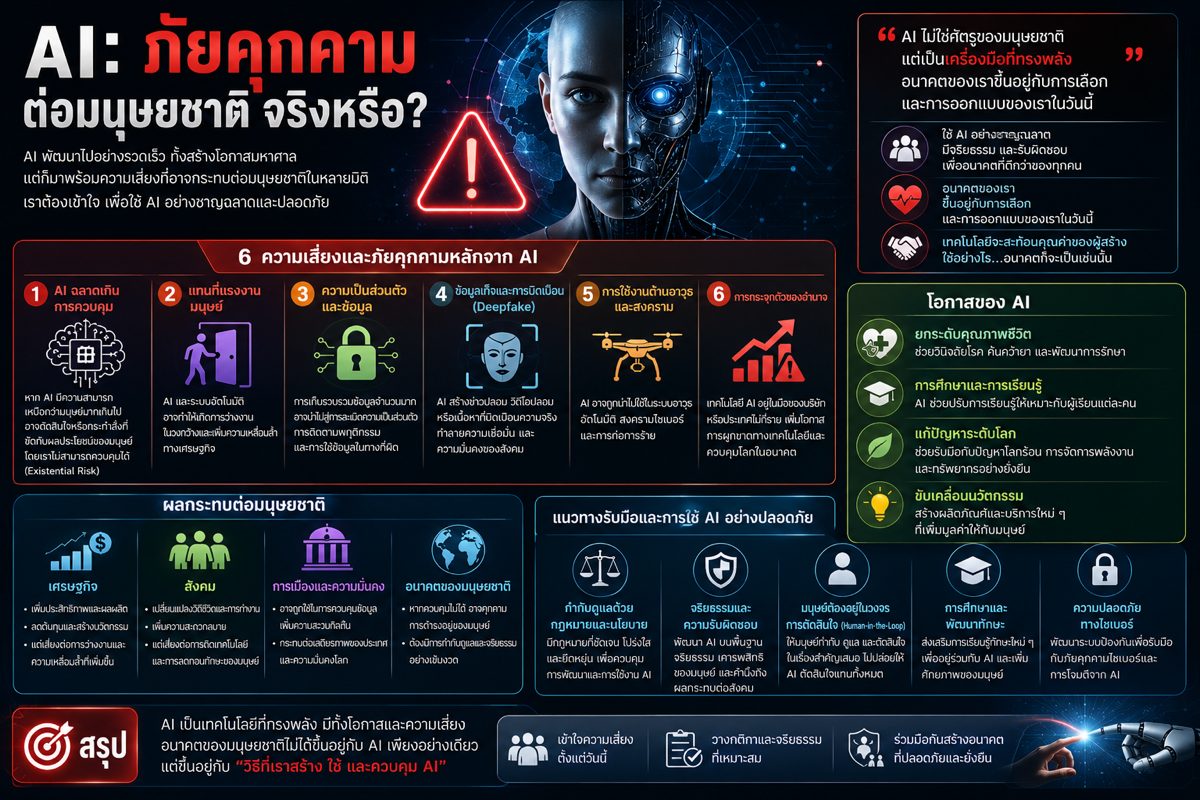
The question "Will AI really be a threat to humanity?" is not just alarmism — because the loudest warnings come from Turing Award-winning scientists and the executives who build AI themselves. The short answer: AI is a "threat" in several concrete ways already happening today — from jobs and misinformation to cybercrime and declining critical-thinking skills — but the picture of "robots rising up to wipe out humanity" remains a long-term risk with no scientific consensus. This article separates which dimensions are real threats, how they work, and which are still overhyped.
In short: In the near term, AI is not a "sci-fi" threat but a "powerful tool used the wrong way" threat — the most urgent danger comes from humans deploying AI without governance, not from AI that "intends" harm. The solution is therefore not fear, but good control systems.
Who Says AI Is a Threat? — Not Just Social-Media Hype
Before answering "is it real," we should see who is warning. If it were merely a social-media trend, that's one thing — but the warnings actually come from the most credible group in the field.
On 30 May 2023, the Center for AI Safety released the "Statement on AI Risk", a single sentence reading: "Mitigating the risk of extinction from AI should be a global priority alongside other societal-scale risks such as pandemics and nuclear war." Signatories included Geoffrey Hinton and Yoshua Bengio (two of the most-cited computer scientists in the world and Turing laureates), along with senior executives of OpenAI, Google DeepMind and Anthropic themselves.
In January 2025 came the International AI Safety Report 2025, the first academic report to systematically synthesize research on AI risk, led by Yoshua Bengio with over 100 experts across many countries. It groups the risks of general-purpose AI into three broad categories:
| Risk category | What it means | Examples |
|---|---|---|
| Malicious use | People deliberately use AI as a tool to cause harm | Scams, cyberattacks, deepfakes, manipulating public opinion |
| Malfunctions | AI fails on its own, unintentionally | Bias/discrimination, confidently wrong answers (hallucination), loss of control |
| Systemic risks | Broad impacts on society and the economy | Labor market, inequality, privacy, concentration of power |
A point people often mix up:
Despite warnings about "extinction," most experts worry more about "near-term harms" than "doomsday." In the World Economic Forum's Global Risks Perception Survey 2025, over 900 experts ranked "adverse outcomes of AI technologies" at just 31 out of 33 risks over a two-year horizon — while "misinformation and disinformation" (which AI accelerates) ranked as the number-one risk.
7 Dimensions Where AI Is a Threat — From Closest to Home
To answer "which dimensions, how" clearly, we break it into 7 dimensions, ordered from threats already happening today to those still under debate in the future.
| Dimension | Happening already? | Urgency |
|---|---|---|
| 1. Jobs & inequality | Yes | High |
| 2. Misinformation & deepfakes | Yes | High |
| 3. Cybercrime | Yes | High |
| 4. Privacy & data ownership | Yes | Medium-High |
| 5. Bias & discrimination | Yes | Medium |
| 6. Over-reliance / skill decline | Emerging | Medium |
| 7. Loss of control (existential) | Debated | Long-term |
Dimension 1: Jobs & Inequality — The Most Tangible Threat
This dimension hits people fastest. The International Monetary Fund (IMF) estimated back in January 2024 that around 40% of jobs worldwide will be affected by AI — rising to about 60% in high-income countries — and IMF Managing Director Kristalina Georgieva warned that "in most scenarios, AI will likely worsen overall inequality."
The World Economic Forum's Future of Jobs Report 2025 gives a more balanced picture: by 2030, AI and related technologies are projected to create 170 million new jobs and displace 92 million existing ones — a net gain of +78 million. But the numbers to watch are:
- 22% of the labor market will see structural churn
- 39% of current skill sets will become outdated by 2025–2030
- 41% of employers plan to reduce headcount where AI can automate tasks
How: AI automates repetitive "tasks," so some roles disappear faster than people can adapt. The real pain isn't "total jobs vanishing" (the net is still positive) but that the people losing jobs and the people gaining new ones are rarely the same people — a displaced driver doesn't become an AI engineer overnight. That is the root of inequality. We explore the executive angle in Before Replacing Workers with AI and What to Do When AI Is Better Than Humans.
Dimension 2: Misinformation & Deepfakes — The World's #1 Risk
The WEF Global Risks Report 2025 ranked "misinformation and disinformation" as the #1 global risk over a two-year horizon — for the second consecutive year — and explicitly identified Generative AI as the main driver enabling false content (video, images, audio, text) to be produced at massive scale and low cost.
How: Before AI, making convincing fake clips required teams and budgets. Today the cost of producing fake content has fallen close to zero — anyone can spread fake news, fake reviews, or clone an executive's voice at a scale detection cannot keep up with. The result is the erosion of trust in information itself — the root of Dimension 3.
Dimension 3: Cybercrime — When AI Arms the Fraudsters
This dimension has real monetary losses. The most famous case is the engineering firm Arup: in February 2024, a finance employee in Hong Kong was tricked into a video conference where every participant — including the "CFO" — was an AI-generated deepfake. The employee ultimately made 15 transfers totaling over US$25.6 million.
Security warning:
Deepfake fraud losses are accelerating alarmingly — in the first half of 2025 alone, losses reached US$410 million, more than all of 2024 (US$359 million). At the same time, AI makes phishing emails far more convincing, with no spelling errors and content tailored to each victim.
How: AI lowers the skill and cost barrier for attackers — what once required experts to fake a voice or write professional-grade phishing can now be done by anyone, increasing both the volume and quality of attacks. Thai organizations should also read Cyber = the #1 Business Risk in Thailand 2026 and revisit fundamentals like two-factor authentication (2FA) and the practices in ERP system security.
Dimension 4: Privacy & Data Ownership
AI learns from enormous amounts of data, and every time an organization feeds data into a cloud AI, the overlooked question is "where is that data processed, who can access it, and how is it reused?" The International AI Safety Report 2025 lists privacy as one of the systemic risks.
How: When business data, customer data, or internal documents flow out to an AI provider's servers (often overseas), an organization may lose control over both trade secrets and PDPA compliance. This is why "data should live in a system the organization owns" — the same point we analyze in Before Replacing Workers with AI and in the provider-specific risks of DeepSeek and the Risks of Chinese AI.
Dimension 5: Bias & Discrimination
AI learns from historical data, and if that data carries bias, AI will reproduce and amplify it at scale. The International AI Safety Report places bias and fairness among both malfunctions and systemic risks.
How: When AI is used in decisions that affect people — screening job applications, approving loans, scoring risk — a model trained on biased data decides in a biased way "systematically," repeating it across many people under the cover of machine neutrality. The danger is that it looks "neutral" when it is not.
Dimension 6: Over-Reliance & Declining Critical Thinking
This is the quietest threat but it touches everyone. A study by Michael Gerlich, published in the journal Societies in 2025, surveyed 666 participants and found a significant negative correlation between frequent use of AI tools and critical-thinking skills, mediated by a mechanism called "cognitive offloading" — delegating the work of thinking to a tool. Notably, younger people relied on AI more and scored lower on critical thinking.
How: Skills are like muscles — when you offload thinking, writing, and analysis to AI every time, what goes unused gradually atrophies. An organization where the entire team leans on AI without preserving core human skills may one day find no one able to check the AI's work. We expand on this in What to Do When AI Is Better Than Humans.
Dimension 7: Loss of Control (Existential) — The Debated One
This is the most dramatic dimension and the most discussed in the news, but also the one with no scientific consensus. Warnings about "extinction risk" and "loss of control" of systems smarter than humans come from the people building AI themselves, so they can't be dismissed entirely — yet there is still no evidence of when or how it would occur.
Opinion in the field splits into two clear camps. One sees it as a risk to prepare for today; the other sees the doomsday focus as a distraction from harms already happening (Dimensions 1–6). What both camps agree on is that, in the near term, the "AI takes over the world" picture is overhyped — reflected in WEF experts ranking this risk near the bottom over a two-year horizon.
How (hypothetically): This risk could only materialize given a highly capable system, goals misaligned with humans, and humans granting it too much decision-making power with no off-switch — note that the last condition is something "humans can control."
The Big Picture: Threats Already Here vs Still Debated
Grouped for easier decision-making, AI threats fall into two clear tiers — and the good news is that the most urgent tier is the one "manageable with good governance today."
| Aspect | Threats already here (Dim. 1–6) | Long-term debated threat (Dim. 7) |
|---|---|---|
| Evidence | Real numbers/cases already exist | Still hypothetical, no consensus |
| Time frame | Today – 5 years | Unknown (long-term) |
| Main cause | How humans deploy AI | System capability + design |
| What orgs can do | Cut risk now with governance | Track policy + AI-safety research |
The more important question isn't "Will AI destroy humanity?" but "How do we use AI without falling victim to those who use it the wrong way?"
- A perspective on AI safety and governance
The Real Threat Is "How We Use AI," Not AI Itself
Look closely and all six threats already happening share a single thread: every one stems from a "governance gap," not from AI with malicious intent — Arup lost money because there was no identity-verification step before transfers; data leaks because there's no policy on what may be fed to AI; bias spreads because no one checks the outputs; skills decline because the human role isn't preserved.
That means the "fix" isn't to fear or reject AI, but to put in place an AI governance framework that keeps humans in control. We cover governance principles in AI Governance — How to Oversee AI Safely.
5 Principles for Thai Organizations to Use AI Without Becoming Victims
- Keep humans in the decision loop (Human-in-the-loop): Never let AI be the final decision-maker on money, people, or legal matters — let AI "propose" and humans "approve."
- Control data and know where it goes: Define clearly which data types may be sent to external AI, and keep core data in a system the organization owns.
- Verify every output: AI can be confidently wrong (hallucination); outputs used for important decisions must be human-reviewed.
- Set up identity verification against deepfakes: Transfer/approval instructions arriving by video or voice must always be re-confirmed through another channel (call-back).
- Preserve core human skills: Use AI to "augment," not "replace," to the point where no one can check the AI's work.
Connecting to Saeree ERP: Why "A Data Core You Control" Matters in the AI Era
As external AI grows more capable every day, what an organization cannot do without is a "single source of truth" it controls itself — and this is the role of an ERP system: keeping transaction, financial, and inventory data in a system the organization owns, whether on-premise or in a controlled cloud. With a trustworthy data core and controlled access, an organization can bring AI in to analyze more safely, instead of letting data scatter and leak unnoticed. We discuss the "lots of data but no information" problem in Why Executives Never See the Reports They Want.
Note (in honesty):
Saeree ERP is developing an AI Assistant, currently in the training phase — it is not yet a fully usable feature. Our design approach is for AI to "assist" people working on controlled data, not to "replace" people in decision-making — consistent with the Human-in-the-loop principle above.
Summary: When to Trust AI, When Humans Must Oversee
| Tasks where AI can help (light oversight) | Tasks that always need human oversight |
|---|---|
| Drafting documents / first-pass summaries | Approving money transfers / payments |
| Searching / categorizing data | Decisions about people (hiring/firing) |
| Proposing ideas / options | Decisions with legal/contractual effect |
| Work whose results are easy to verify | Work using personal data / trade secrets |
Whether AI becomes a threat to humanity therefore depends on humans more than on AI itself — in the near term, the real threat is not "AI being too smart" but "us trusting it too much without oversight." Organizations that build good control systems will benefit from AI without becoming its victims.
References
- Center for AI Safety, "Statement on AI Risk" (30 May 2023) — safe.ai/work/statement-on-ai-risk
- International AI Safety Report 2025 (Jan 2025), chaired by Yoshua Bengio — internationalaisafetyreport.org
- World Economic Forum, "Future of Jobs Report 2025" (Jan 2025) — weforum.org
- World Economic Forum, "Global Risks Report 2025" (Jan 2025) — weforum.org
- IMF, K. Georgieva, "AI Will Transform the Global Economy. Let's Make Sure It Benefits Humanity." (14 Jan 2024) — imf.org
- World Economic Forum, "Cybercrime: lessons learned from a $25m deepfake attack" (Arup case, Feb 2025) — weforum.org
- Surfshark Research, "Deepfake fraud losses" (2025) — surfshark.com
- Gerlich, M. (2025). "AI Tools in Society: Impacts on Cognitive Offloading and the Future of Critical Thinking." Societies, 15(1), 6 — mdpi.com
Want to use AI safely on data you control?
Consult ERP experts from Grand Linux Solution — free, no obligation
Request a Free DemoTel 02-347-7730 | sale@grandlinux.com

About the Author
Paitoon Butri
Network & Server Security Specialist, Grand Linux Solution Co., Ltd.