- 26
- March
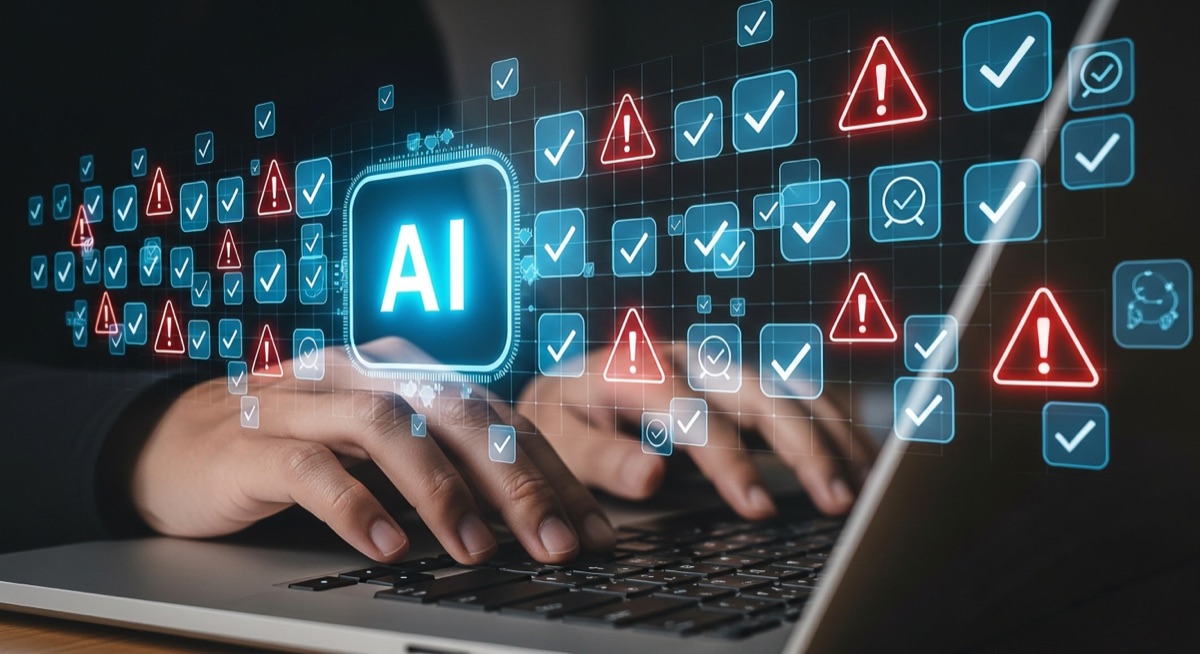
AI in 2026 has become astonishingly smart — it can answer any question, write reports in seconds, and summarize data with remarkable accuracy. But there is a hidden problem: the more convincing AI's answers are, the less people question them. This article explains why AI can "confidently give wrong answers," how organizations can verify AI outputs, and how AI Governance can help.
What is AI Hallucination?
AI Hallucination is a phenomenon where AI generates information that appears correct but is actually fabricated — whether it be numbers, references, names of people, or even laws that never existed — all presented with a confident tone as if they were established facts.
Quick Summary: AI Hallucination = AI confidently giving wrong answers by generating false information that looks real, causing users to trust it without verification. The smarter AI gets, the harder hallucinations are to detect.
Why Does AI "Hallucinate"? — The Real Causes
AI doesn't "lie" intentionally. The problem lies in its underlying mechanisms:
| Cause | Explanation | Example |
|---|---|---|
| Incomplete Training Data | AI is trained on internet data, which is not entirely accurate | Citing research papers that don't exist |
| No "I Don't Know" Mechanism | AI is designed to "always answer" and is not trained to say "I don't know" | Asked about something with no data, yet still answers confidently |
| Ambiguity in Questions | Overly broad questions cause AI to misinterpret and generate answers based on "guessing" | Ask "Is ERP good?" and get a vague answer that can't support decision-making |
| Faulty Pattern Matching | AI constructs sentences based on "probability," not actual understanding of "truth" | Generates calculations that look correct but contain wrong numbers |
Real Numbers — How Severe is AI Hallucination in 2026?
Data from the latest research reports shows that AI Hallucination remains a major problem, even as models become smarter:
| Statistic | Figure | Source |
|---|---|---|
| Hallucination rate in document summarization tasks | 0.7–0.8% | TechWyse 2026 |
| Hallucination rate in reasoning tasks | 33–51% | SAGE Journals 2026 |
| Academic papers with hallucinations found at ICLR 2026 | 16% of samples | HyperAI |
| RAG reduces hallucinations by | 40–71% | Harvard Misinformation Review |
Key Takeaway: For simple document summarization, AI performs very well (only 0.7% error). But when complex reasoning is required — such as analyzing financial statements, calculating costs, or making policy decisions — the error rate jumps to 33–51%, which is dangerous without proper verification.
Why is "High Credibility" Dangerous?
The real problem isn't that AI makes mistakes — it's that people don't verify because AI answers too well. OWASP ranks Overreliance as one of the Top 10 risks for LLMs:
- Automation Bias — When people see an answer from AI, they accept it immediately without questioning, because "computers don't make mistakes"
- Skill Erosion — The longer people rely on AI, the weaker their verification skills become
- Cascading Errors — Wrong information from AI gets passed along, becoming a cascading risk across the entire organization


5 Approaches to Verify AI Accuracy for Organizations
Based on the Zero-Trust AI framework and OWASP LLM Top 10, here are 5 approaches organizations should adopt:
1. Apply the "Trust but Verify" Principle
Every AI output must be verified before being put into practice, especially:
- Numbers and calculations — Cross-check against original data (e.g., data in your accounting system)
- References — Click every link to verify it exists and that the content matches what AI claims
- Names, dates, and laws — Cross-check against trusted sources
2. Use RAG (Retrieval-Augmented Generation)
Instead of letting AI answer from what it "remembers," have AI retrieve information from your organization's actual documents as the basis for its answers. This method reduces hallucinations by 40–71%.
| Traditional (AI answers from memory) | RAG (AI answers from actual documents) |
|---|---|
| Answers from training data that may be outdated | Retrieves the latest data from organizational databases |
| No source provided for verification | Cites the source document every time |
| High hallucination rate (33–51%) | Low hallucination rate (reduced by 40–71%) |
| Difficult to trace back | Full audit trail showing what AI referenced |
3. Establish Human-in-the-Loop for Critical Tasks
High-impact tasks must always have a "human" review before proceeding:
| Risk Level | Example Tasks | Verification Level |
|---|---|---|
| High | Financial reports, policy decisions, procurement | Expert reviews every item |
| Medium | Data summaries, email drafts, preliminary analysis | Spot-check verification (random sampling) |
| Low | Document translation, formatting, news summaries | Review only when anomalies are detected |
4. Create an AI Verification Checklist
Build a standard checklist for every team using AI:
AI Verification Checklist for Organizations
- Do all numbers match the original source data?
- Do the references cited by AI actually exist?
- Are person names, organizations, and laws correct?
- Are AI's conclusions consistent with the input data?
- Is there anything that "looks too good to be true" or seems unlikely?
- If you remove AI, can this information be verified from other sources?
5. Establish an AI Governance Framework
Large organizations should have a clear AI governance framework covering:
- AI Usage Policies — Define what AI can and cannot be used for
- Risk Classification — Categorize tasks by impact level (per the AI Accountability Act)
- Audit Trail — Record what AI generated, who reviewed it, and who approved it
- Training — Teach employees to question AI, not just use it blindly
Case Studies: When AI Hallucination Had Real Consequences
| Incident | Impact | Lesson Learned |
|---|---|---|
| Lawyer cited court rulings fabricated by AI | Sanctioned by the court, reputational damage | Always verify references |
| 16% of ICLR 2026 academic papers contained hallucinations | Trust crisis in academia | Even peer-reviewed work can have errors |
| AI generated financial reports with incorrect figures | Poor investment decisions | Financial figures must always be cross-checked against the Data Warehouse system |
ERP and AI — Why ERP Data is the "Antidote to Hallucination"
One of the best ways to verify AI outputs is to have a trusted data source as the foundation — and that's exactly what an ERP system provides:
| AI Hallucination Problem | How ERP Helps |
|---|---|
| AI fabricates financial figures that don't exist | ERP has real data from the chart of accounts and budget system for instant cross-checking |
| AI suggests processes that don't match actual workflows | ERP has a workflow system with clearly defined steps |
| AI reports incorrect stock levels | ERP records real-time stock with a full audit trail for every item |
| AI summarizes outdated information | ERP serves as the Single Source of Truth with continuously updated data |
The smartest AI isn't the one that's always right — it's the one that gets "questioned" every time. Organizations with ERP as their data foundation can verify AI far better than those running AI on scattered, fragmented data.
- Saeree ERP Team
Summary — 6-Point Guide for Organizations Using AI
| # | Approach | Details |
|---|---|---|
| 1 | Never Trust AI 100% | Apply the Zero-Trust principle — verify every output before use |
| 2 | Use RAG Instead of Standalone AI | Let AI retrieve from real documents, reducing hallucinations by 40–71% |
| 3 | Classify Risk Levels | Critical tasks (finance, legal) must always have human verification |
| 4 | Create a Verification Checklist | Give every team a checklist to verify AI output |
| 5 | Have a Single Source of Truth | Use ERP data as the foundation for verifying AI |
| 6 | Train Your Team | Teach employees to "question" AI, not just "use" AI |
If your organization is planning to adopt AI and needs a trusted data system as its foundation, you can schedule a demo or contact our consulting team to see how Saeree ERP can help your organization.
References
- TechWyse, "Is ChatGPT Lying? Understanding AI Hallucinations in 2026"
- OWASP, "LLM09: Overreliance — Gen AI Security Project"
- HyperAI, "ICLR 2026 Faces Trust Crisis as AI Hallucinations Discovered in Peer-Reviewed Papers"
- SAGE Journals, "Trust me, I'm wrong: The perils of AI hallucinations, a silent killer" (2026)
- Harvard Kennedy School, "New sources of inaccuracy: A conceptual framework for studying AI hallucinations"
- Stack Overflow, "Mind the gap: Closing the AI trust gap for developers" (2026)