- 25
- June
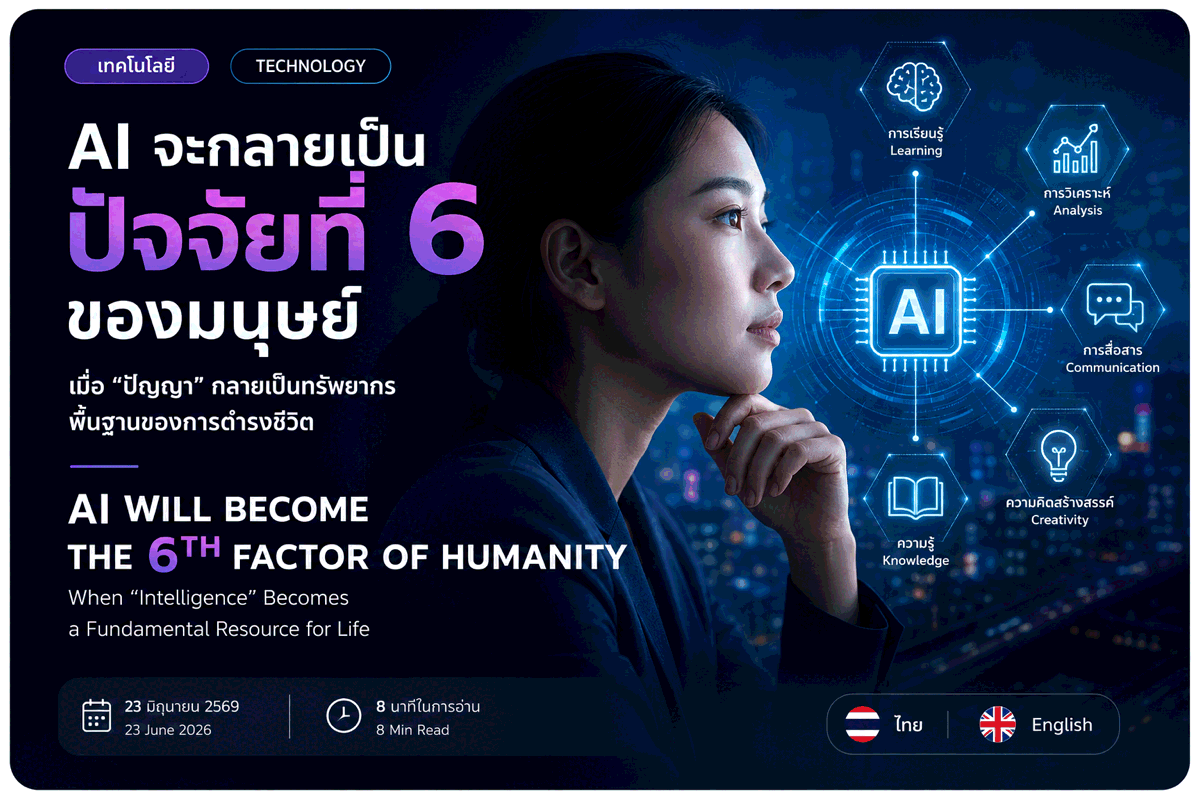
For centuries, humans have held to the "four necessities" — food, clothing, shelter and medicine — as the foundation of survival. But once the world entered the digital age, we quietly added a "fifth necessity": the mobile phone and the internet, which almost no one can now live without. The question worth asking is — what about the "sixth necessity"? This article explains why AI is retracing the path of the phone and the internet through real-world usage, tangible benefits, and the reasons it gradually becomes indispensable — until it is comparable to another organ of the human body. It is the same AI that is already changing how we work, from accounting to building reports for executives.
In short: "The sixth necessity" does not mean everyone must hold AI in their hand the way they hold a phone. It means that "access to intelligence" amplified by AI is becoming an essential condition for learning, working and competing — just as the mobile phone was once seen as a luxury, yet today more than 6 in 10 people feel anxious when separated from it. AI is following the very same "luxury → convenient → indispensable" path.
From four necessities to the fifth — the phone we once laughed off as a "luxury"
Less than 20 years ago, the mobile phone was still seen as a luxury — expensive, more for showing status than for necessity. Today, many Thai media outlets, including major brands, already call the phone and the internet the "fifth necessity" of the online age — because it is no longer something that is merely "nice to have," but something that "makes life hard when you go without it."
The clearest evidence that the phone has become like an "organ" is the condition called Nomophobia (No-Mobile-Phone Phobia) — anxiety when separated from one's phone — which research summarizes as follows:
| Symptom / behavior | Share of people affected |
|---|---|
| Experience some level of fear of being without a phone (Nomophobia) | ~66% |
| Frequently feel anxious when separated from their phone | ~44% |
| Feel panic when the battery drops below 20% | ~54% |
What do these numbers tell us? They tell us that a single piece of technology can genuinely travel from a "luxury" to "something the body and mind feel they cannot do without" within just a few years — and this is the same pattern AI is beginning to walk.
From muscle to mind — AI is the next step in the evolution
Look at the big picture of technological history and you will see humans extending their own capabilities in sequence:
- The Industrial Revolution — machines extended "muscle," producing more, faster, at lower cost.
- The computer and internet era — extended "computation and access to information," connecting the whole world in seconds.
- The AI era — is now extending "the use of intelligence": analyzing, synthesizing, and helping us decide.
This is the most important difference. We once used a search engine to "find" information; today AI does not merely answer questions — it is beginning to act as an "intellectual assistant" that helps us think, articulate, and see angles we might have missed.
What can AI actually do "in real life"?
Observe a single day in a modern person's life and you will find AI woven into more activities than you think — often we use it without realizing, the way we switch on a light without thinking about the power plant. The table below contrasts the old work that used to take time with how AI now helps:
| Task / situation | Before | Today, with AI |
|---|---|---|
| Find information / summarize | Open many sites, read each page yourself | Ask AI to condense hundreds of pages into a few lines |
| Draft an email / report | Think up the opening, polish each sentence yourself | Have AI draft a first version, then tune it into your voice |
| Translate | Open a dictionary or hire a translator | Translate a whole paragraph instantly, with the right tone |
| Plan / decide | Consult whatever you can think of | Have AI list options and pros/cons before you choose |
| Programming / formulas | Search and trial-and-error for hours | Describe what you need, let AI draft the code or formula |
| Design images / slides | Start from scratch, or hire a designer | Generate draft visuals and layouts in minutes |
| Customer service | Wait for an agent during business hours | A chatbot answers basic questions 24 hours a day |
What's striking is that AI isn't only in the apps we deliberately open — it sits in the navigation that picks the least-congested route, in the inbox that prioritizes your mail, in the bank system that flags unusual transactions, and in the hospital that uses AI to help read medical images. So we already use AI every day; we simply haven't noticed yet.
Tangible benefits — why those who use AI pull ahead
Imagine two employees with similar education, experience and ability. The first uses AI as an assistant to research, analyze and produce work; the other still does everything entirely by hand. Over time, the gap will not be about "speed" alone, but about the quality of decisions, the volume of work completed, and the opportunities to learn new things. AI is therefore not a replacement for humans, but a "force multiplier" for humans.
This is not just theory. Global survey data shows that using AI has already become a normal part of work:
- 88% of organizations worldwide use AI in at least one area, and 71% regularly use generative AI in at least one business function (McKinsey, 2025).
- 56% of US employees already use generative AI tools at work.
- Thailand is one of the fastest-growing AI-adoption countries in the world — growing roughly 36% over the past year, outpacing many developed nations.
The tangible benefits come on two levels. At the individual level, AI is a personal assistant available 24 hours a day, saving time on repetitive work so you can focus on tasks that require judgment. At the team level, a small team that uses AI well can deliver the volume and quality once requiring a large team — which connects directly to the classic problem that organizations have plenty of data but no information they can actually decide on. AI is the tool that helps turn "raw data" into "knowledge you can use."
Why AI will become "indispensable" — four structural reasons
Becoming a "necessity" does not come from a passing fad, but from structural forces that make "not using it" increasingly costly — and AI has all four:
| Reason | What happens |
|---|---|
| 1. Embedded in every tool | AI is built into phones, office software, search, and business back-office systems — to the point where "avoiding it entirely" is nearly impossible. |
| 2. The more you use it, the more you rely on it | Once you're used to the speed and quality AI provides, going back to doing it all yourself feels too slow and tiring to accept — like having fast internet and being unable to go back to slow. |
| 3. Others use it and you fall behind | When competitors, colleagues or other organizations use AI to raise productivity, those who don't are automatically disadvantaged in time and quality. |
| 4. Costs fall, access widens | Like the internet and the phone that were once expensive and gradually became affordable for everyone, AI is on the same path — the easier the access, the more it becomes a standard everyone expects. |
When all four forces work together, "not using AI" is no longer a neutral choice but an acceptance of disadvantage — the same mechanism that turned the mobile phone into the fifth necessity.
"The 33rd organ" — when AI becomes an extension of thought
The media theorist Marshall McLuhan proposed back in 1964 that "technologies are extensions of man" — the wheel is an extension of the leg, the telephone an extension of the ear and voice, the camera an extension of the eye. And today the phone is an extension of "memory": we no longer have to remember phone numbers or routes, because the phone remembers for us.
Within the same framework, AI is becoming an extension of "thought" — a kind of second brain that helps us brainstorm, check our reasoning, and see the angles we overlook. In time, "thinking together with AI" may become so ordinary that we can barely tell which ideas are purely ours and which emerged from a discussion with AI — just as today we can barely separate which abilities are ours and which come from the phone in our hand.
A word of caution: AI becoming an "extension of thought" has both upsides and risks. Just as we rely on phones until we can't remember numbers, leaning on AI too heavily without practicing our own thinking can let certain skills atrophy. The healthier approach is to use AI as a "multiplier" of thinking, not a "substitute" for it.
The 6th necessity may not be "AI" itself, but "access to intelligence"
In the past, those who could access more books usually had more opportunity. Later, those who reached the internet first gained an advantage in learning and work. And in the future, the advantage may lie in the ability to use AI to turn data into knowledge, and knowledge into good decisions.
So if we call AI the "sixth necessity," it does not mean every human must carry AI physically the way they carry a phone. It means that "access to intelligence amplified by AI" is becoming an essential condition of living, learning and working in the new world — AI is the "doorway" that leads us to that sixth necessity.
What humans still have to do themselves
Even as AI's capabilities grow rapidly, there are things AI cannot fully replace, including:
- Decisions grounded in morality and ethics
- Empathy and understanding others' feelings
- Responsibility for outcomes
- Creativity distilled from real-life experience
- Building trust between people
AI may help propose options, but the one accountable for the choice is always a human. We explored this from an executive's angle in What to Do When AI Is Better Than People, which concludes that the good question is not "will AI replace people?" but "how do we design human–AI collaboration to work best?"
From personal AI to AI in the business back office
The first wave of AI was personal tools such as chatbots and writing assistants. But the next wave is AI embedded in the business back office — the accounting, inventory, procurement and ERP systems organizations use every day. Once AI lives there, it can summarize reports, flag anomalies, and help executives see the picture faster without waiting for an analysis team.
This is the direction in which Saeree ERP is developing its own AI Assistant (currently in the training phase) so that users can query data and build reports in natural language. At the same time, many Thai organizations are already putting enterprise-grade AI tools like Claude to work immediately, without having to hire their own AI Engineer — an important shortcut at a time when the country still has a large shortage of AI talent.
Summary: the path from the four necessities to the sixth
| Necessity | Era | Example | If you lack it |
|---|---|---|---|
| Necessities 1–4 | Every era | Food, shelter, clothing, medicine | Survival is hard |
| 5th necessity | Digital age | Mobile phone + internet | Cut off from contact, work and basic services |
| 6th necessity | AI age | Access to intelligence through AI | Learn, decide and compete more slowly than others |
The history of humanity is the history of extending our own capabilities — from stone tools to machines, from computers to the internet, and today to AI. The important question is therefore not "will AI replace humans?" but "how far will those who learn to use AI pull ahead of those who don't?"
— Paitoon Butri, Saeree ERP
Want AI working inside your business back office?
Talk to the specialists at Grand Linux Solution about bringing AI into your ERP and choosing the enterprise-grade AI tools that fit your team.
Get a free consultationTel 02-347-7730 | sale@grandlinux.com
References
- ThanachartCSR — "The mobile phone, the fifth necessity of the online age": thanachartcsr.com
- University of the Thai Chamber of Commerce (UTCC) — "AI, the sixth essential of modern life": science.utcc.ac.th
- NCBI / PMC — Systematic Review & Meta-Analysis of Nomophobia and Anxiety: pmc.ncbi.nlm.nih.gov/articles/PMC10380081
- McKinsey — The State of AI 2025: mckinsey.com
- Visual Capitalist / Microsoft AI Economy Institute — AI Adoption by Country 2025: visualcapitalist.com
- Marshall McLuhan, Understanding Media: The Extensions of Man (1964)