- 09
- May
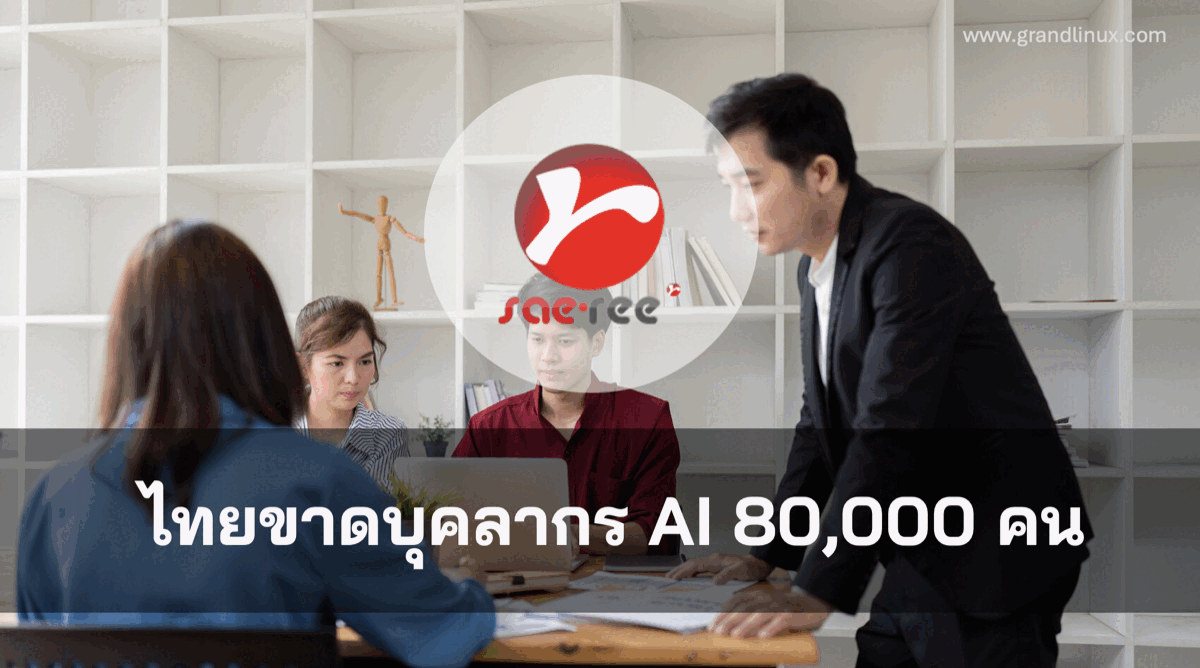
In May 2026 the Thai government launched "AI for All Thais" — a national initiative aiming to give 20 million Thais (about one-third of the population) basic AI literacy within four years. The honest reason behind it: Thailand currently lacks roughly 80,000 AI specialists, and fewer than 20% of Thais have meaningful access to AI tools today. For Thai SMEs that need to compete with banks, big-tech firms, and large e-commerce players for AI engineering talent, those numbers sound terrifying. The reality is different: SMEs don't need to compete. There are five practical ways to use AI in your business — without hiring a single AI engineer — and you can start within six months.
Quick summary: SMEs can use AI without engineers
- The headline number: Thailand is short ~80,000 AI specialists (source: Bangkok Biznews, May 2026)
- Government plan: "AI for All Thais" — True + Google + MHESI + 20+ universities — 20 million Thais in 4 years
- SMEs can't out-bid Big Tech: banks and tech firms pay 2–3× SME salaries for AI engineers
- 5 paths: AI in ERP, SaaS AI, vendor AI agents, train existing staff, vendor partnership
- The AI users in SMEs aren't engineers: they are accountants, HR, sales using AI as a tool — not building AI
- Start in 6 months: no million-baht POC + no in-house LLM
1. Thailand's AI Talent Gap — What's Happening
In May 2026, Thailand's Ministry of Higher Education, Science, Research and Innovation (MHESI), together with True Corporation, Google, and 20+ universities, launched "AI for All Thais." The ministry framed it bluntly: developing Thailand's AI workforce is not merely an education issue — it's a competitiveness issue. Without sufficient AI talent, major technology companies may choose to invest elsewhere in the region.
| Number | Meaning | Implication for SMEs |
|---|---|---|
| ~80,000 specialists | Estimated AI talent shortage today | Hiring an AI engineer is nearly impossible for SMEs |
| 20 million | Target population for AI upskilling within 4 years (up from 12M) | Future SME hires will arrive AI-literate |
| < 20% | Share of Thais with meaningful AI access in 2025 | The market is wide open — early adopters win |
| Two phases | "AI First Citizen" (Gemini Academy) + "AI for Future Workforce" (45-hour credit-bearing curriculum) | Pipeline of trained workforce SMEs can hire from |
Separately, the State of AI Engineering 2026 report finds that Thai organizations adopt AI faster than most ASEAN peers — but lag on operational system readiness. In other words, executives are eager but back-end systems aren't ready. This is the gap the previous AI Adoption Gap article highlighted — and it's the gap that ERP systems with built-in AI can close.
2. Why SMEs Can't Win the AI Hiring War
Before discussing solutions, you need to understand why "just hire an AI engineer" doesn't work for SMEs. There are four reasons:
| Factor | Big Tech / Banks | Typical SME |
|---|---|---|
| AI Engineer salary | 2–3× regular dev salary + bonus + stock | Cannot match the package |
| Project appeal | LLM, RAG, large-scale fine-tuning | Mostly basic automation — top engineers get bored fast |
| Data infrastructure | Data lake + dedicated data team | Data scattered across Excel and legacy systems — no fuel for the engineer |
| Retention | Career path + AI lab + research | Engineer leaves quickly — typically back to Big Tech |
The pattern we see all the time: an SME hires "an AI engineer," spends six months on a proof-of-concept, the engineer resigns just as it goes live, and the system becomes unmaintainable. 1–2 million baht of investment becomes sunk cost. This is exactly why the AI Investment ROI article argues that for SMEs, "buying AI features" beats "building AI" in nearly every scenario.
3. Five Ways SMEs Can Use AI — Without Hiring an AI Engineer
The answer for SMEs is neither "don't use AI" nor "hire an engineer." It's a shift in mindset — from 'build AI ourselves' to 'use AI the vendor built for us.' Five paths are available right now:
| Path | What It Is | Who Uses It | Starting Cost |
|---|---|---|---|
| 1. AI in ERP | AI features built into your ERP — auto-categorization, anomaly detection, AI assistant | Accounting, procurement, HR | Bundled in ERP fee |
| 2. SaaS AI tools | Claude, ChatGPT, Gemini — for legal review, copywriting, data analysis | Any read/write-heavy team | $20–100 / seat / month |
| 3. Vendor-provided AI agents | Domain-specific agents — e.g., Claude Finance Agents for finance work | CFO, analysts | License + setup |
| 4. Train existing staff | Teach accountants/HR/sales to use AI as an "assistant" — not a replacement | Current employees | 2–5K baht / person / course |
| 5. Vendor partnership | Engage vendors that bring AI capability via the Enterprise AI Firm model | Executives (decision) | Project-based |
The critical observation: none of the five paths require a full-time AI engineer. They all rely on "AI that already exists" and ask employees to "use it well" rather than "build it." The distinction matters enormously: building an LLM requires 5–10 senior data scientists plus a GPU cluster worth hundreds of millions of baht; using AI requires one employee with a Claude or ChatGPT login.
4. AI Features Your ERP Should Have — An Executive Checklist
When evaluating an ERP with built-in AI — or a vendor partnership — executives should ask about these capabilities before signing:
| AI Feature in ERP | Use Case | Measurable ROI |
|---|---|---|
| AI financial summarizer | Summarize P&L, cash flow, flag anomalies for executives | 50–70% reduction in monthly review time |
| Anomaly detection | Flag unusual transactions or stock movements — see AI in Accounting | Catch fraud/errors before close |
| Auto-categorize transactions | AI assigns GL codes from vendor descriptions | 30–60% less data entry |
| AI assistant for queries | "What's this month's revenue?" "Which SKUs are running low?" | Executives self-serve insights |
| Predictive forecasting | Demand, cash flow, invoice due-date forecasts | 20–40% reduction in over/under-stock |
| Document AI | Auto-ingest invoices, POs, tax receipts | 70–90% less manual key-in |
Notice — none of these six features add headcount. They live inside an ERP your business already runs: no new engineer to hire, no data team to stand up. The decisive choice is picking a vendor that ships these features. AI + ERP in 2026 is becoming the new industry baseline.
5. A 6-Month Plan — How an SME Starts Using AI Without Heavy Investment
Instead of betting on an AI Engineer hire and waiting 6–12 months for a POC, this plan delivers visible results every 30 days — with no new headcount:
SME 6-month AI start plan:
- Month 1: Buy Claude/ChatGPT Team plan for executives + accounting + marketing (10–20 seats)
- Month 2: Audit current ERP — what AI features ship by default but haven't been turned on?
- Month 3: Train accounting + HR teams to use AI as an assistant (1–2 day workshop)
- Month 4: Enable existing ERP AI features (anomaly detection, document AI)
- Month 5: Measure outcomes — manual work reduced by what %, reports faster by how many days
- Month 6: Expand to other departments + evaluate domain-specific vendor AI agents to add
Total six-month budget — for a 30–100 person SME, expect to land in the low-six-figure baht range (SaaS licenses + workshops). That's less than one month's salary for an AI engineer — and the impact spreads across the whole organization rather than sitting on one engineer's laptop who might leave next quarter.
6. Four AI Misconceptions SMEs Should Avoid
Across SME advisory work over the past year, four recurring misconceptions consistently lead to wasted investment:
| Misconception | Why It's a Problem | Right Frame |
|---|---|---|
| 1. We must hire an AI engineer first | Long hiring cycle + expensive + hard to retain | Start with SaaS + AI in ERP — hire later if needed |
| 2. AI requires a big data team | Most SMEs don't have enough data even to train a model | Use vendor pre-trained models — no training required |
| 3. AI = full automation | Wrong expectation — when AI errs, users abandon it | AI = augmentation (assistant), not 100% automation |
| 4. AI doesn't need governance | Customer data leaks → PDPA exposure + reputational damage | Set an AI policy from day one — who can use what, with what data |
Misconception #4 is the most consequential: even without an AI engineer, SMEs need an AI policy stating which AI tools employees may use, what data they may submit, and how outputs are stored. The moment a staff member pastes customer records into a free-tier ChatGPT, legal risk is created instantly.
7. The Vendor's Role — What Executives Should Ask Before Signing
Because SMEs depend on vendors as their "AI intermediary," vendor selection matters more than any hire. Use these questions when evaluating an ERP vendor:
| Question | "Pass" Criteria |
|---|---|
| 1. What AI features does your system already have — not on the roadmap? | Live today + demo-able right now |
| 2. Whose LLM do you use? Where is data stored? | Clear data residency policy + no unnecessary cross-border transfer |
| 3. Does your implementation team know AI workflows? | Real case studies + has shipped AI for clients |
| 4. Can you train our staff — in Thai? | Curriculum + Thai-speaking trainer + Thai documentation |
| 5. If the AI feature breaks, who owns it? | Clear SLA + Thai-language support |
Question #5 matters enormously. A vendor that sells "AI in ERP" but, when something breaks, says "you'll need to hire a consultant" was selling AI marketing — not AI you can actually use.
Summary
| Topic | Key takeaway |
|---|---|
| Thailand's AI specialist gap | ~80,000 — Big Tech and banks absorb the supply; SMEs shouldn't try to compete |
| "AI for All Thais" | 20 million in 4 years — future SME hires arrive AI-literate |
| Five SME AI paths | AI in ERP, SaaS AI, vendor agents, train staff, vendor partnership |
| Who uses AI in an SME | Accounting / HR / sales — not an AI engineer |
| Six-month plan | SaaS Month 1 → train Month 3 → ERP AI Month 4 → expand Month 6 |
| Vendor questions | Real features today + data location + Thai-language training |
"Thailand's 80,000-person AI shortage is not the SME's problem — it's a problem for Big Tech and banks competing for talent. SMEs that adopt 'vendor AI' through ERP, SaaS, and partnerships are not at a disadvantage — they have an advantage. They don't pay top-of-market salaries, don't fight retention battles, and don't bear the risk when an engineer walks out the door. The ERP vendor's job is to make AI easy to use. The SME's job is to pick the right vendor."
References
- Bangkok Biznews — AI for All Thais: Thailand's 80,000 AI Specialist Shortage (May 2026)
- Naewna — AI Economy column
- Daily News — AI Talk 2026
Is Your SME Ready to Use AI in ERP?
Saeree ERP is developing an AI Assistant for Thai businesses. Get a consultation on where your business can start with AI in ERP — without hiring an AI engineer.
Free ConsultationCall 02-347-7730 | sale@grandlinux.com