- 20
- April
On April 15, 2026, Google DeepMind released Gemini Robotics-ER 1.6 — the first practical embodied-reasoning model (AI that understands the physical world) capable of reading analog instruments at production-grade accuracy. This is no longer a lab demo.
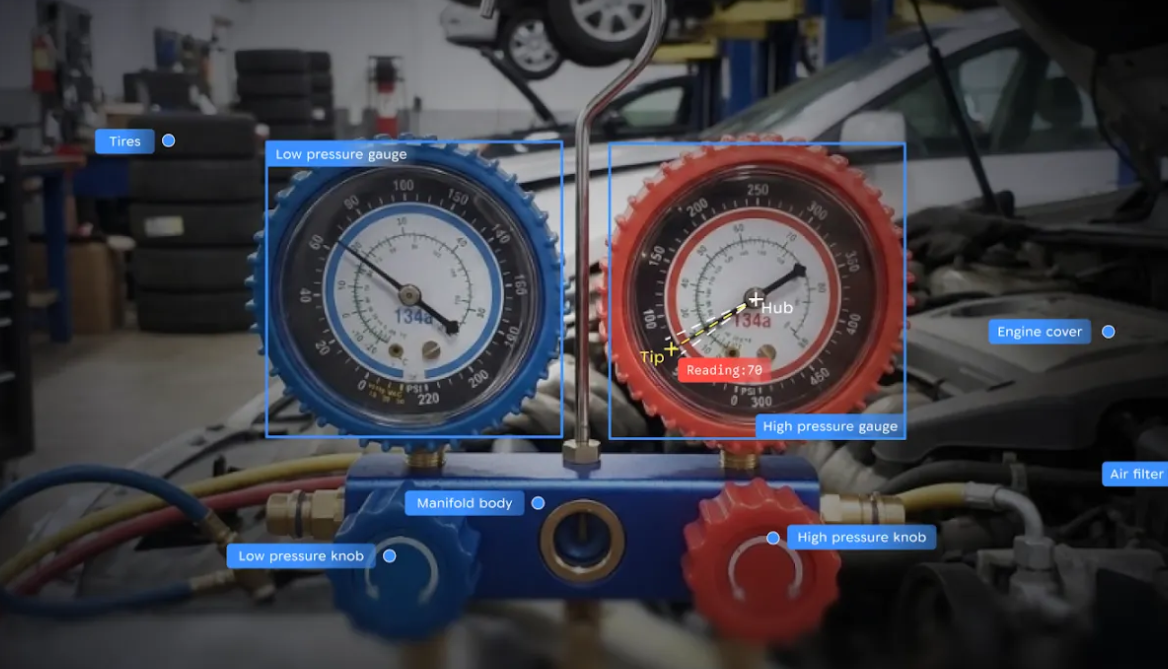
Boston Dynamics integrated the model into its Spot quadruped robot via the Orbit fleet software the very same day — the first commercial deployment of Robotics-ER 1.6. Spot can now patrol factories and power plants, reading pressure gauges, thermometers, and sight glasses in place of human inspectors.
In short: Gemini Robotics-ER 1.6 reads analog gauges at 98% accuracy (a 4x jump over the previous generation). Boston Dynamics Spot is the first commercial deployment, supporting pressure gauges, thermometers, and sight glasses — unlocking full automation of industrial inspection. Available to enterprises now through the Gemini API.
What Is Gemini Robotics-ER 1.6
Gemini Robotics-ER 1.6 is Google DeepMind's latest robotics reasoning model. The important distinction: it is not a robot. It is the "brain" that lets robots understand the world around them. The model takes multi-view camera input plus natural-language instructions, then reasons about what the robot should do in three-dimensional space.
Three new capabilities over the previous generation:
- Improved spatial reasoning — better understanding of object relationships, distances, and orientations
- Multi-view perception — fuses images from multiple cameras (front, top, side) into a single coherent scene
- Instrument reading — reads analog gauges, needles, glass indicators, and dial numbers at production grade (the flagship feature)
It is now available to select researchers, engineers, and enterprises through the Gemini API. On the same day, Google also launched Gemini 3 Deep Think in the Gemini app for Google AI Ultra subscribers — a specialized reasoning mode for science, engineering, and research (see the broader Gemini landscape in ChatGPT vs Claude vs Gemini and AI Model Comparison).
What Does "98%" Actually Mean
The most important number in the release is 98% — the accuracy rate for reading analog gauges, thermometers, and sight glasses. Compared to previous generations, this is an enormous jump:
| Version | Accuracy | Gauge Types Supported |
|---|---|---|
| Previous (ER 1.0-1.5) | ~25% | Limited (mostly digital displays) |
| ER 1.6 | 98% | Analog pressure, thermometers, sight glass, needle dials |
| Improvement | ~4x | Covers most legacy industrial gauges |
Why does this matter? Because analog gauges are everywhere — factories, power plants, refineries, old warehouses. Even in the IoT era, most legacy equipment still uses needle gauges with no digital output to integrate with a control system. Until now, a human had to walk over, read it, and log the reading into the ERP manually. Now Spot can patrol, read, and stream readings into the ERP through an API in real time.
Boston Dynamics Spot + Orbit — First Commercial Deployment
Boston Dynamics partnered with Google Cloud and Google DeepMind to integrate Gemini Robotics-ER 1.6 into two of its platforms:
- Spot — a quadruped robot that walks, avoids obstacles, climbs stairs, and carries multi-view cameras, lights, and a variety of sensors
- Orbit — Boston Dynamics' fleet-management software that tracks robot locations, routes, and inspection results
- AIVI (AI Visual Inspection) and AIVI-Learning — Orbit sub-systems that analyze images captured by Spot during patrols
The live workflow: Spot walks a predefined route → captures images of each gauge → AIVI feeds those images to Gemini Robotics-ER 1.6 → gets numeric readings back → Orbit logs results and fires alerts on abnormal values. The entire loop closes in seconds, with no human in the loop — and everything can stream to the ERP via REST API (see a similar integration pattern in Agentic AI).
Note: "Embodied AI" is AI that understands the physical world — multi-view cameras, 3D geometry, temporal continuity — in contrast to chatbots that live purely in text. 2026 is the first year that embodied AI is commercially viable. Until now, every player was stuck in demos and prototypes. For broader context on the 2026 AI race, see Claude Opus 4.7 and AI Songkran 2026 Roundup.
5 Industries Immediately Impacted
Automated analog-gauge reading is not a "nice demo" — it solves a daily, painful problem in five industries:
| Industry | Use Case | Value Delivered to ERP |
|---|---|---|
| Power / Energy | Inspect boilers, turbines, cooling systems | Real-time asset data feeds asset management + predictive maintenance |
| Refining / Petrochemicals | Legacy pressure gauges on production lines | Uptime monitoring + safety compliance, lower downtime |
| Ports / Logistics | Sight glass on chemical / container tanks | Inventory accuracy + lot tracking into WMS |
| Manufacturing | Conveyor sensors and legacy machine gauges | MRP integration + OEE (Overall Equipment Effectiveness) |
| Mining | Underground pressure gauges in hazardous zones | Safety compliance + reduced human risk exposure |
Notice that these five industries are the backbone of Thailand's heavy industrial economy — PTT, EGAT, industrial-estate factories, Laem Chabang Port, mines in the Northeast. All of them have legacy equipment with needle gauges. Automating this layer will finally unlock tight coupling between ERP / MRP and field operations (for broader AI-in-business context see AI Tools for Business and AI Tools for Government).
Connecting to ERP and MRP Systems
Before embodied AI, the typical gauge-reading workflow in a Thai factory looks like this:
- 8:00 AM — A technician walks the floor and logs 40-60 gauges on paper or a tablet
- 2:00 PM — Second round, logged again
- 6:00 PM — The log sheet is entered into the ERP / CMMS (some sites do this weekly)
Result: 8-24 hour data lag, risk of transcription errors, and no real predictive maintenance because the data is not real-time.
With Spot + ER 1.6: the robot walks the route every 30 minutes, reads gauges → the API streams readings into the ERP immediately → predictive-maintenance rules fire when drift appears → MRP schedules spare parts before a breakdown. What used to be a "nightly batch" becomes a "continuous stream," changing the economics of both manufacturing and supply chain (see cost details in Manufacturing Cost and warehouse integration in ERP Warehouse Management).
How Thai Organizations Should Plan
As of April 2026, there is no publicly announced commercial Spot + ER 1.6 deployment in Thailand. Spot robots must be imported — millions of baht per unit — plus separate Orbit and Gemini API licenses.
A reasonable timeline for Thai enterprises:
- 2026-2027 — Planning Phase — study use cases, model ROI, prepare the ERP to ingest real-time data
- 2028 — Pilot Phase — deploy 1-2 robots in high-risk zones (chemical plants, power stations) and measure results for 6-12 months
- 2029+ — Scale Phase — if the pilot works, expand to a fleet and integrate into enterprise-wide predictive maintenance
The danger to avoid: buying Spot before the ERP is ready. If the robot works well but the ERP cannot ingest real-time data, the ERP becomes the bottleneck. Readings pile up unused, and a multi-million-baht investment is under-utilized.
The recommendation: upgrade the ERP to have REST APIs + event-driven architecture + real-time ingestion capability before buying the robot, not after. The sequence matters (see AI-team framing in AI Agent Team and consumer-AI market context in Apple Siri + Gemini 2026).
Is Saeree ERP Ready for the Embodied AI Era
Robot fleets are a custom integration everywhere, not an off-the-shelf connector — and custom integration is precisely what we do. What Saeree offers:
- Open REST APIs — all core modules (asset, inventory, MRP, purchase) accept external data via HTTP / JSON
- Time-series data ingestion — accepts data directly from IoT sensors, PLCs, or robot fleet managers without long ETL cycles
- Event-driven hooks — when a gauge reading goes out of range, a maintenance work order can be triggered automatically
- Java + PostgreSQL stack — integrates with Orbit or any other fleet manager via API, with no vendor lock-in
On the AI layer — Saeree ERP is still developing its AI Assistant (in training since March 2026) and has not released it to production. When it is ready, it will analyze sensor data streamed by robots automatically — e.g., review six months of gauge trends and flag which machines are approaching a required PM. That is the layer between Spot (data collector) and ERP (system of record).
Suitable / Not Suitable — Invest in Spot + ER 1.6 Now
Not every organization needs to move now. This table helps assess readiness:
| ✓ Invest in Spot + ER 1.6 now | ✗ Not urgent — can wait |
|---|---|
| Large factory / power plant / refinery with 100+ analog gauge points | Small business, few machines, no legacy gauges |
| Regular human patrol inspections — high labor + overtime cost | Inspections are occasional (monthly) |
| Has hazardous zones (heat, chemicals, radiation) where humans should not go | Safe, easily accessible areas with low risk exposure |
| ERP already has open APIs and real-time ingestion | Legacy ERP with no open integration — must upgrade first |
| Already running predictive maintenance + OEE programs | Still on preventive-maintenance schedules — sufficient for now |
| CEO/CTO has committed a 5-10 million baht pilot budget | Tight budget — invest in fixed sensors and SCADA first |
The "not urgent" column does not mean no preparation — it means prepare the ERP APIs first, then wait for prices to fall (quadruped robots are expected to drop roughly 50% in the next 24-36 months).
"AI isn't just smart on a screen anymore — now it walks over and reads the gauges for you."
— Saeree ERP, 2026